



There is enough oil, but not enough fuel
Where is the energy market's biggest risk hidden?
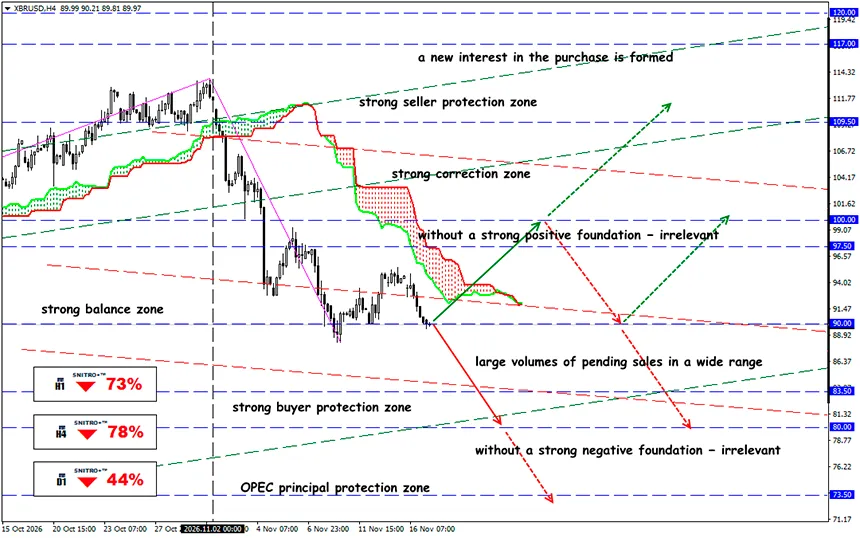
XBR/USD
Key zone: 87.00 - 92.00
Buy: 93.50 (on a decisive break above 92.50); target 96.50; StopLoss 92.80
Sell: 86.50 (on strong negative fundamentals); target 83.50; StopLoss 87.20
The recovery in global oil production does not guarantee the normalization of diesel fuel supplies. The divergence between the crude oil market and refined petroleum products creates conditions in which Brent and WTI may decline in price while ICE Gasoil remains expensive.
The problem is shifting from crude oil availability to refining, logistics, and the quality of crude oil streams. For traders, the key indicators are the diesel crack spread and refinery margins.
The global oil market is facing a contradiction that could change the familiar logic of energy trading. An increase in oil production no longer automatically means lower prices for all types of fuel. Even as global crude oil supply recovers, certain petroleum products may remain in short supply.
A reminder:
Diesel is used in freight transportation, industry, agriculture, and logistics. A shortage directly increases businesses' operating expenses and can sustain inflation even when oil prices decline. According to the IEA, global oil supply in October 2026 amounted to 105.4 million barrels per day. At the same time, the agency continues to point to tight conditions in the petroleum products market, particularly middle distillates, and growing logistical constraints.
This fundamentally changes the structure of risks.
Whereas the main question previously concerned the availability of sufficient oil, the ability to refine available crude into the required types of fuel and deliver them to end consumers is now becoming increasingly important.
For example, according to IEA data, North Sea Dated fell from its October peak of around $136 to $93 per barrel by the time the November report was prepared. This represents a decline of approximately 32%.
However, European diesel lost only 11% over a comparable period and continued to trade at around $180 per barrel. Thus, the decline in crude oil prices was not accompanied by a comparable reduction in the price of the refined product.
Oil may reach the global market, but refining it requires available capacity, a suitable crude grade, sufficient hydrogen and energy, and properly functioning technological equipment. Even when all these conditions are met, the resulting fuel must still be delivered to a specific market.
As a result, Europe and other importing regions are competing not merely for crude oil, but for a limited supply of finished fuel.
The physical shortage is being intensified by high freight rates for large oil tankers on routes from the Middle East to Asia. Even when crude oil prices decline, expensive transportation limits improvements in refining economics.
The market expects the diesel fuel shortage to persist at least until next year's summer season.
Additional supply could come from U.S. refineries, increased refining activity in Asia, and new Chinese export quotas. The IEA also points to the accelerated release of emergency diesel reserves as a temporary mechanism for covering the shortage.
However, strategic reserves cannot replace a sustainable recovery in production. Their use reduces short-term tightness but does not eliminate technological and logistical constraints.
The most informative signals will be movements in nearby futures contracts, the structure of calendar spreads, and changes in middle distillate inventories.
So What Is the Outcome?
The oil market is gradually emerging from the acute phase of the shortage. Crude oil supplies from the Persian Gulf are recovering faster than exports of finished fuel.
A high diesel crack spread potentially supports refinery profitability, but record transportation costs and technological constraints may absorb a significant portion of this premium.
For Brent and WTI, increased crude oil availability creates conditions for lower prices. However, ICE Gasoil may remain relatively resilient due to low inventories, limited refining capacity, and expensive logistics. It is precisely the divergence between crude oil prices and diesel prices that is becoming one of the most significant trading signals.
The main risk for traders is assessing the oil market exclusively on the basis of crude oil production and inventories. In the coming weeks, developments in refining, diesel exports, and crack spreads will show how sustainable this divergence is.
So we act wisely and avoid unnecessary risks.
Profits to y’all!


