



The Yen is setting a trap for carry trades
Interest rate differentials sustain intervention risks
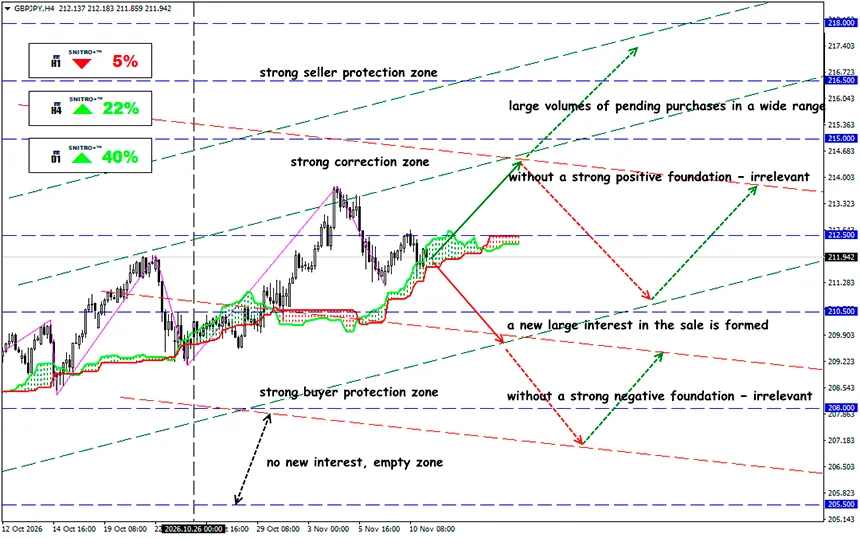
GBP/JPY
Key zone: 211.50 - 212.50
Buy: 213.50 (on a decisive break above 213.00); target 216.50; StopLoss 212.80
Sell: 211.00 (on strong negative fundamentals) ; target 208.50; StopLoss 211.70
The normalization of Bank of Japan policy, currency injections into the market, and the risk of an equity sell-off are creating conditions for a sharp unwinding of positions against the yen. The foreign exchange market has reached a point where the conventional logic of interest rate differentials is beginning to conflict with liquidity risks.
EUR/JPY and GBP/JPY remain attractive for carry trades. However, the continued normalization of Japanese monetary policy is gradually changing the economics of these transactions, while instability in equity markets could trigger a rapid unwinding of positions.
A reminder:
A classic carry trade involves borrowing in a currency with a relatively low interest rate and investing the proceeds in a higher-yielding asset. For EUR/JPY and GBP/JPY, this means selling yen and buying euros or pounds, respectively.
The BOJ has already raised its key interest rate to 1.25%, the highest level since 1995, yet the Japanese currency remains relatively weak. On November 5, the BOE raised its rate by 25 basis points, bringing the pound's nominal interest rate advantage over the yen to 275 basis points. The ECB's deposit rate stands at 2.50%, providing a nominal advantage of 125 basis points over the Bank of Japan.
Additional uncertainty comes from Japanese currency intervention statistics published on November 9. The Ministry of Finance confirmed that authorities spent ¥15.3993 trillion supporting the national currency over just three trading days during the summer. The scale of these operations demonstrates Tokyo's willingness to intervene in the market when it considers currency movements excessive. However, such actions do not eliminate the fundamental interest rate differential or guarantee sustained yen appreciation.
At its October meeting, the BOJ kept its rate at 1.25%. At the same time, the regulator confirmed that it would continue reducing purchases of Japanese government bonds. According to MUFG's November review, monthly JGB purchases are being reduced by ¥200 billion each quarter through the first quarter of 2027, after which they are expected to stabilize at approximately ¥2 trillion per month.
This change matters for two reasons:
- Higher short-term interest rates gradually increase the funding costs of carry trades.
- Reduced bond purchases change the supply-demand balance in the JGB market, potentially making Japanese debt instruments more attractive to domestic investors.
An additional argument for further normalization emerged on October 30. The Bank of Japan acknowledged that underlying inflationary pressure had approached a level consistent with its 2% target. BOJ Governor Kazuo Ueda emphasized that decisions would be made at each meeting, including the December meeting, taking inflation risks into account.
The reaction to currency interventions is a separate speculative factor. Direct operations by Japanese authorities are usually concentrated in the most liquid currency instruments, primarily USD/JPY. However, their effects quickly spread to cross rates through arbitrage relationships. For example, if EUR/USD remains unchanged, a 3% decline in USD/JPY mathematically implies a comparable decline in EUR/JPY. A similar mechanism applies to GBP/JPY through GBP/USD.
The combination of intervention and an equity sell-off is particularly dangerous. In such a situation, carry traders may simultaneously buy yen to repay funding, reduce positions in risk assets, and cut leverage. Initial JPY appreciation could trigger further forced purchases of the Japanese currency.
So What Is the Outcome?
EUR/JPY and GBP/JPY are currently of particular interest because of the contradiction between the European currencies' continuing interest rate advantage and the growing risk of sharp Japanese yen appreciation.
The base-case scenario assumes gradual yen strengthening and an increased risk of a downward correction in EUR/JPY and GBP/JPY, but it does not guarantee an immediate reversal.
Carry trades continue to generate positive interest income, but potential foreign exchange losses can wipe out the returns accumulated over many months of holding a position within just a few hours. The greater the concentration of speculative long positions in EUR/JPY and GBP/JPY, the more dangerous even a relatively small initial move toward yen appreciation becomes.
So we act wisely and avoid unnecessary risks.
Profits to y’all!


