



The European trap
Why high inflation no longer saves the Euro
EUR/USD
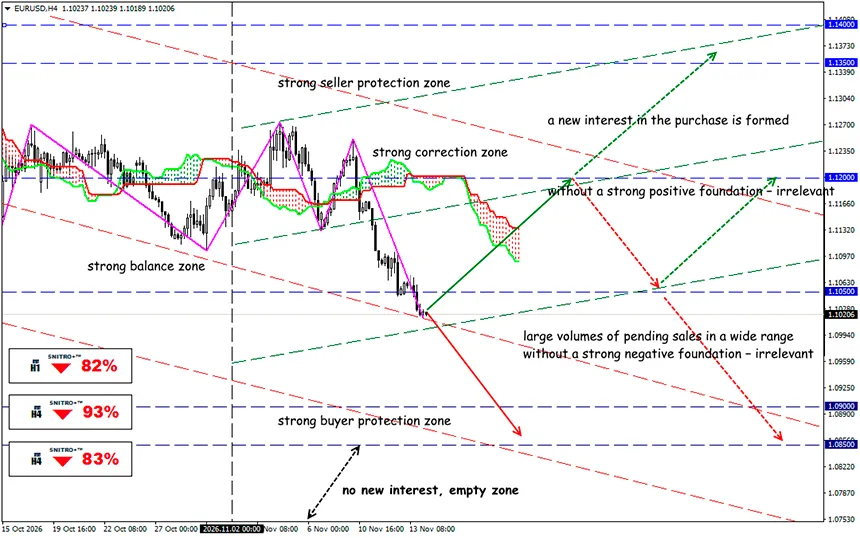
Key zone: 1.0980 1.1050
Buy: 1.1080 (on strong positive fundamentals) ; target 1.12501.1350; StopLoss 1.1020
Sell: 1.0950 (on a pullback following a retest of 1.1000) ; target 1.08001.0750; StopLoss 1.1000
Eurozone inflation accelerated to 4% in October, with energy prices making the largest contribution to the increase. Industry is facing higher costs and expensive financing. Can the ECB contain prices without intensifying the economic slowdown?
Rising energy prices are bringing back inflation risks while simultaneously undermining the competitiveness of European industry. The European economy is once again facing a classic stagflationary dilemma: higher energy prices simultaneously accelerate consumer inflation and increase business costs.
A Reminder:
Energy inflation accelerated to 20.8%, while prices in the services sector rose by 3.3%. Core HICP, excluding energy, food, alcohol, and tobacco, remained at 2.5%. Inflation significantly exceeds the ECB's 2% target. The main acceleration is associated with energy rather than a comparable increase in core prices. Raising the policy rate can restrain domestic demand, but it does not eliminate a physical shortage of energy resources or reduce global oil or gas prices.
- For the foreign exchange market, the situation is ambiguous. Higher inflation may support the euro through expectations of restrictive monetary policy. However, if expensive energy worsens the trade balance and the production outlook, the positive effect of interest rate differentials will be shortlived.
- The October bank survey showed a decline in corporate demand for new loans and a further tightening of lending standards. For industry, this means double pressure: businesses are simultaneously facing higher energy costs and more expensive access to financing.
- The 2026 energy crisis represents more than just a temporary acceleration in consumer prices. It directly affects the competitiveness of European manufacturers in the global market. Additional costs for gas imports in the summer of 2026 are estimated at €18–33 billion compared with a scenario without the crisis.
These costs spread throughout the economy through several channels.
- Direct increase in production costs. If businesses cannot fully pass costs on to customers, their operating margins shrink.
- Loss of export competitiveness. European companies compete with manufacturers from regions where energy resources are cheaper.
- Inflationary pressure. Higher production costs gradually feed through into the prices of final goods and services.
- Currency factor (less obvious). The eurozone remains a major importer of energy resources. Rising energy costs increase the need for foreign currency to pay for imports. This may limit euro appreciation even when interest rates remain relatively high.
Therefore, high European inflation does not necessarily mean a strong euro. If it is driven by more expensive imported energy, the effect may be the opposite.
So What Is the Outcome?
The eurozone is preparing for a serious crisis. Industrial production is contracting, credit conditions are tightening, and economic growth is slowing. For the ECB, this means limited room for maneuver: raising interest rates increases pressure on production, while premature easing risks entrenching inflation expectations.
The most likely scenario involves maintaining a cautious monetary policy and elevated volatility in European assets. For EUR/USD, the yield differential with the United States will remain critical, while European equities will be particularly sensitive to changes in industrial companies' earnings forecasts.
If prices rise because of imported energy while industry loses competitiveness, restrictive monetary policy may intensify pressure on investment, lending, and economic growth.
For traders, the decisive factor will not be any single HICP or industrial production figure, but rather their combination with yield movements and the foreign exchange market's reaction. It is the consistency of these signals that will make it possible to distinguish temporary inflationdriven volatility from the emergence of severe stagflationary conditions.
So we act wisely and avoid unnecessary risks.
Profits to y’all!


