

















The Dollar is losing its balance
The Labor market threatens the Fed’s new rate
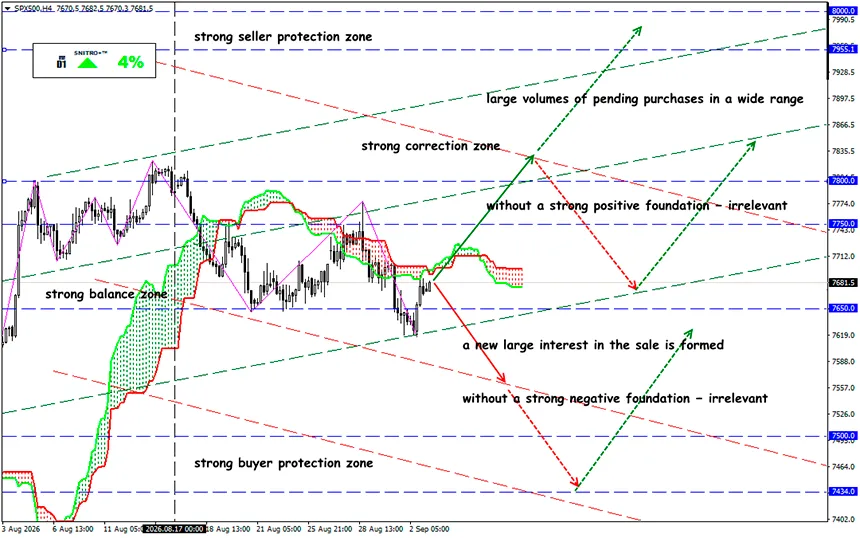
SP500
Key zone: 7,600 - 7,700
Buy: 7,750 (on strong positive fundamentals); target 7,900; StopLoss 7,700
Sell: 7,550 (on a decisive break above 7,600); target 7,400-7,350; StopLoss 7,600
Weak ADP data showed that the U.S. labor market is losing momentum. Just 38,000 new jobs dealt a blow to the main argument of USD buyers. Now the fate of DXY will be determined not by NFP alone, but by the combination of employment, Treasury yields, and the oil shock.
DXY retreated from a three-week peak, while Treasury yields moved lower. However, expensive oil, inflation, and the war with Iran make it impossible to count on a decline in the dollar.
A reminder:
For the Fed, this is crucial: the labor market is beginning to cool precisely when the inflation problem caused by the energy shock is intensifying again. After the weak data was released, the dollar indeed came under pressure. On the morning of September 3, DXY was trading around 99.4, retreating from a nearly three-week high of around 99.86. But there was no full-scale USD sell-off.
After the revision, July’s increase amounted to 46,000 — the slowest pace of job creation since January.
But the headline looks even better than the internal structure of the report.
- Manufacturing lost 17,000 jobs.
- Professional and business services — 16,000.
- Information sector — 4,000.
- The entire goods-producing sector reduced employment by 10,000.
- Small companies added just 3,000 jobs.
- Mid-sized companies created no jobs at all.
Another signal came from wages. Base pay increased by 3.2% y/y: for workers who stayed with their previous employer — by 3.0%, and for those who changed jobs — by 4.7%. ADP notes that wage growth has been slowing for four years.
The classic macroeconomic chain now looks simple:
weak employment → more dovish Fed → falling yields → weaker dollar.
In September 2026, this relationship is breaking down. The reason is the energy shock. On September 3, Brent was trading at around $95 per barrel, while WTI was around $90–91. The previous day, Brent closed at $95.63, while renewed clashes between the U.S. and Iran restored a Middle East supply risk premium to the market.
This creates an extremely unpleasant combination for the Fed: the labor market is weakening while energy inflation is rising. Weak employment limits the scope for further rate hikes. But oil near $95 and geopolitical risks simultaneously prevent the Fed from declaring victory over inflation.
Therefore, weak ADP does not yet equal a weak dollar. Treasuries are becoming the key confirmation indicator. For an FX trader, what matters now is not only employment data, but also the reaction of the bond market.
- After reaching multi-year highs, the 10-year Treasury yield began to decline and on September 3 stood at around 4.77%. The dollar weakened at the same time.
- If a weak NFP triggers a further decline, primarily in short-term Treasury yields, the market will effectively confirm that the USD interest-rate premium is shrinking. Dollar selling could then become significantly more aggressive.
- If NFP is weak but long-term yields remain high because of oil, inflation, and fiscal risks, the dollar could prove surprisingly resilient to poor economic data.
So, What Does This Mean?
The market is entering an unusual regime.
On the one hand, 38,000 jobs, employment declines in manufacturing and professional services, and zero job growth among mid-sized companies show that the U.S. labor market is clearly losing momentum.
On the other hand, the U.S.-Iran war is keeping oil near $95, increasing inflation risks and maintaining demand for safe-haven assets. Therefore, a factor that worsens the outlook for the U.S. economy can simultaneously support the dollar.
- A return above 100 after weak ADP and a moderate NFP would mean that the oil shock, inflation, and high Treasury yields are still stronger than the cooling economy.
- A break below 99 on weak NFP combined with falling short-term yields would be far more significant. In that case, the market would begin trading not another poor statistical release, but a change in the Fed’s policy trajectory.
Therefore, the key question is not how many jobs the U.S. created. The key question is whether the bond market will stop paying the dollar an interest-rate premium for a hawkish Fed. It is the answer from Treasuries that could determine the direction of DXY for the entire month of September.
So we act wisely and avoid unnecessary risks.
Profits to y’all!


