



Student revolution shakes the euro
France on the brink of a budget explosion
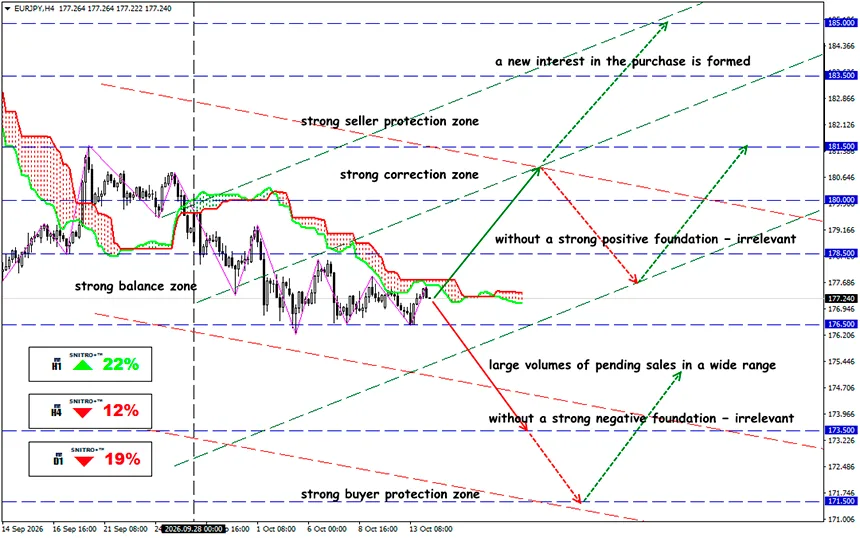
EUR/JPY
Key zone: 176.50 - 178.00
Buy: 178.50 (on strong positive fundamentals); target 180.00; StopLoss 177.80
Sell: 176.00 (on a pullback following a retest of 176.50) ; target 173.50; StopLoss 176.70
A crisis in French schools is turning into a financial risk: Paris needs billions for social reforms, but investors are demanding an increasingly high premium for holding French debt. We examine the threat posed by student protests to the euro, European banks, and stock markets.
A Quick Recap
Mass protests by French school students, which began on September 21, have spread nationwide, creating an additional challenge for Prime Minister Sébastien Lecornu's government. Dissatisfaction with the education system has coincided with a sharp rise in government borrowing costs and parliamentary disagreements over the 2027 budget. The fiscal crisis is intensifying: government debt exceeds 119% of GDP, bond yields are approaching 5%, and investors are demanding a higher risk premium.
The protests are gaining political significance despite declining participation.
As of October 9, reports indicated that more than 6,800 people had been detained, while preliminary estimates placed damage to school infrastructure at approximately €30 million. The Ministry of Education is considering hiring around 3,000 additional teachers.
For financial markets, the immediate cost of repairing schools does not represent a systemic threat. Far more important is the potential increase in permanent budget commitments, including salaries, staffing expenses, building modernization, and social programs.
The government plans to allocate approximately €64 billion to education in 2027, compared with €48.8 billion in 2017. The nominal increase amounts to €15.2 billion, or 31.1% over ten years. However, these figures cannot be interpreted as an equivalent increase in the education system's real resources without adjusting for inflation and changes in budget classifications.
The main market risk is not the cost of the school protests, but the possibility that social pressure will derail fiscal consolidation.
The key indicator of French sovereign debt stress is not the absolute yield on OATs, but their yield spread over German Bunds.
Since late August, the risk premium has widened by approximately 56 basis points. However, its current level remains below the October peak of around 147 basis points, indicating partial stabilization rather than a restoration of investor confidence.
The fiscal arithmetic is deteriorating. French risk is extending beyond national borders: a sustained increase in OAT yields could change how investors price risk not only in French assets but also across other European markets.
Today, ECB President Christine Lagarde emphasized that resolving France's debt problems must primarily depend on the country's own fiscal policy. This weakens the case for speculation about immediate intervention by the central bank to support the French bond market.
France's CAC 40 stock index is partially insulated from the domestic economic crisis by the international revenue exposure of its largest companies. For exporters, luxury goods producers, and industrial corporations, foreign markets are often more important than domestic French demand.
Nevertheless, higher costs of capital, deteriorating European business activity, and weaker consumption in China could intensify pressure on corporate valuations.
So What Is the Bottom Line?
French school protests alone are unlikely to trigger a European financial crisis. However, they are increasing the social and political cost of fiscal consolidation precisely when markets are demanding credible deficit reduction from the government.
The main risk is not a French sovereign default, but a gradual increase in the cost of capital across the eurozone, declining appeal of European assets, and a reallocation of international portfolios toward dollar-denominated instruments.
An alternative scenario cannot be ruled out: a successful budget compromise could rapidly narrow France's risk premium and trigger the covering of speculative short positions in the euro.
For now, the French crisis is reinforcing the euro's existing downtrend. For event-driven trades, it is prudent to limit risk to 0.5–1% of trading capital per position and account for correlations among short positions in EUR/USD, the CAC 40, and French bonds.
So we act wisely and avoid unnecessary risks.
Profits to y’all!


