



Strong NFP: Reality or Manipulation?
The Labor Market Challenges Monetary Policy
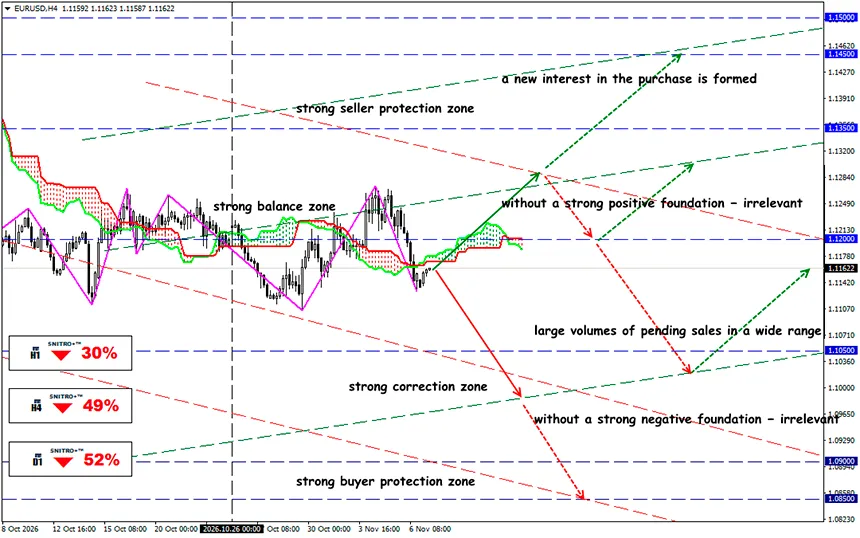
EUR/USD
Key zone: 1.1100 - 1.1200
Buy: 1.1250 (on strong positive fundamentals) ; target 1.1400-1.1450; StopLoss 1.1190
Sell: 1.1100 (on a decisive break above 1.1120) ; target 1.0950; StopLoss 1.1160
Unexpected employment growth is changing expectations for Federal Reserve interest rates, but the reliability of the statistics and the bond market's reaction will determine the sustainability of the dollar rally.
The release of October U.S. employment statistics on November 6 significantly altered the short-term balance of fundamental factors in the foreign exchange market.
As a reminder:
The U.S. economy added 165,000 nonfarm payroll jobs versus the expected 65,000, while the unemployment rate declined from 4.2% to 4.1%. The BLS revised its August estimate upward to 186,000 (+53,000) and its September estimate to 60,000 (+31,000). Together, the last three months generated 411,000 new jobs, or an average of 137,000 per month. This is notably higher than the average monthly increase of 48,000 over the preceding 12 months.
For the Federal Reserve, which simultaneously assesses employment resilience and inflation risks, these results provided an additional argument against easing monetary policy.
The October figure was 2.54 times higher than forecast. The question is whether the statistics reflect a genuine acceleration in hiring or temporary characteristics of the sample, seasonal adjustment, and the submission of business reports. Subsequent revisions could change not only the assessment of the labor market but also the justification for the dollar's already realized appreciation.
Of course, a large deviation of the actual figure from the forecast does not, by itself, prove that the statistics are unreliable, much less deliberately distorted. However, revisions to employment figures for previous months and the ambiguous reaction of yields call the sustainability of the momentum into question and increase the risk of major currencies reversing against the dollar.
The Dollar Is Strengthening, but Bonds Do Not Confirm an Unconditional Reversal
The reaction of financial markets showed that investors interpreted the NFP primarily as an argument in favor of a more hawkish Federal Reserve policy.
The reaction of financial markets showed that investors interpreted the NFP primarily as an argument in favor of a more hawkish Federal Reserve policy.
How Likely Is It That the BLS Published Incorrect Data?
The following hypotheses should be distinguished:
- Ordinary statistical error. NFP is a preliminary estimate, not an exact accounting of every job. Initial results are revised as additional reports become available.
- Systematic estimation bias. If the seasonal adjustment model or the composition of responding businesses does not accurately reflect changes in the economy, the error may recur over several months. Systematic bias can create a false impression of economic acceleration or deceleration without any intentional interference.
- Deliberate distortion of data to influence markets. Theoretically, such a hypothesis could be investigated, but confirming it would require independent evidence or the results of an official investigation.
The market's reaction does not constitute a statistical quality check of the BLS, and a 153.8% deviation from the forecast cannot be interpreted as a statistical error of 153.8%.
So What Is the Outcome?
In any case, the risk of further statistical revisions is real and deserves separate consideration in a trading strategy. However, the available data are insufficient to reasonably claim that the October NFP was overstated, much less to attribute to the BLS an intention to mislead the market.
The practical danger for traders lies not only in a potential BLS error. Far more important is the risk that the market has overvalued a single release, turning a strong statistical surprise into excessively aggressive expectations of further interest rate hikes.
Key recommendation: do not chase the dollar's already realized appreciation. The priority is selling after a confirmed correction, provided that the interest rate market continues to support the Fed's hawkish scenario.
So we act wisely and avoid unnecessary risks.
Profits to y’all!


