



Silver market loses its shine
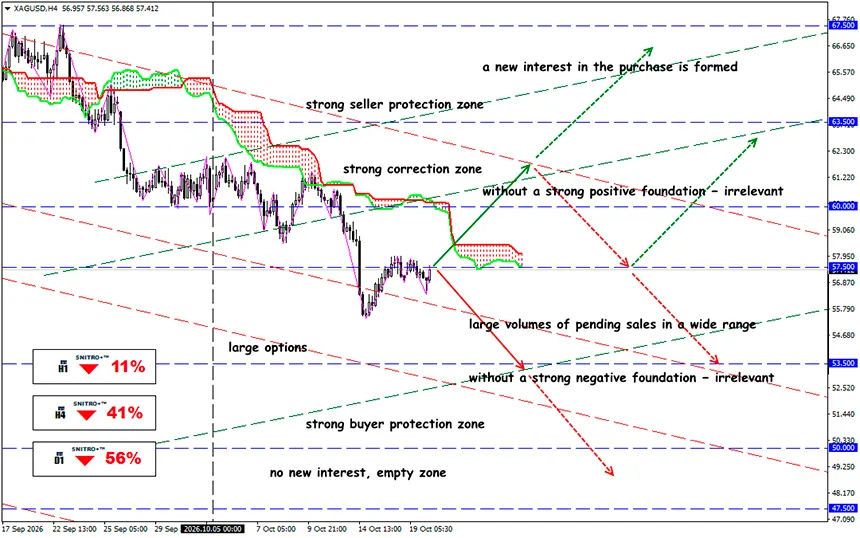
Fed Policy fails to shield the metal from selling pressure
XAG/USD
Key zone: 56.50 - 57.50
Buy: 58.50 (on strong positive fundamentals); target 61.50; StopLoss 57.80
Sell: 56.00 (on a confident break of 56.50); target 53.50-51.50; StopLoss 56.70
The declining probability of an October Fed rate hike is supporting precious metals, but elevated U.S. bond yields and weakening industrial demand are limiting silver's recovery.
Silver remains under pressure following a sharp decline on October 14, when prices plunged 6.43%. The subsequent rebound has not been strong enough to push prices back above $59–60. Elevated U.S. Treasury yields and weak industrial demand continue to constrain gains.
A quick recap:
The key development in recent days has been the reassessment of expectations for the Fed's October policy decision. According to MarketWatch, the probability of a rate hike at the October 27–28 meeting stood at 33.8% on October 15. Following Fed Chair Warsh's remarks on October 16, the probability of rates remaining unchanged exceeded 85%. This substantial shift in market expectations does not guarantee a positive performance for precious metals.
For silver, two scenarios must be distinguished:
- A decision not to raise rates is potentially positive, as it reduces the likelihood of further increases in borrowing costs.
- A shift toward rate cuts would be a much stronger bullish catalyst, as it could lower real bond yields and the opportunity cost of holding silver.
For now, markets are primarily pricing in the likelihood of a pause rather than the beginning of a new monetary easing cycle.
U.S. Bond Yields Remain the Main Obstacle.
Silver generates no coupon or interest income. Therefore, even without a Fed rate hike, investment demand may remain subdued. A sustained silver rally requires three conditions to occur simultaneously: declining real U.S. Treasury yields, a weaker U.S. Dollar Index (DXY), and stabilization in demand for industrial metals. So far, there is no confirmation that these conditions are aligning.
However, monetary policy explains only part of XAG/USD's performance. According to the World Silver Survey 2026:
- Global silver demand fell 2% in 2025 to 1.13 billion ounces.
- Industrial consumption declined 3% to 657.4 million ounces.
- Total demand is expected to fall another 2% in 2026 to 1.11 billion ounces.
- The projected structural market deficit for 2026 stands at 46.3 million ounces.
- Demand for coins and investment bars is expected to increase 18% in 2026, according to the April forecast.
This highlights a key contradiction in the current market: the physical supply deficit persists even as industrial consumption declines.
Geopolitical risks also remain an important pricing factor. The conflict involving Iran, uncertainty surrounding energy supplies, and international trade tensions could support demand for precious metals.
However, the implications for silver are mixed.
Rising oil prices increase inflation risks and could force the Fed to maintain restrictive monetary policy for longer. At the same time, a deteriorating outlook for global manufacturing could reduce demand for silver as an industrial raw material.
As a result, gold may outperform silver during periods of escalating geopolitical tensions, particularly when investors favor safe-haven assets with less exposure to the industrial cycle.
So What Is the Outcome?
Market takeaway: The declining probability of a rate hike has already been partially priced in.
Silver is caught between two opposing fundamental trends.
On one hand, a sixth consecutive year of projected structural deficits, geopolitical risks, and investment demand provide a foundation for a medium-term price recovery. On the other hand, elevated borrowing costs, persistent inflationary pressures, and declining industrial consumption limit upside potential.
On one hand, a sixth consecutive year of projected structural deficits, geopolitical risks, and investment demand provide a foundation for a medium-term price recovery. On the other hand, elevated borrowing costs, persistent inflationary pressures, and declining industrial consumption limit upside potential.
So we act wisely and avoid unnecessary risks.
Profits to y’all!


