














Price is rising, but demand remains weak
Why OPEC+ plans to increase production
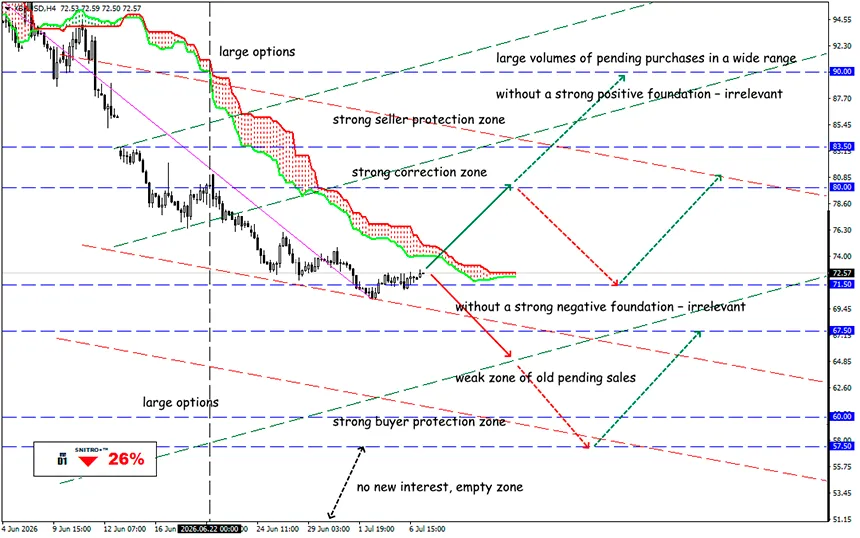
XBR/USD
Key zone: 68.50 - 73.50
Buy: 74.50 (on strong positive fundamentals); target 76.50-78.50; StopLoss 73.80
Sell: 67.50 (on a decisive breakout of the 70.00–68.50 zone); target 65.50-63.50; StopLoss 68.20
The market's reaction to OPEC+'s decision to raise its August production target by 188,000 barrels per day has so far been restrained. Exports from the Persian Gulf countries continue to recover unevenly and remain below pre-war levels.
OPEC+ is setting a new supply target. The decision continues the group's gradual effort to return part of the previously withheld supply to the market, although actual production remains constrained by disruptions related to the Strait of Hormuz.
Reminder:
OPEC's oil production increased by 3.3 million barrels per day in June compared with May, reaching 19.43 million barrels per day. Oil exports from the Persian Gulf countries also jumped by more than 3 million barrels per day from May levels, exceeding 10 million barrels per day, although they remained approximately 40% below pre-war levels.
- The latest production increase largely matched market expectations. As a result, the immediate price reaction was limited because traders had already priced in part of the additional supply.
- The focus is now shifting to a different question: will producers actually be able to deliver these additional barrels while regional exports are still recovering from disruptions caused by the U.S.-Iran conflict?
- At the same time, Russian exports add another layer of uncertainty. Damage to Russian refineries has forced Moscow to export more crude oil instead of processing it domestically.
- This combination of factors is pulling the oil market in two different directions. OPEC+ is signaling higher supply, while exports from both the Persian Gulf and Russia continue to improve.
Saudi Arabia's latest pricing strategy illustrates efforts to stabilize an unstable market. The Kingdom is once again trying to retain Asian buyers by lowering prices for its flagship crude grade sold in Asia. The previous two occasions when Saudi Arabia offered similar discounts were during the oil price wars of 2020 and 2015.
According to the official price list released on Monday, Saudi Aramco will reduce next month's price for Arab Light by $11, setting it at $1.50 per barrel below the regional benchmark. For the first time since the beginning of the 2020 oil price war, the grade is being sold at a discount to the regional benchmark. European buyers will receive even larger discounts, with prices for all grades reduced by $15 per barrel, while shipments to the United States will become $8 per barrel cheaper.
Even after these reductions, Saudi crude remains more expensive than cargoes from other regional producers available on the spot market. This suggests that further price cuts remain possible if available crude supplies continue to increase.
What does this mean?
Rising prices indicate that the market does not interpret OPEC+'s decision as an outright bearish signal. On paper, there may be more barrels available, but the actual recovery of supplies still depends on shipping conditions, producers' operational capacity, and the stability of export routes through the Persian Gulf.
The sharp price revision highlights how quickly Persian Gulf producers restored physical shipments through the Strait of Hormuz after the United States and Iran signed their temporary agreement. The return of previously blocked volumes is putting pressure on the physical oil market, forcing exporters to offer increasingly aggressive discounts.
For buyers, the key question is whether exports from the Persian Gulf will continue to normalize. For producers, the challenge is to restore production without oversupplying the market. With Brent trading around $72 and WTI near $69, traders appear to expect additional supply but remain unwilling to eliminate the geopolitical risk premium associated with the Strait of Hormuz and the broader tensions across the Middle East.
So we act wisely and avoid unnecessary risks.
Profits to y’all!


