

















Precious metals as protection against the Fed
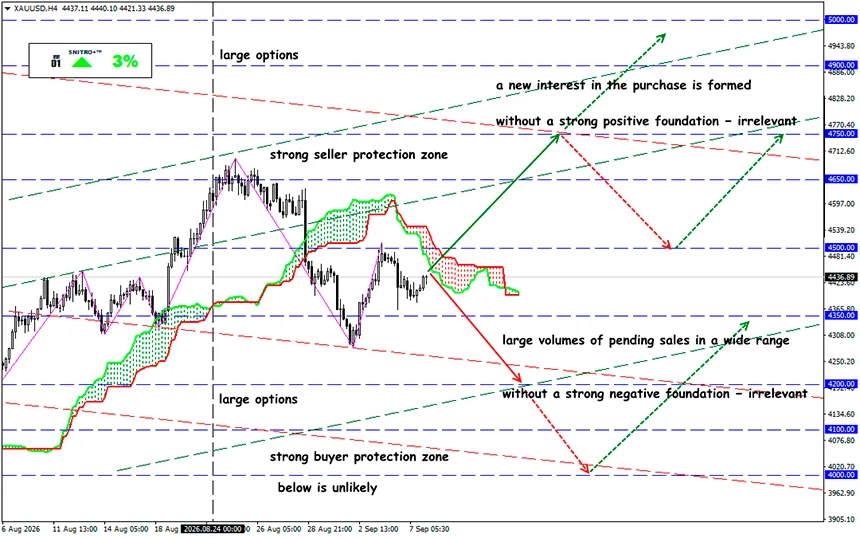
Capital returns to gold
XAU/USD
Key zone: 4,400.00 - 4,500.00
Buy: 4,550.00 (on a decisive breakout of 4,500); target 4,750-5,000; StopLoss 4,450.00
Sell: 4,350.00 (on a strong negative fundamental); target 4,000.00; StopLoss 4,450.00
Global investment funds are buying gold again after the price decline, as they expect long-term growth factors to remain intact despite the Fed intensifying its fight against inflation. Gold-backed ETFs are once again attracting investor money.
The precious metals market entered September with a sharp shift in the macroeconomic backdrop. Until recently, the main scenario for gold remained a decline in the cost of money in the U.S. Now investors are being forced to consider the opposite scenario — another Fed rate hike.
A reminder:
In January, speculative capital drove gold to an all-time high of around $5,600. From March through July, gold prices remained under pressure, but in August they jumped almost 10%. The catalyst was the U.S. Treasury’s plan to increase the volume of Treasury purchases, which raised concerns about a possible increase in inflation and a weaker dollar. But the rush into such purchases has now subsided.
A strong labor market and oil near $100 are changing rate expectations, but central bank purchases and structural demand continue to provide long-term support for gold. XAU/USD is attempting to rise amid a flight from risk.
High energy prices and inflationary shocks caused by the war in Iran in June pushed prices back to $4,000. It was precisely at this level that investment funds began taking another look at gold.
Long-term investors have not abandoned gold so far. Investment funds see gold’s main strength in the fact that the metal hedges a broad investment portfolio. Especially since the key $5,000 level looks very attractive.
- For example, Pictet Asset Management, Robeco Institutional Asset Management, and Fidelity International increased their holdings after previously reducing positions during the pullback from the all-time high.
- Giants such as BNP Paribas Asset Management and Manulife John Hancock Investments have either increased gold’s share in their portfolios over the past few weeks or maintained their bullish stance.
- In August, the Bank of China increased its gold purchases despite a substantial rise in prices. At the end of last month, the country’s gold reserves increased by 650,000 ounces at once — a record figure since 2023.
Large investors always buy gold on pullbacks but consider targets over a 3–6 month horizon. Investment fund managers are now warning that even if gold breaks above the recent ceiling near $4,600, the rise is unlikely to be rapid. U.S. Treasury yields are rising, while the market expects at least one more Fed rate hike before the end of the year.
XAU/USD dynamics are now determined not by the fact of high inflation itself, but by how inflation data will change the trajectory of real rates.
- If CPI/PPI come in above expectations, Treasury yields could continue to rise, the dollar would receive additional support, and gold would face another wave of profit-taking.
- If inflation turns out to be moderate, the current pricing for a Fed rate hike will begin to decline rapidly. In that case, the combination of falling yields, a weaker dollar, and recovering demand for safe-haven assets could return XAU/USD to its all-time highs.
So, What Does This Mean?
Of course, the Middle East conflict supports gold in its role as a safe-haven asset, but rising oil prices can simultaneously pressure it through real rates. Therefore, gold’s reaction to geopolitical news can no longer be interpreted mechanically.
Gold is once again functioning as a traditional hedging instrument rather than merely an object of speculative trading. The sustainability of gold’s rise increasingly depends on a weaker dollar, while debt risk is driving money into real assets.
No matter how the Fed fights inflation, investors continue to hold bullion as a counterweight to macroeconomic and geopolitical uncertainty. The precious metal always retains its value as insurance against what lies beyond the Fed’s control.
If the XAU/USD correction is caused solely by rising rates while structural demand remains intact, the decline may represent not the beginning of a bear market, but an opportunity to build a new long position.
So we act wisely and avoid unnecessary risks.
Profits to y’all!


