

















Market is bracing for a new wave of inflation
Why oil is no longer the most important indicator
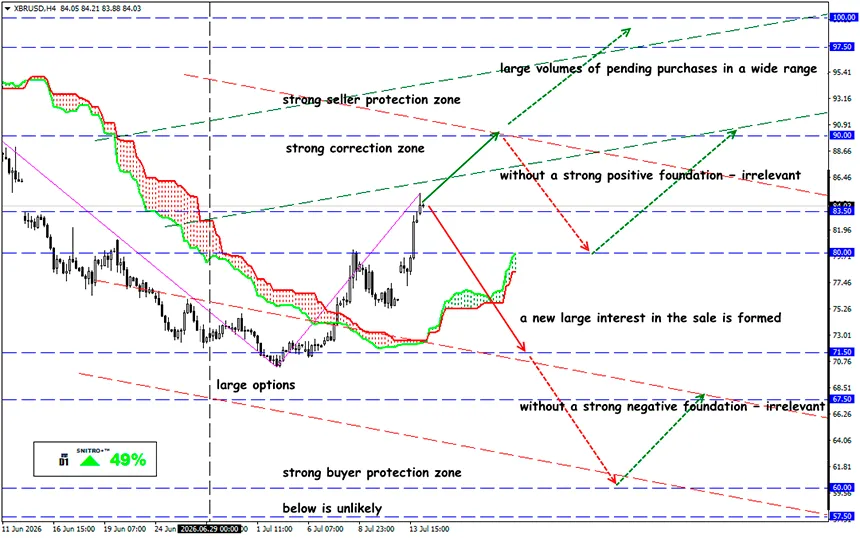
XBR/USD
Key zone: 81.50 - 85.00
Buy: 86.50 (on strong positive fundamentals); target 90.00; StopLoss 85.70
Sell: 80.00 (on a decisive break above 81.00); target 76.50-75.00; StopLoss 80.70
While investors continue debating whether Brent will hold above $80 per barrel, the refined fuels market is already sending a far more alarming signal. Crude oil no longer reflects the true cost of energy for the global economy.
Today, it is diesel fuel that determines the cost of global logistics, industrial production, mining, and agriculture. And its current price already reflects a full-scale energy crisis scenario.
Reminder:
During trading on July 13, Brent was hovering around $78–79 per barrel, while European low-sulfur gasoil futures climbed above $1,050 per metric ton, equivalent to approximately $141–142 per barrel. The U.S. ULSD contract was trading even higher, at roughly $154 per barrel on an equivalent basis. In other words, the refined fuels market is already pricing energy at nearly twice the value of crude oil.
The spread between crude oil and diesel fuel has widened to record levels: refining margins have become more expensive than the feedstock itself.
European diesel crack spreads approached $60–65 per barrel, while at some U.S. trading hubs they exceeded $80. In effect, the market is signaling that the real problem is no longer crude oil production, but rather the production and delivery of refined fuels.
- Russia has temporarily suspended diesel exports. The decision was driven by attacks on refineries and the need to stabilize domestic fuel supplies. For Europe, North Africa, Türkiye, and Brazil, this means tougher competition for alternative diesel supplies.
- The geopolitical risk premium remains elevated. Any disruption to shipping through the Strait of Hormuz or the Red Sea affects refined petroleum products far more than crude oil itself. As a result, the physical fuel market is tightening much faster than the crude market.
- The latest IEA report showed an unexpected decline of approximately 5 million barrels in U.S. distillate inventories, despite analysts expecting an increase. This confirms that diesel demand remains strong even as the global economy slows.
- Rising diesel crack spreads serve as a leading inflation indicator. They have not yet been fully reflected in CPI data, corporate earnings, or central bank expectations, but they are already embedded in business operating costs.
- The first sectors likely to see margin pressure are logistics, airlines, agriculture, mining, and retail chains with long supply networks.
What does this mean?
Real inflation does not begin when oil reaches $100 per barrel. It begins when diesel becomes so expensive that it fundamentally changes the economics of transportation, manufacturing, and global trade.
For traders, monitoring Brent alone is no longer sufficient. Close attention should also be paid to:
- the performance of European gasoil and U.S. ULSD relative to Brent and WTI;
- weekly IEA distillate inventory reports;
- earnings reports from major global logistics companies.
Crude oil may stabilize in the $70–80 range, but transportation, agriculture, construction, and mining companies do not purchase Brent—they purchase diesel. It is the price of distillates that determines freight costs, food production expenses, heavy equipment operating costs, and backup power generation.
An inflationary shock no longer requires oil to rise above $100 per barrel. It is enough for crude to remain around $75–80 while diesel holds above $130–140 per barrel. Under such a scenario, the global economy faces expensive energy without an obvious oil market crisis.
Crude oil still appears relatively stable. Diesel, however, is already trading as though a major disruption is just around the corner.
So we act wisely and avoid unnecessary risks.
Profits to y’all!


