



Hormuz intensifies the oil market squeeze
The geopolitical risk premium is not going away
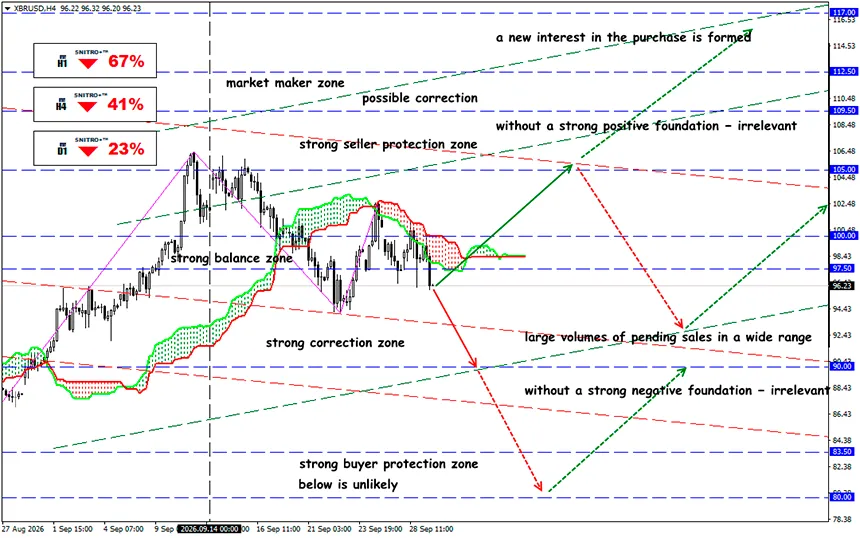
XBR/USD
Key zone: 95.00 - 97.50
Buy: 98.50 (on a strong positive fundamental basis); target 102.00-103.50; StopLoss 97.50
Sell: 94.50 (on a pullback following a retest of 96.50); target 91.50-90.00; StopLoss 95.50
U.S.-Iran negotiations have returned to the diplomatic track, but there is still no actual agreement. The oil market is once again trading not so much the balance of supply and demand as the probability of the Strait of Hormuz reopening.
Middle Eastern oil exports have recovered to 12.8 million bpd, but the supply deficit and expensive diesel guarantee a high Brent price. The fact that negotiations are taking place reduces the probability of the most severe scenario, but does not yet eliminate the geopolitical premium: the parties’ positions on sanctions, the nuclear program, and the terms for ending hostilities remain substantially different.
A reminder:
Tehran proposed reopening Hormuz and returning to negotiations on the nuclear program within seven days if Washington meets a number of conditions. These include ending the U.S. naval blockade of Iranian ports, easing restrictions on Iranian oil exports, and implementing a ceasefire. Trump rejected the initial version of the proposal, but mediation contacts are continuing.
This is precisely why oil is demonstrating extremely high sensitivity to political headlines: reports of a possible compromise trigger a sell-off, while signs of a deadlock quickly bring buyers back.
The situation in the physical market has improved. Saudi Arabia has been the main source of the recovery: Kpler estimates the kingdom’s September exports at approximately 5.4 million bpd, compared with 2.446 million bpd in August. Shipments through Ras Tanura increased from approximately 929,000 to 3.6 million bpd.
According to preliminary Kpler data, oil exports from seven key Middle Eastern producers — Saudi Arabia, the UAE, Iraq, Oman, Qatar, Kuwait, and Iran — recovered to approximately 12.8 million bpd in September. But the region is still supplying the market with roughly 6 million bpd less than in February.
Another important factor is the diesel shortage. Trump said he is considering restrictions on U.S. diesel exports “very seriously.” The consequences for the global market could be significant: the U.S. exports around 1.5 million bpd of fuel, while Europe and Latin America are among the most important destinations. Restrictions on U.S. exports could raise European wholesale diesel prices by almost 2% for every week the ban remains in effect. In other words, an administrative attempt to lower U.S. prices could subsequently deepen the shortage of petroleum products.
For medium-term positions, the key indicators are:
- actual oil volumes passing through Hormuz;
- exports from Saudi Arabia and the UAE;
- utilization of the East-West pipeline;
- the number of VLCCs and freight costs;
- the structure of Brent backwardation;
- diesel and gasoil crack spreads.
If a diplomatic agreement is accompanied by a sustained increase in shipping through Hormuz, the geopolitical premium in Brent will have a fundamental reason to decline.
If negotiations break down again and physical flows stop recovering, the market could quickly return to trading the supply deficit.
And What Is the Result?
The consequences of the crisis already extend far beyond the energy market. For example, the correlation between WTI and the 10-year Treasury yield reached approximately 65% in September — the highest level since 1990. The reason is obvious: high oil prices increase inflation expectations, while the market prices in a tighter monetary policy trajectory.
This creates the following chain:
expensive oil → inflation expectations → rising Treasury yields → pressure on equities → support for the dollar.
The situation around Hormuz is a critical factor not only for Brent and WTI. It can alter rate expectations, the U.S. yield curve, and technology stock valuations.
Although the crisis is far from over, the market has learned to partially work around its consequences. Rising physical supplies are limiting the potential for an oil rally even when political risk barely declines.
It is precisely this contradiction that will determine Brent’s trajectory in the near term. A full reopening of Hormuz could sharply reduce the geopolitical premium. Another breakdown in negotiations or a strike on energy infrastructure would once again make the supply deficit the main pricing factor.
So we act wisely and avoid unnecessary risks.
Profits to y’all!


