



Gold is getting nervous: a weak labor market vs. expensive money
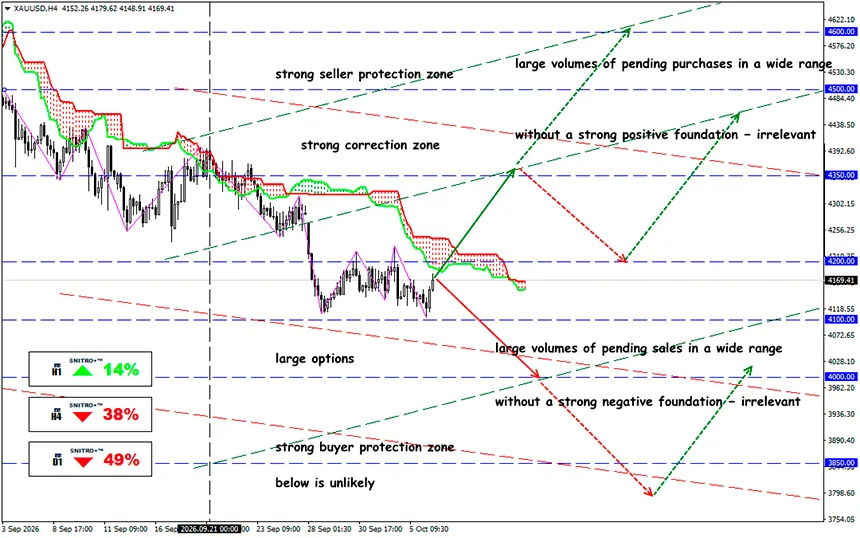
The Fed becomes irrelevant until december
XAU/USD
Key zone: 4,100.00 - 4,200.00
Buy: 4,200.00 (after breaking through a strong positive support level); target 4,320-4,380; StopLoss 4,100.00
Sell: 4,100.00 (on a pullback following a retest of 4,150); target 3,950-3,850; StopLoss 4,200.00
Gold is attempting to form a reversal after the weak NFP, but the advance still looks corrective: the UST10Y yield remains around 5.3%, DXY is near 102, and the market has almost priced out an October Fed hike. The main risk for bulls is persistent inflation and a high probability of another move by the regulator as early as December.
A reminder:
The main problem for gold right now is not the Fed policy rate itself, but the cost of long-term money. The 10-year Treasury yield is around 5.27–5.30%, after reaching 5.349% on October 5 — its highest level since 2002. The 30-year yield climbed as high as 5.703%. This sharply increases the opportunity cost of holding an asset that generates no interest income.
Weak NFP Saved Gold From a Deeper Decline
The September labor-market report sharply changed expectations for the Fed. The U.S. economy added only 29,000 jobs, while the unemployment rate remained at 4.2%. In addition, July and August were revised down by a combined 60,000 jobs. Average hourly earnings growth slowed to 0.1% m/m and 3.0% y/y.
It was after the NFP report that the probability of an October rate hike plunged from around 70%, where it had stood as recently as late September, to approximately 21–23%. As of October 6, CME FedWatch puts the probability of the rate remaining unchanged at approximately 78%.
This is an important positive for gold: the labor market gives the Fed a reason to pause. But only in October.
Inflation Brings Back the December Risk
The problem for gold buyers emerged after the employment report. The ISM Services PMI for September came in at 54.9 versus 55.4 a month earlier, but the Prices Paid component rose to 74.0 from 72.6 — its highest level since July 2022.
The Fed is therefore facing an extremely uncomfortable combination:
- the labor market is slowing noticeably;
- the services sector continues to expand;
- price pressures remain very high;
- long-term yields are rising on their own, tightening financial conditions.
The market has therefore almost ruled out a hike on October 28, but it has not abandoned the scenario of further tightening. According to the latest CME estimate, the probability that at least one additional hike will occur by the December 9 meeting is around 86%. The base case is a policy rate of 4.00–4.25%.
This is where the main risk to gold’s medium-term advance lies.
Additional pressure on XAU/USD is coming through the dollar.
France’s budget problems and the selloff in European government debt widened the spread between 10-year French and German bonds to around 145–150 bps — an area near the highs seen since the European sovereign debt crisis. Against this backdrop, the euro hit a 17-month low against the dollar.
DXY climbed to 102.535 on October 5 and is holding around 102.0–102.2 on October 6. Therefore, the recent weakening of the dollar still looks more like profit-taking than a full-fledged reversal in the U.S. currency.
For gold, this is critical: the weak NFP was not enough to reverse both the dollar and Treasuries at the same time.
And What Is the Result?
The key event in the coming sessions is the release of the minutes from the September FOMC meeting on October 7. For gold, however, the minutes themselves matter less than the answers to two questions: how concerned is the Fed about accelerating prices, and does it view the September hike as the beginning of a new tightening cycle or as a one-off adjustment?
Gold has received a breather, but it has not yet established a new bullish trend. The weak labor market has almost removed a Fed rate hike from the October scenario, but at the same time, the ISM report showed that strong inflationary pressures persist, while Treasury yields remain near 24-year highs.
As long as UST10Y remains above 5.2% and DXY stays above 102, the rise in XAU/USD should primarily be viewed as a correction after the decline. A genuine shift in the balance in favor of buyers would require a simultaneous decline in the dollar, long-term yields, and December rate-hike expectations. Until then, the $4,100–4,230 range remains the main battleground between buyers and sellers. A break below $4,100 would be a separate bearish signal with a base target of $4,000.
So we act wisely and avoid unnecessary risks.
Profits to y’all!


