



France is turning debt into currency risk
The Euro is under pressure again
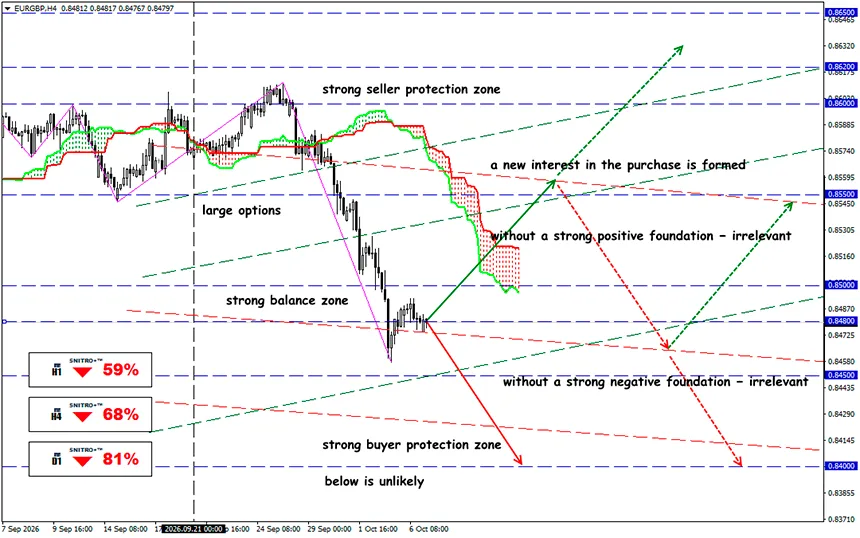
EUR/GBP
Key zone: 0.8460 - 0.8500
Buy: 0.8510 (on a decisive break above 0.8500); target 0.8600-0.8620; StopLoss 0.8460
Sell: 0.8450 (on strong negative fundamentals) ; target 0.8350; StopLoss 0.8500
The French debt crisis has already spread beyond the OAT market: the rising risk premium is weighing on the euro, supporting the Swiss franc, and changing expectations for ECB rates. The key question for currencies is whether stress in France will turn into a new eurozone fragmentation crisis.
For most of the past decade, lending money to France was considered almost as safe as lending to Germany. That confidence is now rapidly collapsing.
A reminder:
France’s government debt stood at €3.5955 trillion, or 119.0% of GDP, at the end of Q2 2026. France’s borrowing costs reached their highest level since 2002, while the gap with Germany widened to its highest since 2011. Last week, investors demanded yields of up to 5% for lending money to the French government for 10 years.
France is too large for stress in its debt market to remain local — French risk is becoming European risk. The premium investors demand for holding French debt instead of German debt has risen to its highest level since the 2011–2012 eurozone debt crisis.
In other words, France is now paying more to borrow than Italy and Greece, the countries that were at the epicenter of that crisis.
A rescue plan is still under discussion: last Thursday, Prime Minister Lecornu’s government presented a draft 2027 budget that envisages around €54 billion in spending cuts and additional revenue. The deficit target is 5% of GDP next year, compared with 5.4% in 2026.
Roughly two-thirds of the fiscal adjustment is expected to come from spending restraint and one-third from higher taxes and contributions. The measures include €6 billion in savings in both the pension system and healthcare. Government spending, excluding debt servicing and defense, is planned to be frozen in nominal terms, which would effectively tighten budgets after accounting for inflation.
However, instead of reassuring investors, the plan made them more cautious.
France is already putting pressure on the euro through three channels:
- Direct capital outflows — if an international investor sells OATs and moves the money outside the currency bloc, the transaction creates direct demand for USD, CHF, or other currencies and supply of EUR.
- Banks — rising government bond yields mean falling market prices. French and European banks are major holders of sovereign debt, so a further decline in OATs could reduce collateral values, increase volatility in bank capital, and tighten financial conditions.
- ECB expectations — inflation requires tight policy, but further rate hikes simultaneously increase pressure on the most heavily indebted countries.
This is precisely why the market has reduced expectations for further ECB tightening. This has become an additional factor behind the decline in EUR/USD.
But the cleanest expression of French risk is in EUR/CHF. The Swiss franc performs two functions at once: it is a safe-haven currency and an alternative to the euro within Europe.
The pound is also benefiting from euro weakness — the UK is outside the eurozone, so French sovereign risk does not directly enter the BOE’s monetary-policy mechanism. Britain itself is facing high debt-servicing costs and rising gilt yields. Therefore, in a global risk-off environment, GBP/USD is quite capable of falling alongside EUR/USD. In addition, the market currently maintains more hawkish expectations for the BoE, which supports GBP relative to EUR.
And What Is the Result?
The ECB can stop the panic, but it cannot solve France’s problem. The main counterargument against the scenario of a new eurozone crisis is that the ECB now has tools that did not exist at the beginning of the 2010–2012 crisis.
The ECB can purchase a country’s government bonds if disorderly market moves threaten the transmission of the single monetary policy. But in such operations, the ECB must take into account compliance with EU fiscal rules, debt sustainability, and the quality of macroeconomic policy. And these purchases are intended to counter market dynamics that are not justified by fundamentals. But Paris’s problems are rooted precisely in high debt and a persistent deficit.
Economically, the direction is clear. Politically, it is unrealistic: France is entering the 2027 presidential cycle, parliament is fragmented, and budget battles are coinciding with social discontent.
So we need to watch simultaneously:
OAT-Bund spread → banking sector → ECB rate expectations → EUR/CHF → EUR/USD.
This sequence currently provides the earliest signal of a regime change.
So we act wisely and avoid unnecessary risks.
Profits to y’all!


