



France is killing the Euro
The Market is trading eurozone fragmentation risk again
EUR/USD
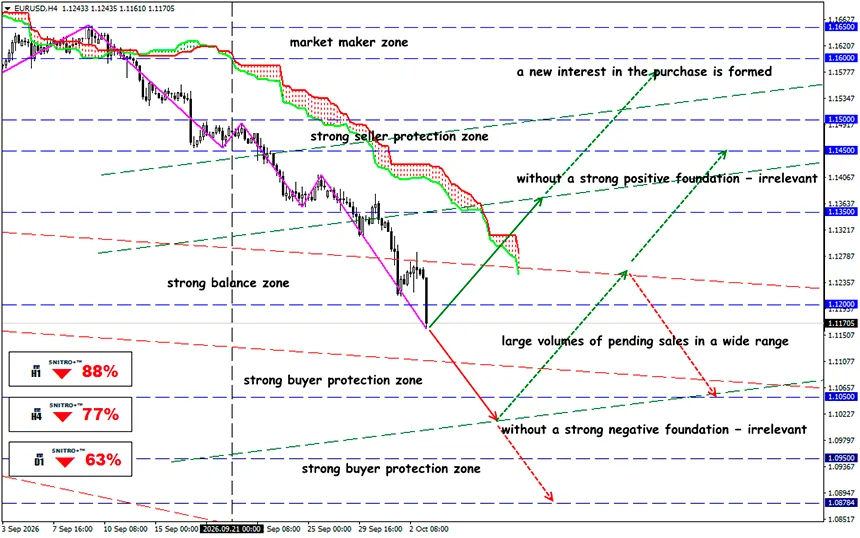
Key zone: 1.1150 - 1.1250
Buy: 1.1320 (on a strong positive fundamental basis) ; target 1.1500-1.1580; StopLoss 1.1250
Sell: 1.1120 (on a pullback following a retest of 1.1230) ; target 1.1000-1.0950; StopLoss 1.1200
French debt stress has pushed weak NFP out of the spotlight: EUR/USD has hit its lowest level since May 2025, while the OAT–Bund spread has approached levels seen during the sovereign debt crisis. For the euro, what matters now is no longer inflation but confidence in France’s fiscal sustainability.
According to theory, non-residents flee a country for two reasons: when the government cannot or does not want to pay. With either the right or the left in power, France should be avoided like the plague for both reasons. Instead of falling to 5% of GDP, the budget deficit is, on the contrary, heading toward 6%. At the same time, rising borrowing costs and debt-servicing expenses are making the government’s efforts to reduce it extremely difficult.
Rumors that the widening spread between French and German bonds to its highest level since the 2012 European sovereign debt crisis will result in credit-rating downgrades for Paris are prompting investors to pull their money out. Moreover, the similarly rapid rally in Italian, Greek, and Belgian bond yields, alongside French yields, suggests that the contagion is spreading across the eurozone much faster than could have been expected.
A reminder:
The facts confirm a sharp widening of the spread between 10-year French OATs and German Bunds. On October 5, French yields were holding around 4.88–4.90%, while German yields were around 3.43%. France’s premium therefore stood at approximately 145–146 bps. Following a peak of around 159 bps late last week, this represents only a minor correction: the peak was the highest in roughly 15 years.
- Rising OAT yields alongside falling or stable Bund yields indicate not simply a global bond selloff, but a shift of capital out of France and into safer European assets.
- France’s government debt rose to €3.5955 trillion, or 119.0% of GDP, at the end of Q2, compared with 117.5% a quarter earlier. At the beginning of the year, the figure was still significantly lower.
- France already has an A+ rating from Fitch and S&P. Moody’s maintains an Aa3 rating with a negative outlook and plans its next decision for October 23, 2026. On October 2, the agency separately emphasized that political fragmentation is complicating budget approval and fiscal consolidation.
Against this backdrop, even weak NFP cannot save the situation. In September, NFP increased by a modest 29,000, almost three times less than forecast, data for previous months were revised downward by 60,000, and unemployment increased to 4.2%. As a result, the probability of Fed monetary policy tightening in October fell to 18%. In theory, this should have sent the U.S. dollar sharply lower. In reality, it strengthened.
In fact, strong NFP growth is not required for the Federal Reserve to raise rates. An aging population and restrictions on immigration are slowing labor supply growth. Against this backdrop, even an increase in the participation rate points to strength in the labor market.
However, it is still too early to describe the situation as a full-scale repeat of the 2012 European sovereign debt crisis. The ECB has the Transmission Protection Instrument, which can be used against “unwarranted and disorderly” fragmentation in bond markets. In other words, the regulator now has significantly more stabilization tools than it did during the early stages of the previous crisis.
The ECB has found itself in a much more uncomfortable position.
Eurostat’s preliminary estimate shows HICP inflation accelerating to 3.8% y/y in September from 3.2% in August. Core inflation excluding energy, food, alcohol, and tobacco increased from 2.4% to 2.5%. The energy component remains particularly strong at +18.8% y/y.
Formally, these data support further policy tightening, but French debt stress radically complicates the choice. If the ECB continues its monetary tightening cycle, eurozone bond yields will rise even further. It may then have to urgently rescue the euro.
And What Is the Result?
The main risk for EUR/USD has changed. Until recently, the market was comparing the future rate paths of the Fed and ECB; now, a premium for eurozone fiscal and political risk has been added to the interest-rate differential.
Three indicators are now in focus:
- the 10-year OAT–Bund spread;
- the probability of Moody’s taking a rating action on October 23;
- the ECB’s willingness to separate the fight against inflation from protecting the monetary transmission mechanism.
As long as the French spread remains around 145–150 bps and EUR/USD trades below 1.1250–1.1300, the outlook is bearish only.
So we act wisely and avoid unnecessary risks.
Profits to y’all!


