



Europe hit by oil-driven inflation
Can the euro survive its battle against the dollar?
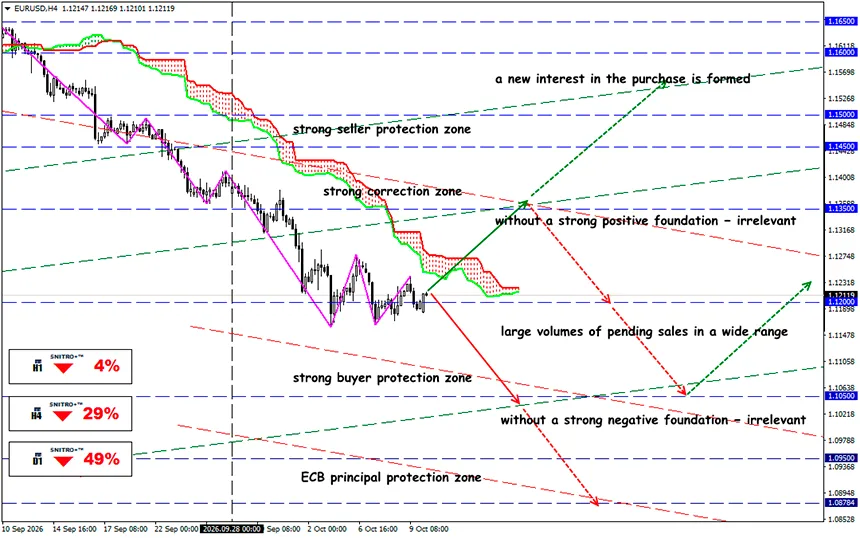
EUR/USD
Key zone: 1.1150 - 1.1250
Buy: 1.1270 (on strong positive fundamentals) ; target 1.1400-1.1450; StopLoss 1.1200
Sell: 1.1120 (on a decisive break above 1.1150) ; target 1.1000-1.0950; StopLoss 1.1190
Accelerating inflation, French sovereign debt risks, and safe-haven demand are supporting the dollar. However, ahead of the U.S. CPI release, a bearish strategy requires confirmation from price action, not just macroeconomic arguments.
A reminder:
Eurostat's preliminary estimate shows that annual inflation in the eurozone accelerated to 3.8% in September, up from 3.2% in August. Energy inflation rose to 18.8% year over year, compared with 14.3% a month earlier. Meanwhile, services inflation stood at 3.2%, while non-energy industrial goods inflation was 1.1%.
These figures require a more nuanced interpretation than the simple assumption that "high inflation means a weak euro."
- An energy price surge can simultaneously worsen the eurozone's trade balance, increase business costs, and reduce consumers' real incomes. For the currency, this creates a negative transmission channel through economic growth and energy imports.
- Accelerating inflation could limit the ECB's ability to ease monetary policy or strengthen expectations of higher interest rates. All else being equal, this would support the euro. Therefore, the currency's reaction depends on how ECB rate expectations change relative to expectations for the Fed.
- Accelerating inflation could limit the ECB's ability to ease monetary policy or strengthen expectations of higher interest rates. All else being equal, this would support the euro. Therefore, the currency's reaction depends on how ECB rate expectations change relative to expectations for the Fed.
Inflation creates a conflicting backdrop for the euro. The negative impact of rising costs and a weakening economy competes with potential support from interest rate expectations. For the foreign exchange market, relative interest rate levels, rather than absolute levels, remain decisive.
Another Disruptive Factor: Germany
German industrial orders fell 10.6% in August compared with July. However, excluding large orders, the decline was just 0.1%. The sharp overall drop was driven by a 61.5% contraction in orders for transportation equipment following an exceptional increase in July.
This does not eliminate the problems facing German industry, but it significantly changes how the data should be interpreted. A single monthly reading heavily affected by volatile large contracts does not indicate a collapse in industrial demand.
For the ECB, this presents a difficult challenge: price pressures are intensifying while industrial activity remains uneven. The central bank must consider the risk of inflation becoming entrenched without ignoring the impact of high interest rates on investment activity.
French Debt Is Not a Signal to Sell
France's fiscal risks have become one of the central drivers of the European bond market. According to INSEE, government debt reached €3,595.5 billion in the second quarter of 2026, equivalent to 119.0% of GDP, compared with 117.5% in the first quarter.
France's preliminary annual inflation rate rose to 3.0% in September from 2.4% in August, while the harmonized inflation rate reached 3.4%.
However, France's domestic fiscal problems do not necessarily have to develop into a systemic eurozone crisis.
U.S. CPI Could Shift the Balance of Expectations
The U.S. dollar is benefiting from geopolitical safe-haven demand and concerns that energy-driven inflation will make it more difficult for inflation to return to the Fed's target.
Forecasts suggest that headline inflation could accelerate to approximately 3.7% year over year, while core inflation is expected to be around 2.5%.
So What Is the Bottom Line?
The fundamental backdrop currently favors the dollar, but it does not provide a clear signal to sell the euro. Energy-driven inflation is simultaneously weakening Europe's growth outlook and limiting the scope for monetary easing.
French sovereign debt risk is becoming an important source of volatility. The OAT–Bund spread should be analyzed alongside U.S. Treasury yields rather than in isolation. A widening European risk premium combined with rising U.S. yields would provide a more convincing bearish setup for EUR/USD than either factor alone.
The next major catalyst is the U.S. CPI release on October 14. If inflation exceeds forecasts and U.S. yields resume their upward trend, a break below 1.1170 would gain fundamental confirmation.
If the data comes in softer than expected, a rebound toward 1.1240–1.1250 is likely, even if Europe's underlying problems persist.
So we act wisely and avoid unnecessary risks.
Profits to y’all!


