



Euro weakens, Pound resists: which will lose to the Yen?
Currency crosses ahead of central bank decisions
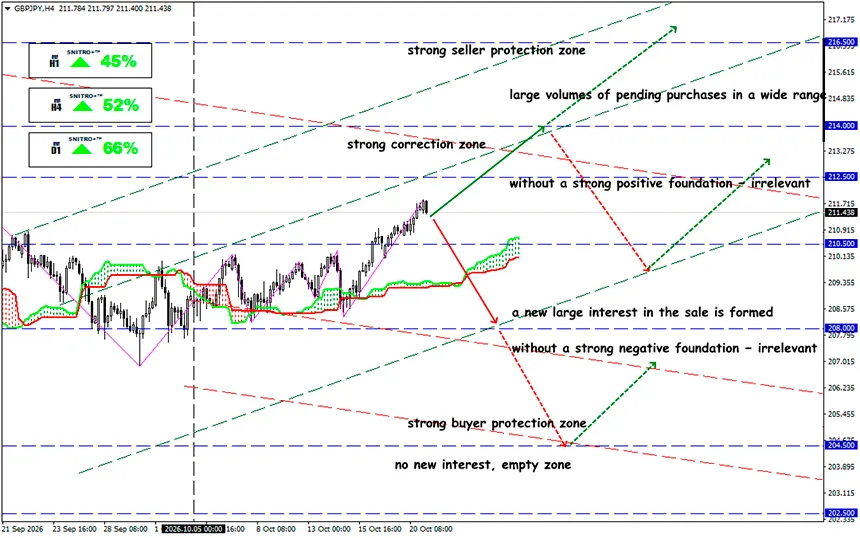
GBP/JPY
Key zone: 211.00 - 212.00
Buy: 212.50 (on strong positive fundamentals); target 214.50-215.50; StopLoss 211.80
Sell: 210.50 (on a confident break of 211.00) ; target 208.50; StopLoss 211.20
The yen is preparing for another monetary policy test. Debt problems in the eurozone are weakening the euro, while high yields on British assets are supporting the pound. The currency market is entering a period of heightened uncertainty.
A quick recap:
Today, October 21, markets are awaiting speeches by BOE Governor Bailey and ECB President Lagarde. Their comments on interest rates and inflation could reshape short-term expectations for key crosses against the Japanese yen. The main risk for both pairs following central bank interest rate decisions is a shift in expectations regarding the pace of policy normalization and the future trajectory of Japanese interest rates. Both speculative moves and a reversal of the medium-term trend are possible.
- ECB, October 29: Markets are assessing the prospects for further monetary tightening against a backdrop of 3.8% inflation and debt risks. Particular attention will be paid to inflation forecasts and financial stability assessments. Political uncertainty in France and public finance problems are increasing investors' sensitivity to debt-servicing costs and European bond yield spreads.
- BOJ, October 30: Markets are focused on whether the yen can enter a sustained appreciation trend if Japan continues normalizing policy while European central banks face constraints on raising rates. The yen remains a funding currency for international carry strategies, meaning falling equity markets, rising volatility, or reduced leverage could trigger demand for JPY even without an unexpected Bank of Japan decision.
- BOE, November 5: Markets are considering the possibility of tightening and raising the benchmark rate to 4%. The British central bank is holding its key rate at 3.75%, which is 250 basis points above the BOJ rate and 125 basis points above the ECB deposit rate. This differential gives the pound an advantage in potential carry trade returns.
A BOJ Rate Hike Still Does Not Guarantee a Strong Yen
Further yen appreciation depends on three factors.
- The persistence of domestic inflation and wage growth. If rising wages continue to support consumer demand, the BOJ will have stronger grounds for tightening monetary policy.
- The performance of Japanese government bond yields. Rising JGB yields could reduce the appeal of foreign debt instruments for Japanese investors, particularly when currency hedging costs are taken into account.
- The state of global risk appetite.
The Key Risk for Yen Sellers Is an Accelerated Unwinding of Carry Trades.
If market participants begin simultaneously reducing long positions in EUR/JPY and GBP/JPY, both pairs could decline much faster than a typical reaction to changes in interest rates would suggest.
Even if Japan tightens monetary policy, interest rate differentials remain favorable to European currencies. However, the sustainability of carry trades depends not only on interest rate levels but also on expected exchange rate movements.
A sharp appreciation of the yen by just a few percent could wipe out a substantial portion of the annual return from a strategy based on selling JPY and buying higher-yielding currencies.
So What Is the Outcome?
At present, the pound looks stronger, but the euro offers a more attractive selling opportunity. Rather than betting on an immediate strengthening of the Japanese yen against all currencies, a more promising approach is to exploit differences between the eurozone's and the UK's fundamental conditions.
EUR/JPY faces pressure from debt risks and uncertainty surrounding future ECB policy. As long as the pair remains below 178.20, selling into rebounds has an advantage over buying.
GBP/JPY, by contrast, benefits from a wider interest rate differential and expectations of BOE tightening. However, a sustained break above 212.00, followed by 213.50, is required to confirm further gains.
Over the next four weeks, selling EUR/JPY near resistance levels is preferable, while buying GBP/JPY is justified only after technical confirmation.
The main factor that could invalidate both forecasts is an unexpected acceleration in BOJ monetary policy normalization. In that case, the pound's yield advantage may prove insufficient to protect GBP/JPY from a sell-off.
So we act wisely and avoid unnecessary risks.
Profits to y’all!


