













El Salvador: 5 years with legal bitcoin
The results of a cryptocurrency experiment
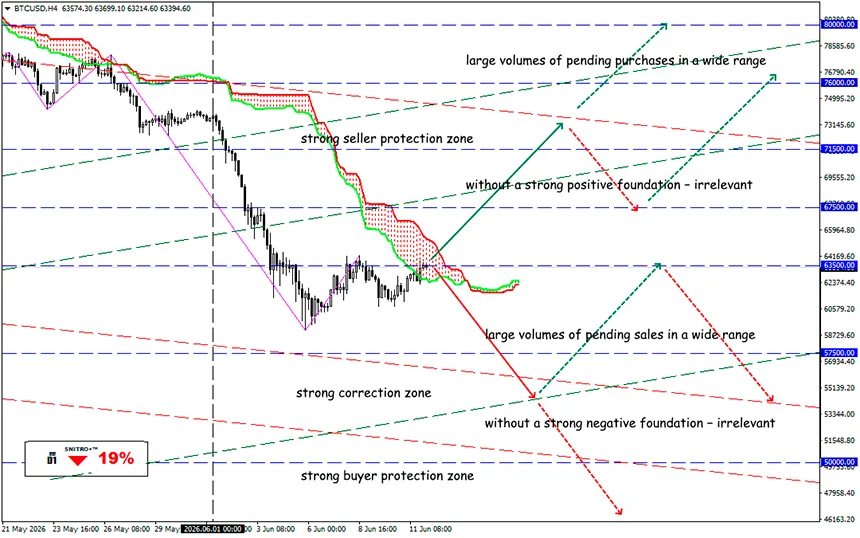
BTC/USD
Key zone: 60,000 - 63,500
Buy: 65,000 (on a strong positive foundation); target 71,500-73,500; StopLoss 64,000
Sell: 60,000 (on a pullback following a retest of 63,500) ; target 57,500-55,000; StopLoss 61,000
El Salvador became the first country in the world to recognize Bitcoin as legal tender alongside the U.S. dollar. President Nayib Bukele’s decision sparked widespread debate: supporters saw it as a revolution in the global financial system, while critics viewed it as a dangerous experiment on the economy of a small developing nation.
Five years later, it is now possible to draw preliminary conclusions and assess the real consequences for the country’s economy, financial sector, and legal system.
Let us recall:
On June 8, 2021, El Salvador adopted the world’s first “Bitcoin Law,” recognizing BTC as legal tender. After September 7, 2021, when the law came into force, the authorities began building a dedicated infrastructure around BTC: they launched the state-owned Chivo Wallet, started installing Bitcoin ATMs, and promoted payments through the Lightning Network.
The main idea behind the project was to provide financial services to people without bank accounts and reduce remittance fees, which account for approximately 25% of El Salvador’s GDP. To achieve this, the government created the Chivo wallet system and deployed a nationwide cryptocurrency infrastructure.
However, the actual results proved far more modest.
- According to the country’s Central Reserve Bank, in April 2026 only about $5.7 million in transfers were processed through cryptocurrency wallets, compared with more than $851 million in total remittance inflows from abroad. As a result, cryptocurrency transfers account for less than 1% of the remittance market.
- Expectations for widespread BTC adoption as a payment method were not met. Despite initial incentives such as registration bonuses in Chivo Wallet, most of the population continues to use the U.S. dollar. Despite the limited everyday use of cryptocurrency, the project did bring certain benefits to the country.
- El Salvador became a global center for cryptocurrency tourism and attracted the attention of the international crypto community. New investments flowed into infrastructure projects, the hospitality sector, and the fintech industry.
- The BTC accumulation strategy proved profitable during the strong market rally. As of 2025–2026, the value of the government's Bitcoin reserves significantly exceeded the original investment thanks to Bitcoin’s rise above $100,000 per coin.
- Unrealized gains in the government portfolio were measured in hundreds of millions of dollars.
For the first time, the state effectively transformed part of its reserves into a high-risk speculative asset.
In January 2025, El Salvador’s authorities were forced to substantially revise the Bitcoin law as part of an agreement with the IMF on a $1.4 billion credit facility. The law was amended so that businesses were no longer required to accept Bitcoin. Cryptocurrency also ceased to be used for tax payments and settlements with the government.
The IMF also pointed to concerns regarding the transparency of the government’s Bitcoin purchases for state reserves.
In practice, the country abandoned the key element of the original legal-tender concept. While in 2021 every economic agent was required to accept BTC, after the reform the use of cryptocurrency became entirely voluntary.
The experiment demonstrated that a model based on mandatory integration of cryptocurrency into a national monetary system cannot ensure mass adoption of a digital asset by the population and businesses.
And what is the result?
El Salvador’s experience remains highly important.
- An international precedent for integrating cryptocurrency into a state financial system was created.
- Regulators obtained practical material for assessing the risks of digital assets.
- The problem of high volatility continues to significantly limit the use of cryptocurrency in everyday payments.
However, as a tool for attracting capital, increasing the country's international visibility, and creating alternative state reserves, the experiment can be considered partially successful.
According to 2026 data, government-controlled addresses hold 7,677 BTC worth approximately $480 million. In January 2025, Tether announced that it had obtained a Digital Asset Service Provider license in El Salvador and was relocating part of its business there.
After five years, Bitcoin has not become a full-fledged currency, but it has firmly established itself as a new class of global reserve and investment assets.
So we act wisely and avoid unnecessary risks.
Profits to y’all!


