


















Donald is taking risks, but he has no choice
The war with Iran could cost Trump Congress
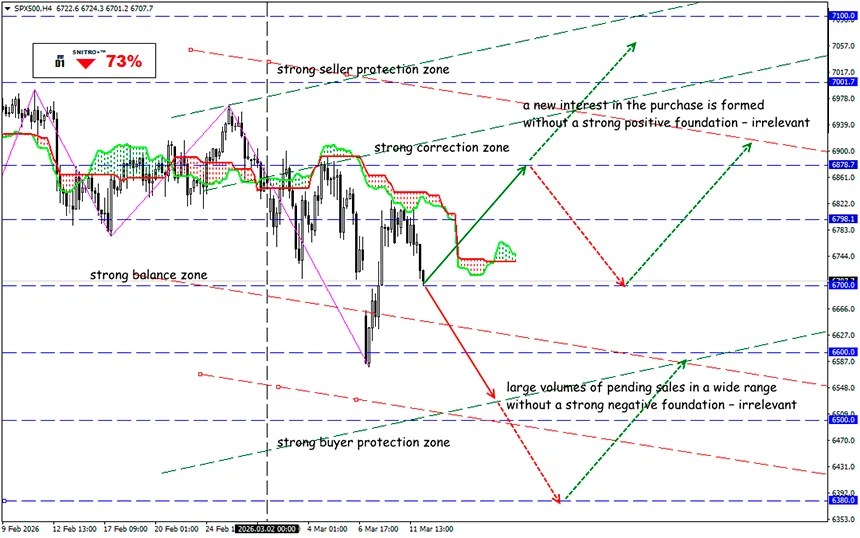
SP500
Key zone: 6,700 - 6,800
Buy: 6,800 (on strong positive fundamentals); target 6,950-7,100; StopLoss 6,740
Sell: 6,680(on a pullback after retesting 6,750); target 6,550-6,500; StopLoss 6,740
High oil prices will become a huge problem for the White House ahead of the midterm congressional elections. If the conflict with Iran drags on for another couple of months, Republicans are facing a catastrophe.
The probability of Trump’s impeachment on prediction markets has risen to 71%, while the probability of Democrats winning the Senate is already estimated at 47%. On Polymarket, Democrats have a record probability (85%) of gaining a majority in the House of Representatives.
Recent polls show that American society is generally skeptical:
- about 53% of citizens oppose continuing the military operation against Iran;
- only about 40% support the actions of the administration;
- about 60% believe the conflict could make the United States less safe.
At the same time, support is sharply polarized:
- 85% of Republicans support the war;
- 90% of Democrats oppose it.
Support for Trump is sustained almost exclusively by nuclear brinkmanship and the active Republican electorate.
Most independent respondents also support ending the military action — and it is precisely this segment of the electorate that is crucial in midterm elections.
The political threat for the Trump administration lies in the economic consequences of the conflict: while oil rose above $100 per barrel, gasoline in the United States climbed to $3.54 per gallon (an increase of nearly 60 cents), and gasoline prices are the main indicator of voter sentiment.
If gasoline reaches $4+ during the summer, this will almost guarantee electoral losses for the president’s party.
The Trump administration has fallen into a classic pre-election war trap.
Historically, the party of the sitting president almost always loses seats in midterm elections, and war combined with rising prices amplifies this effect.
There are two scenarios:
- First: a quick victory, society unites around the “national idea,” the president’s rating rises, and control of Congress is preserved.
- Second: a prolonged conflict sustains high oil prices, the economy receives an inflationary shock, support from independent voters declines, and control of Congress is lost.
History shows that the second scenario occurs far more often.
The problem is that Tehran has no intention of capitulating. This means the conflict could drag on — at least for months.
Investors recognize the instability and for now are not risking their money. Futures on U.S. stock indices remain range-bound after a correction. Of the 11 sector groups in the S&P 500 index, nine closed yesterday in the red. Energy companies experienced the greatest pressure amid speculation around oil.
The indices are attempting to rise on expectations of the conflict in the Middle East ending, but the chances of a diplomatic settlement are minimal. Moreover, the risks of a global crisis are rising — before the war with Iran the probability of a U.S. recession on Polymarket was estimated at 20%, but now it is 30%.
Prediction markets usually begin to sense such things earlier than polls and political analysts. And if this happens, the congressional elections could turn into a referendum not about Trump, but about the price of gasoline.
So we act wisely and avoid unnecessary risks.
Profits to y’all!


