
















China's trade surplus threatens stability
Europe is preparing to defend its market
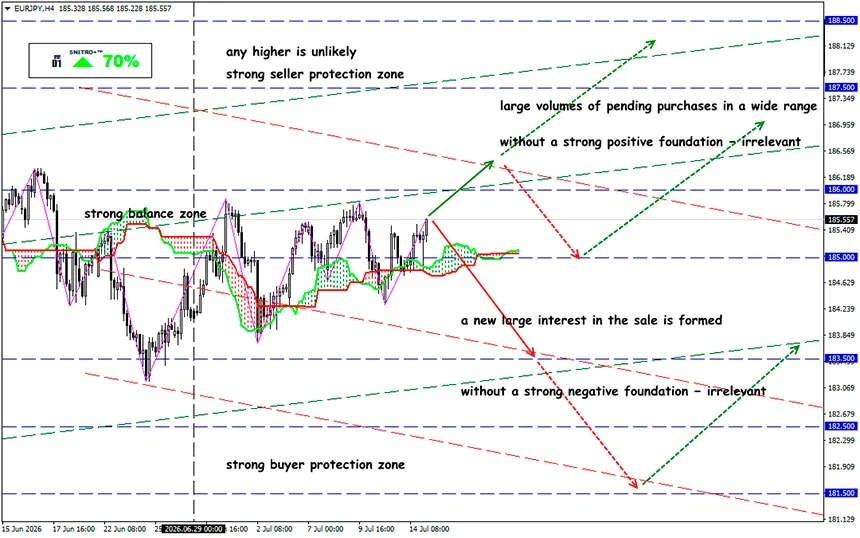
EUR/JPY
Key zone: 185.00 - 185.80
Buy: 186.20 (against a strong positive fundamental backdrop); target 187.50; StopLoss 185.50
Sell: 185.00 (on a pullback after retesting 185.50) ; target 183.50-182.50; StopLoss 185.70
China continues to expand its exports at a pace that is becoming increasingly difficult to explain solely by the recovery in global demand. June's data once again showed that China's manufacturing engine is operating far faster than the country's domestic consumption is growing.
For Europe, this means increasing pressure on industry, corporate earnings, and the European Union's economic policy.
China's trade surplus with the European Union reached a record level in June, intensifying a dispute that has become one of the main sources of tension between Beijing and Brussels.
- According to Bloomberg, citing data from China's customs authorities, China's trade surplus with the EU increased by 27% year-over-year, reaching $32.9 billion in June.
- In June 2026, Chinese exports reached a record $412.4 billion, up 27% from a year earlier.
- China's total foreign trade turnover reached $699.2 billion during the month, exceeding the June 2025 figure by 30.6%.
- During the first half of the year, China imported $135.6 billion worth of goods from the EU, an increase of 9% compared with the same period last year.
- • China's trade surplus with Germany more than doubled compared with the previous year, while its surplus with France declined by 81%.
For the European Union, China's trade surplus is the mirror image of Europe's rapidly widening trade deficit. Over the past year, imports from China increased by 6.4%, while EU exports to China declined by 6.5%.
For European manufacturers, inexpensive Chinese goods mean lower prices, shrinking profit margins, and lower capacity utilization. The most vulnerable industries include automotive manufacturing, steelmaking, chemicals, solar energy, battery production, industrial equipment, and certain segments of the electronics industry.
The situation is particularly painful for Germany. In the past, German automakers generated a substantial share of their profits in the Chinese market. Today, they are losing market share to local manufacturers and then competing against those same companies within the European Union itself.
The record trade surplus gives Brussels stronger grounds to consider additional trade protection measures.
- Since July 1, 2026, the EU has implemented a new safeguard regime designed to protect the steel industry from the consequences of global overcapacity. Countervailing duties on Chinese electric vehicles also remain in force.
- In February, the EU imposed anti-dumping duties ranging from 57.7% to 90.3% on Chinese seamless steel cylinders and tariffs of 56% to 60% on candles imported from China.
- In July, the European Commission also introduced definitive anti-dumping measures on Chinese passenger car and light truck tires.
- The next possible steps include safeguard quotas, minimum pricing mechanisms, and restrictions affecting the chemical industry, hybrid vehicle manufacturing, and renewable energy components.
The two sides have set October as the deadline for achieving progress in resolving their trade disputes, but the gap between their positions remains substantial.
What does this mean?
For currency traders, the key indicators will be the People's Bank of China's daily yuan fixing, the performance of USD/CNH, European manufacturing PMI data, and changes in Germany's trade balance. For equity markets, the greatest risk lies not in China's record export figures themselves, but in the political response to those figures.
At present, the yuan remains approximately 15% below its estimated fair value against the euro, compared with around 20% a year ago.
For USD/CNH, the most important drivers remain the combination of three factors: the PBOC's policy stance, the yield differential between the United States and China, and the likelihood of additional tariffs. An escalation of the trade conflict could weaken the offshore yuan even in the face of record trade surpluses.
For the euro, the consequences are mixed. Cheap imports help reduce inflationary pressure and potentially provide the European Central Bank with greater room for a more accommodative monetary policy. At the same time, however, the deterioration of the trade balance and mounting pressure on industry weigh on economic growth. All else being equal, this combination creates a fundamental downside risk for EUR/USD, particularly if the U.S. economy continues to outperform Europe in terms of growth.
So we act wisely and avoid unnecessary risks.
Profits to y’all!


