















Canada goes all in
A new pipeline changes the rules of the game
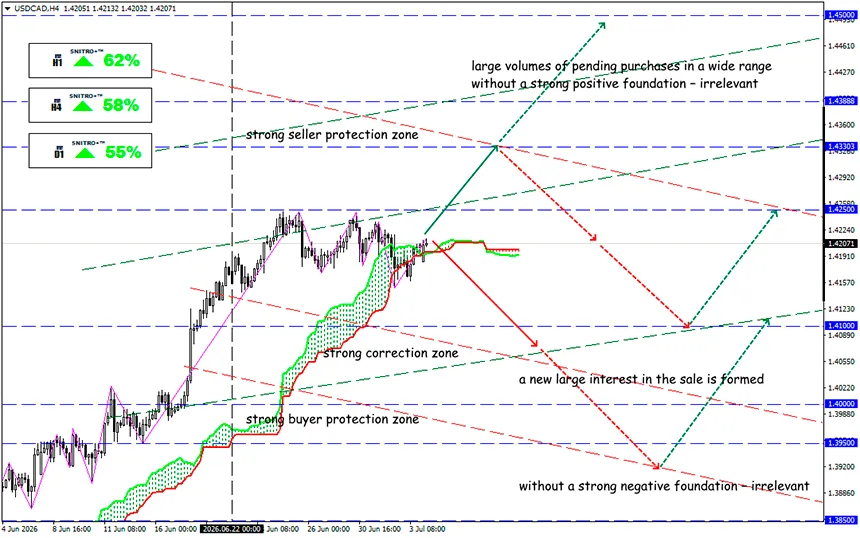
USD/CAD
Key zone: 1.4160 - 1.4250
Buy: 1.4300 (on a pullback after retesting 1.4250) ; target 1.4450; StopLoss 1.4230
Sell: 1.4100 (on a confirmed break of 1.4150) ; target 1.3950; StopLoss 1.4170
Canada is preparing to launch its largest infrastructure project in decades. The new oil pipeline to the coast of British Columbia is intended to become more than just a transportation corridor—it is designed to serve as a tool of economic sovereignty. While Washington continues to use trade threats as an instrument of political pressure, Ottawa is betting on redirecting its exports toward Asian markets.
Reminder:
Following the completion of the CAD 34 billion Trans Mountain Expansion project, Canadian oil exports reached record highs. However, this has proven insufficient. Most exports are still overwhelmingly directed to the U.S. market, leaving the entire industry highly dependent on political decisions made in Washington.
Last week, Prime Minister Mark Carney confirmed that Alberta's government had submitted an application to the federal Major Projects Office for the construction of a new pipeline stretching more than 1,000 kilometers to the coast of British Columbia. Construction is scheduled to begin in September 2027.
The project is becoming the centerpiece of Canada's strategy to establish itself as an independent energy superpower.
- The new pipeline will run parallel to the existing Trans Mountain corridor and will enable the export of up to an additional 1 million barrels of oil per day to the rapidly growing Asian markets.
- The project will be developed jointly by the state-owned Trans Mountain Corp and Pembina Pipeline Corp, significantly reducing political risks associated with financing.
- The Canadian government expects to attract more than CAD 200 billion in new investments into energy, transportation, and industrial infrastructure.
- At the same time, Canada plans to more than triple its LNG exports over the next decade by building five new LNG terminals and investing another CAD 10 billion in the modernization of the Port of Vancouver.
- Alberta's government aims to nearly double oil production by the middle of the next decade, transforming western Canada into one of the world's largest energy export hubs.
Behind the economic rationale, geopolitical considerations are becoming increasingly evident.
President Trump continues to threaten Canada with 100% tariffs, repeatedly raises the idea of making Canada the 51st U.S. state, and has refused to support a long-term extension of the USMCA agreement. Under these circumstances, diversifying export routes has become a matter of national security for Ottawa—not merely an economic objective.
Nearly 75% of Canada's total exports still go to the United States. In the oil sector, dependence is even greater: approximately 4 million barrels per day are shipped almost exclusively to U.S. consumers, accounting for roughly 60% of total U.S. oil imports.
It is precisely this dependence that Canada is now trying to break.
For the global oil market, the emergence of a new export route means stronger competition for Asian buyers. If the project moves forward as planned, the volume of North American crude reaching China, Japan, South Korea, and India will increase substantially. This will intensify competitive pressure on Middle Eastern suppliers and could reshape traditional global trade flows.
Another important factor is the potential increase in oil production in both Canada and the United States. Unless global demand rises at a comparable pace, this will strengthen competition among producers for market share and limit the long-term upside potential of oil prices.
The implications for the foreign exchange market also appear significant. Higher export revenues, massive infrastructure investment, and reduced dependence on U.S. demand create a fundamentally positive long-term outlook for the Canadian dollar. However, in the short term, the CAD will remain highly sensitive to oil price movements and to any new statements coming from Washington.
What does this mean?
Canada is embarking on its most significant energy transformation since the development of Alberta's oil sands. The new pipeline is no longer simply about transporting crude oil—it represents an effort to reshape political influence in North America and reduce dependence on decisions made in the White House.
If the project is completed on schedule, the global oil market will gain a major new supplier with direct access to Asia, while the Canadian economy will secure an additional engine of growth for many years to come.
So we act wisely and avoid unnecessary risks.
Profits to y’all!


