



Asia delivered a classic “Sell the Fact”
Australia does not trust the monetary regulator
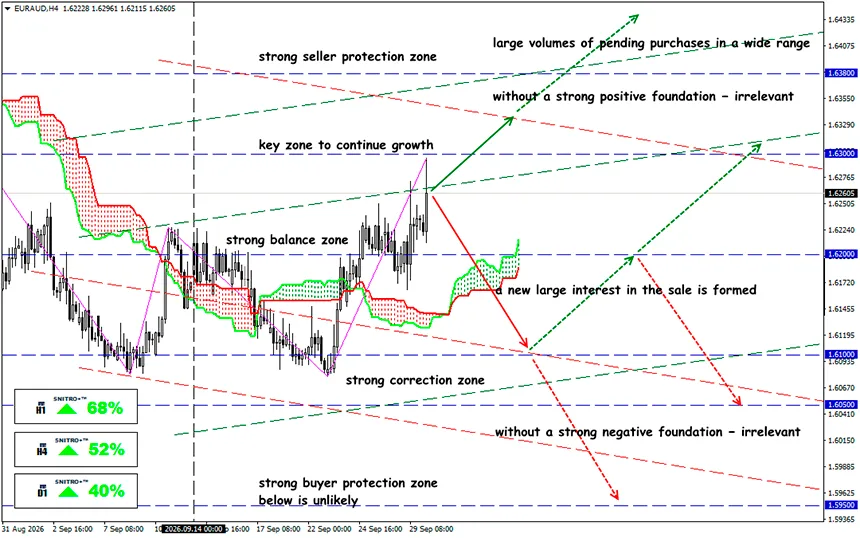
EUR/AUD
Key zone: 1.6230 - 1.6280
Buy: 1.6300 (on the pullback following the retest of 1.6260); target 1.6400-1.6450; StopLoss 1.6250
Sell: 1.6200 (against a strong negative fundamental backdrop) ; target 1.6050-1.6000; StopLoss 1.6250
The new rate had already been priced in, Michele Bullock did not promise further hikes, and rising U.S. rates are narrowing the yield gap. The RBA raised its rate for the fourth time this year — to 4.60%, but the Aussie fell below 0.7000 and hit a new low.
Global monetary tightening — the Fed, ECB, Bank of Japan, and RBNZ — is depriving the Australian dollar of its previous carry advantage, while the dollar is supported by high real rates and expensive oil. But the main reason lies in the RBA’s overly cautious statement.
A reminder:
The regulator raised the rate by 25 bps from 4.35% to 4.60%, in line with the forecast. The hike itself did not surprise the market, although the rate reached its highest level since November 2011. The vote was unanimous, and the official statement remained hawkish: the RBA confirmed its readiness to raise the rate further “if necessary.”
The unpleasant reversal for the bulls came at the press conference. The RBA governor said the committee had discussed two options: a 25 bps hike and keeping the rate unchanged. She also said she hoped the current measures were sufficiently restrictive, but there was no certainty about that. She did not call a recession the base-case scenario and warned that a single monthly CPI reading would not be decisive.
A gap emerged between Bullock’s rhetoric and market expectations: futures were pricing in a rate above 5% by May 2027, while the probability of another move in November is estimated at only around 33%. The yield on 3-year Australian government bonds fell by 6 bps after the press conference to 4.974%.
Unfortunately, the Australian economy limits the hawks’ room for maneuver:
- August CPI accelerated to 4.0% y/y from 3.5%, but came in below the 4.1% forecast. The trimmed mean remained at 3.6%. At the same time, the headline index rose 0.7% m/m on a seasonally adjusted basis — price pressures persist.
- The composition of the increase is important: housing costs rose 5.7% y/y, while transportation costs increased 5.6%. Electricity prices rose 13.2%, largely due to the expiration of federal rebates.
- Q2 GDP rose 0.4% q/q and 2.1% y/y, while labor productivity fell 0.2% y/y. Growth potential is low, and the economy is quickly running into its “ceiling.”
- Unemployment rose to 4.6% in August from 4.5%, while employment increased by 39,500.
- Property prices fell 0.9% m/m, the fifth consecutive decline, while Sydney is already down 7.1% from its February peak. Falling property values do not mean a cheaper consumer basket: rents, utilities, and new-home construction can become more expensive even when prices in the secondary market are declining.
Analysts’ forecasts diverge. ANZ expects a hike to 4.85% in November, CBA expects a pause until mid-2027, while AMP considers a second hike unnecessary. ING maintains its 0.720 target for December but acknowledges increased short-term downside risks. BBH notes that the market is pricing in around 36 bps of tightening over 12 months, while Australia’s exposure to commodities for the energy, AI, and defense industries remains a long-term support factor.
And What Is the Result?
An unpleasant feedback loop is emerging for the AUD: currency weakness can increase import costs and intensify inflation. But another rate hike will provide sustained support to the exchange rate only if market expectations are revised.
So the bulls need a higher expected rate trajectory; the current rate alone is not enough. The next test is September CPI on October 28: an acceleration in core inflation will strengthen the case for another rate adjustment, while a slowdown will trigger a pause.
In the EUR/AUD cross, both currencies are weak against the dollar, so inflation and RBA rhetoric will be the main factors. For now, the pair is reacting actively — the RBA rate is 4.60% versus the ECB deposit rate of 2.50% — leaving a 210 bps gap in favor of the AUD. Over the medium term, AUD-specific factors will dominate: gold, oil, and the October 15 labor market report. Keep in mind: liquidity in the EUR/AUD cross is significantly lower than in AUD/USD, so the StopLoss should be set with a wider buffer.
So we act wisely and avoid unnecessary risks.
Profits to y’all!


