



AI has failed to rescue bitcoin miners
Bitcoin faces a new wave of competition
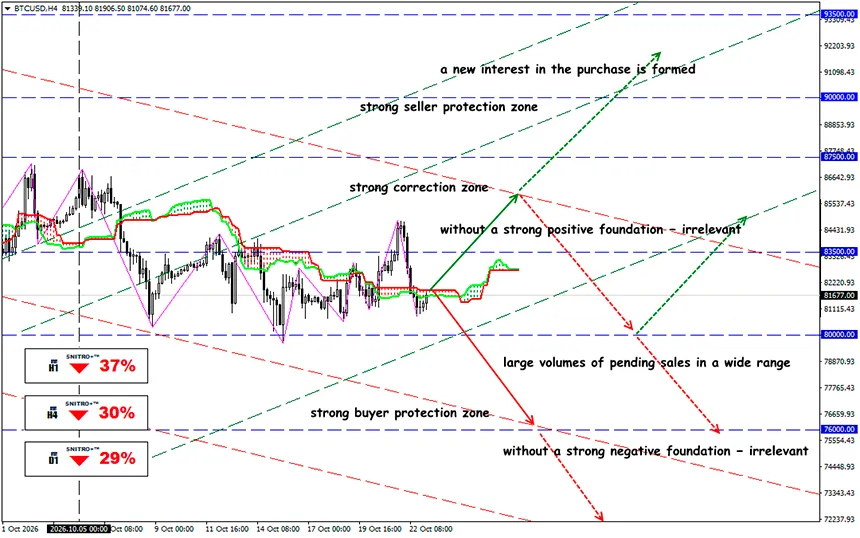
BTC/USD
Key zone: 81,500 - 82,500
Buy: 83,500 (on strong positive fundamentals); target 86,500-87,500; StopLoss 82,500
Sell: 80,000 (on a decisive break above 81,500) ; target 76,500; StopLoss 81,000
The shift by major miners toward AI technologies has not reduced competition within the Bitcoin network. Computing capacity has recovered, BTC's hash rate has returned above 1 ZH/s, mining difficulty has increased by 5.92%, and hardware profitability is declining. For BTC, this represents both fundamental support and a risk of increased selling ahead of the Fed meeting.
Unfortunately, a stronger network does not guarantee an increase in the token's market price.
A quick recap:
- The large-scale shift by publicly traded mining companies toward AI and high-performance computing (HPC) has not resulted in the expected reduction in competition within the Bitcoin network.
- According to BlocksBridge Consulting, the seven-day average hash rate has once again exceeded 1 zettahash per second (ZH/s), equivalent to 1,000 exahashes per second (EH/s). This is the highest level since March 3, 2026.
- On October 16, mining difficulty increased from 132.72 trillion BMD (Bitcoin Mining Difficulty) to 140.58 trillion BMD, or by 5.92%. All else being equal, this means an approximately 5.59% reduction in the expected amount of BTC mined per unit of hash rate.
Network expansion improves its resilience but simultaneously worsens the economics of operators unable to offset rising difficulty with more efficient equipment or inexpensive electricity.
Nevertheless, difficulty remains approximately 9.9% below its all-time high of 155.97 trillion BMD, recorded in October 2025.
Changes in the industry are structural. Publicly traded miners increasingly view their own energy infrastructure as the foundation for developing data centers capable of supporting artificial intelligence.
The value of mining equipment being freed up is estimated at approximately $1.5 billion.
Unlike Bitcoin mining, where revenue depends on BTC prices, network difficulty, and transaction fees, AI/HPC infrastructure can generate more predictable cash flows under long-term contracts.
This advantage comes with high capital expenditures: ASIC hardware designed for SHA-256 cannot simply be repurposed to run modern AI models. Moreover, transitioning to AI requires the use of electricity, facilities, cooling systems, and new management protocols.
According to TheEnergyMag, the 14 companies examined spent $18.6 billion during a comparable reporting quarter. For six operators already generating HPC revenue, the median estimated recurring revenue was approximately $180 per MWh, within a range of $86–300.
Publicly traded mining companies are gradually becoming hybrid energy and computing businesses. Their stock prices increasingly depend less exclusively on BTC movements and more on financing costs, data center construction timelines, and their ability to monetize computing capacity.
There is no direct relationship between rising hash rate and an increase in BTC prices.
- Hash rate is a lagging indicator. Decisions to purchase equipment and build facilities are made long before computing capacity comes online.
- Mining difficulty automatically adjusts to the rate at which blocks are discovered. Therefore, an increase reflects the intensity of competition rather than stronger demand for Bitcoin.
- For short-term prices, liquidity, capital flows into investment products, the behavior of large holders, and expectations for U.S. interest rates are considerably more important.
So What Is the Outcome?
A high hash rate confirms the network's ability to adapt to the large-scale transformation of the mining industry, but it does not independently generate a buy signal for BTC/USD.
Over the medium term, the redistribution of equipment and development of energy infrastructure strengthen Bitcoin's resilience.
In the short term, the increase in difficulty to 140.58 trillion BMD, with hashprice around $37, creates additional pressure on mining profitability. This increases the likelihood that some miners will draw down their reserves and sell BTC.
For BTC/USD, U.S. monetary policy remains the most important near-term factor. Ahead of the Fed meeting, a cautious approach with controlled risk is preferable. A sustained breakout above $82,500 would improve buyers' short-term prospects, while a loss of $80,700 would create conditions for a deeper correction.
The medium-term outlook remains moderately positive, provided support at $77,800–80,000 holds and global liquidity conditions do not deteriorate further.
So we act wisely and avoid unnecessary risks.
Profits to y’all!


