

















A weak Yen is a vitamin for Japanese stocks
Japan's stock market is back in focus
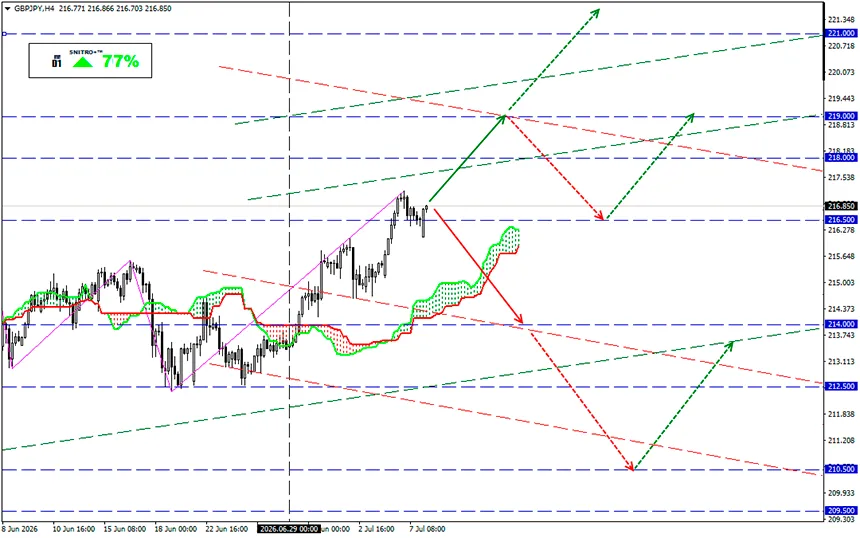
GBP/JPY
Key zone: 215.80 - 217.00
Buy: 217.50 (on a decisive break of 216.00); target 219.50-221.00; StopLoss 216.80
Sell: 215.50 (on strong negative fundamentals) ; target 214.00-212.50; StopLoss 216.20
While most market participants remain focused on the prospects of Federal Reserve rate cuts and the performance of U.S. technology companies, a new growth story is unfolding in Asia. The weakening Japanese yen continues to support shares of the country's largest exporters, allowing the Nikkei 225 to outperform most regional equity markets.
At the same time, the Japanese currency remains near multi-decade lows against the U.S. dollar despite the Bank of Japan's gradual monetary tightening and rising government bond yields.
Reminder:
Japan's economic model continues to rely heavily on exports. Automakers, manufacturers of industrial equipment, electronics, robotics, and semiconductors generate a significant share of their revenue outside the country. When the yen depreciates, overseas earnings automatically become larger once converted back into the domestic currency.
For investors, this means higher expected corporate profits without any significant increase in physical sales volumes. That is why every meaningful weakening of the yen is typically accompanied by upward revisions to corporate earnings forecasts and higher analyst price targets.
- Despite volatility across global markets, the USD/JPY exchange rate remains around 161–162 yen per dollar, placing the Japanese currency near its weakest level in almost 40 years.
- At the same time, the Nikkei 225 reached a new all-time high during the first half of 2026, surpassing 73,000 points. Even after its correction, the index continues to trade above 65,000 points, representing growth of approximately 66% compared with the same period last year.
- The Bank of Japan is gradually moving away from its era of ultra-loose monetary policy and has already raised its benchmark interest rate. Nevertheless, the national currency continues to face downward pressure.
- Even after the rate hike, Japanese assets still offer lower yields than comparable U.S. assets. As long as this yield differential persists, global investors continue allocating capital to dollar-denominated instruments, supporting demand for the U.S. dollar.
- Japan's current account surplus from trade transactions fell to approximately ¥6.9 billion in May, significantly weakening the natural support for the national currency.
- Yields on 10-year Japanese government bonds remain near their highest levels in roughly 30 years, reflecting investors' concerns about the country's public finances.
A weaker yen benefits not only exporters but also international investment funds:
- Corporate earnings continue to demonstrate solid growth thanks to favorable exchange rates.
- Many Japanese companies continue implementing large-scale share buyback programs, increasing dividend payments, and improving corporate governance.
These structural improvements have become one of the main reasons why global investment funds continue to show strong interest in Japanese equities.
Another factor supporting the weak yen is the continued expansion of carry trade strategies. As long as interest rates in Japan remain significantly lower than those in the United States, investors continue borrowing in yen and investing the proceeds in higher-yielding dollar-denominated assets.
At the same time, part of those profits is reinvested into Japanese equities—particularly export-oriented companies—strengthening the correlation between a weak yen and a rising stock market.
What does this mean?
In the coming weeks, GBP/JPY may become an even more informative instrument than USD/JPY. The pair is trading in the 215–216 range, close to its highest levels of the past decade. In reality, the market continues buying the British pound not so much because of the strength of the U.K. economy, but rather because of the persistent weakness of the yen.
As long as USD/JPY remains above 160, the bullish trend in GBP/JPY retains solid fundamental support. However, at the first signs of yen appreciation, this cross is likely to become one of the first where investors begin taking profits on a large scale.
So we act wisely and avoid unnecessary risks.
Profits to y’all!


