













A new trade war threatens global markets
The EU creates a fund to reduce strategic risks
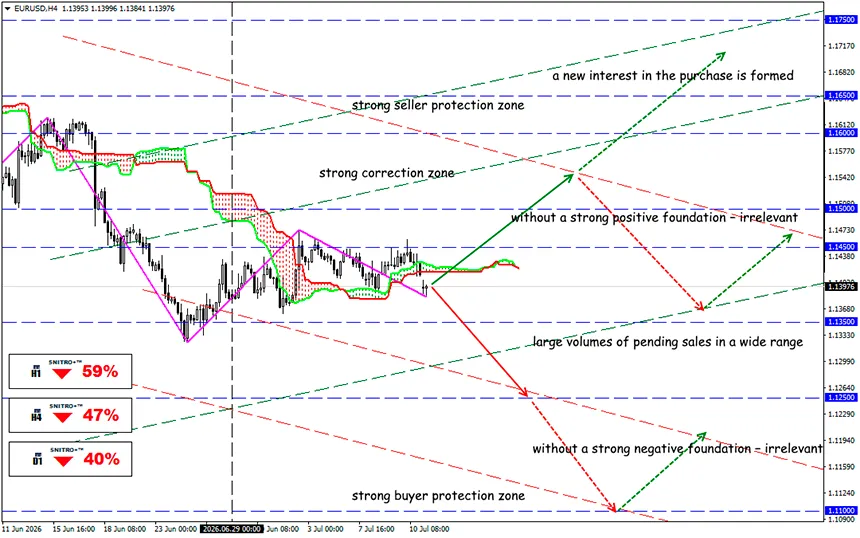
EUR/USD
Key zone: 1.1350 - 1.1450
Buy: 1.1500 (on a decisive break of 1.1450) ; target 1.1650; StopLoss 1.1440
Sell: 1.1350 (on strong negative fundamentals) ; target 1.1200-1.1150; StopLoss 1.1410
Europe is preparing to shield its industrial sector from Chinese imports, but Beijing has already demonstrated its ability to respond asymmetrically—through critical raw materials, agriculture, and access to its domestic market for European companies.
Trade tensions between the European Union and China are intensifying. Brussels is building an institutional framework designed to reduce Europe's dependence on Chinese technology, industrial components, and critical raw materials. The cornerstone of this strategy is the European Competitiveness Fund (ECF).
Reminder:
The European Commission has proposed allocating €234 billion to the ECF under the EU's 2028–2034 budget. Together with the Horizon Europe program, total funding for strategic technologies, industrial scaling, and research is expected to reach €409 billion. The proposed seven-year EU budget amounts to nearly €2 trillion. The Fund is scheduled to launch on January 1, 2028, provided the proposal is approved by the European Parliament and the Council of the European Union. However, if tensions escalate, implementation could be accelerated.
- Formally, the ECF is not described as a "China protection fund." Instead, the EU aims to create a financial buffer for industries that could be harmed either by low-cost Chinese imports or by retaliatory measures from Beijing.
- The economic foundation of the conflict is the rapidly widening trade imbalance. In 2025, the EU exported €199.6 billion worth of goods to China, while imports reached €559.4 billion. The resulting trade deficit totaled €359.8 billion, or nearly €986 million per day on average.
- Over the past year, European exports to China declined by 6.5%, while imports from China increased by 6.4%. Compared with 2015, EU exports have grown by 37.1%, whereas Chinese exports to Europe have surged by 89%. During the first quarter of 2026, the trade deficit reached €98 billion, the highest quarterly figure since the third quarter of 2022.
In 2025, the EU imported approximately 7,100 tonnes of rare earth elements directly from China, accounting for 46.8% of total imports. Another 25.9% came from Russia and 23.1% from Malaysia. Over the past three years, China has expanded export restrictions to include graphite, gallium, germanium, tungsten, bismuth, rare earth elements, batteries, and equipment used for processing rare earth materials.
Companies at greatest risk
- European automakers with significant sales exposure to China and substantial local manufacturing operations, including Volkswagen, Mercedes-Benz, and BMW.
- Luxury goods and premium alcoholic beverage producers, including LVMH, Rémy Cointreau, and Pernod Ricard.
- Agricultural producers, with pork, dairy products, and high value-added food manufacturers facing the greatest direct exposure.
An escalation of the trade conflict would be negative for the euro. Reduced exports to China would weaken the trade balances of several EU member states, slow industrial production, and increase pressure on the European Central Bank to pursue a more accommodative monetary policy.
If the Chinese market continues replacing European products with domestic alternatives, EUR/USD could develop a structural discount reflecting the weakening competitiveness of European industry.
The moderate scenario assumes continued negotiations, pricing commitments by Chinese exporters, and greater localization of Chinese manufacturing within the EU. This would reduce the likelihood of direct tariffs while intensifying competition for European subsidies and advanced technologies.
What does this mean?
For financial markets, the primary risk lies in the mismatch of timing. China can introduce export licensing requirements or sector-specific tariffs within a matter of weeks. Europe, meanwhile, is unlikely to implement meaningful countermeasures for at least another year and a half.
The ECF reduces Europe's long-term strategic vulnerability but does little to eliminate the short-term risk of Chinese retaliation. Traders will increasingly have to evaluate European assets not only on corporate earnings, but also on three key variables: exposure to Chinese revenues, dependence on Chinese components, and access to European government subsidies.
The real EU-China trade war has not yet been officially declared. But markets are already placing their bets on who will ultimately bear the cost of preparing for it.
So we act wisely and avoid unnecessary risks.
Profits to y’all!


