



Stocks vs CFDs: Owning the Asset or Trading the Price

The same stock can be used in different ways. For example, you can buy it through a broker and become the owner of the security. Or you can open a CFD on that stock and get a result from changes in its price without buying the asset itself.
The same stock can be used in different ways. For example, you can buy it through a broker and become the owner of the security. Or you can open a CFD on that stock and get a result from changes in its price without buying the asset itself.
But in one case, the investor actually owns the stock and may be entitled to dividends and voting rights. In the other, they only have a position on the price movement.
Let's look at the difference between stocks and CFDs, how both options work, and why looking only at the price chart is not enough.
What Happens When You Buy a Stock
When an investor buys a stock, they acquire a stake in the company. And the security remains in their portfolio regardless of what happens to its price. This is an important point: the price changes, but that does not mean the investor stops being the owner of the stock.
For example, if a stock falls from $100 to $80, the investor still owns the same security. Their position is simply worth less. Until the investor sells the security, such a loss is considered unrealized.
The stock itself does not have a predetermined expiration date after which the position must be closed. The investor can sell the security after a day, a month, or several years — as long as it continues to trade on the market and the broker allows the transaction.
In addition to price changes, the owner may receive other benefits. For example, dividends, if the company decides to pay them. Some classes of shares also provide the right to participate in shareholder voting.
With a regular purchase, the investor receives the asset itself, not just the result of changes in its price.
What Happens When Trading Stock CFDs
CFDs work differently.
The trader does not buy the stock itself — they open a position whose result depends on the difference between the opening and closing prices of the trade.
For example, a stock is priced at $100. The trader opens a CFD position expecting the price to rise and closes the position at $110. The difference is $10 per contract before trading costs. If the price had instead fallen to $90, the result would have been negative — minus $10 per contract.
Therefore, when trading CFDs, not only the direction of the price movement matters, but also the size of the open position.
At the same time, the trader does not become the owner of the stock. They do not own the security itself, a stake in the company, or shareholder rights.
This is the main difference between CFDs and stocks. The other differences follow from this: dividends, voting rights, costs, and leverage.
We explained how such contracts work in more detail in the articles CFD Demystified and What Is a Stock CFD.
Asset Ownership
When buying a stock, the investor owns the security. When trading a CFD, they do not. The trader only gets a position whose result depends on changes in the value of the underlying asset.
As long as you look only at the chart, the difference is barely noticeable. But it quickly becomes apparent when it comes to dividends, voting rights, costs, and the duration of the trade.
For example, a stockholder may be entitled to company distributions or participate in corporate decisions if the particular class of shares provides such rights.
CFDs do not provide such opportunities because the trader does not own the asset itself.
Essentially, in one case a person owns part of a business, while in the other they are working only with changes in the market price.
Dividends
A stockholder may receive dividends if the company decides to pay them and the conditions for receiving the payment are met.
For example, the board of directors recommends dividends, shareholders approve their amount, and then the company determines the date used to identify the holders of the securities. If the investor meets the conditions, the money is credited to the account.
With CFDs, there are no actual dividends because the trader does not own the stock itself. Instead, the broker may make a dividend adjustment. For a long position, it is usually credited, while for a short position, it is debited. The exact calculation procedure depends on the broker's terms.
In monetary terms, the result may be similar, but the mechanism is different: a shareholder receives dividends, while a CFD holder receives an adjustment under the contract.
This is important if the investor is counting not only on the stock rising but also on dividends.
Leverage
Regular stocks can be purchased entirely with your own money.
For example, if ten shares cost $1 000, the investor deposits $1 000 and receives the securities. Margin trading in stocks also exists, but that is a separate arrangement with a broker.
CFDs are margin instruments. To open a position, the trader may need only a portion of its full value.
Suppose a CFD position is $1 000, and $500 of the trader's own funds are required to open it. If the underlying stock changes in price by 10%, the result on the position will be $100 before costs.
Relative to the $500 deposited, that is already 20%.
Leverage amplifies the result in both directions: both profit and loss. If the market moves in the desired direction, potential profit increases faster. If the forecast turns out to be wrong, the loss also increases faster.
Therefore, the same price movement affects an investor holding stocks and a trader using CFDs differently.
An investor who bought a stock with their own money will see the value of the position change by the same 10%. For a trader who used margin, this movement may represent a much larger share of their own funds in the account.
Therefore, comparing the two instruments based only on the final price movement is not entirely correct.
Price Rises and Falls
With a regular stock purchase, the most straightforward scenario looks like this: buy the security at a lower price and sell it at a higher price.
It is also possible to profit from a decline, but short selling stocks is more complicated. It usually requires borrowing securities from a broker, while the ability to open such a position depends on the specific instrument and service conditions. In addition, not all stocks are available for short selling. Restrictions may apply in certain markets or to certain securities.
With CFDs, opening a trade on a price decline is usually easier.
If the trader expects the price to rise, they open a long position. If they expect it to fall, they open a short position. In the latter case, they do not need to buy the stock itself first. The result depends on how much its price changes and whether the market movement matches the forecast.
For example, if a CFD position is opened expecting a decline at a price of $100 and the quote then falls to $90, the $10 difference may generate a profit before costs. If the price rises to $110 instead of falling, the result will be negative.
We explained this mechanism in more detail in the article Long and Short in CFD Trading.
Trading Costs
It cannot be said in advance that stocks are always cheaper than CFDs or vice versa: everything depends on the terms of the trade.
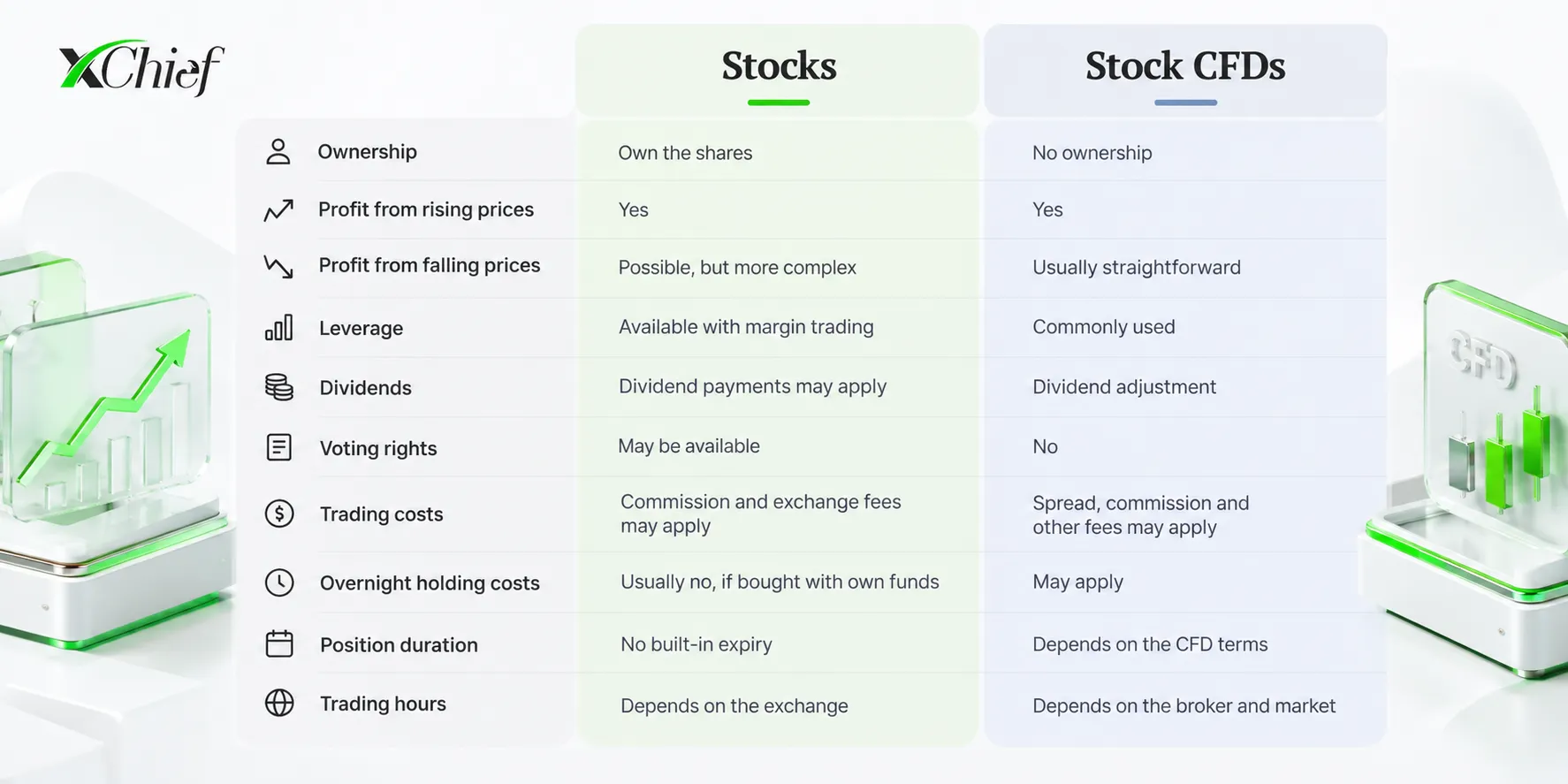
Some trading costs arise immediately when the trade is opened. For example, the spread affects the result as soon as the position is entered. A trading commission may also be charged when opening or closing the trade.
Other costs depend on time. If a CFD remains open into the next trading day, a rollover fee may be charged. Therefore, a trade held for several hours and a position kept open for several weeks may differ significantly in their final cost. The longer the position remains open, the more important its rollover costs become. An investor who bought stocks with their own money usually does not pay simply for continuing to own them. With CFDs, rollover costs may gradually accumulate.
This is why it is not enough to compare only the commission for opening a trade.
You need to look at the total cost of the position: how much it costs to enter, how much it costs to hold, whether currency conversion applies, and what additional fees are charged by the broker.
Trading Hours
Regular stocks are traded according to the schedule of the exchange on which they are listed.
For example, U.S., European, and Asian exchanges have their own trading hours. In some markets, trades are also available before the main trading session opens and after it closes. But this does not mean that every stock can be bought or sold at any time of day.
For CFDs, the schedule is determined by the broker. It is often linked to the trading hours of the underlying asset but may differ. Therefore, a CFD on a U.S. stock cannot necessarily be bought or sold around the clock simply because the contract itself is traded over the counter. Before making a trade, it is better to check the schedule of the specific instrument. This is especially important before earnings releases, corporate events, or other news that may sharply affect the price.
Voting Rights
Some stocks give their owners the right to participate in voting on company matters.
For example, shareholders may vote for members of the board of directors or on other corporate decisions. The specific rights depend on the class of shares.
A CFD holder does not have this right. The reason is simple: they are not a shareholder and do not own the security itself. If it is important for an investor to be a shareholder and participate in voting, CFDs do not provide this.
Stocks vs CFDs: Key Differences
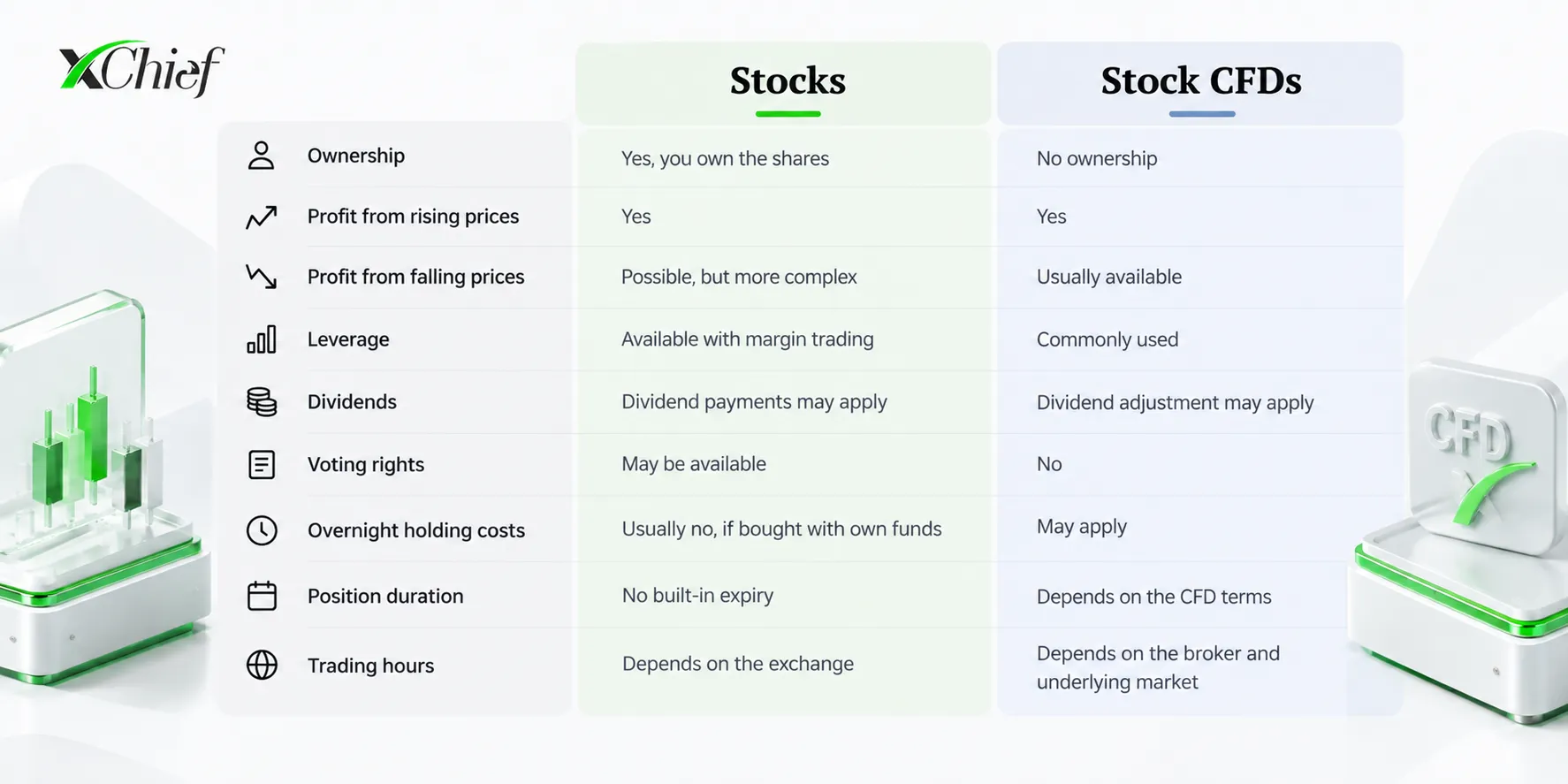
A Simple Example
Suppose a company's stock is priced at $100.
An investor buys 10 shares and spends $1 000.
The price rises to $110 — the entire position is now worth $1 100. The increase in the value of the position is $100.
At the same time, the investor owns the stocks themselves. If the company pays dividends, they may receive them. And if the class of shares provides voting rights, they may participate in shareholder voting.
Now suppose a trader opens a CFD on the same 10 shares.
The position size is also $1 000, but thanks to leverage, only a portion of this amount may be required to open it.
If the stock price rises from $100 to $110, the result from the price movement will also be $100 before trading costs. But the trader will not own the stocks themselves. They do not become the owner of a stake in the company and do not receive shareholder rights. Their financial result is determined by the price movement and the terms of the CFD itself.
The difference becomes even more noticeable if the price moves in the other direction.
Suppose the stock falls from $100 to $90.
For the owner of ten shares, the value of the portfolio will decrease from $1 000 to $900.
With a CFD, the price movement will produce the same $100 loss on the position, but if only $500 of the trader's own funds were used to open it, this result will already amount to 20% of the amount deposited.
This is why the same price movement does not necessarily mean the same risk.
What Stocks and CFDs Are Used For
Stocks and CFDs may be linked to the same company, but they are usually used differently.
Buying stocks is suitable when owning the security itself is important. For example, an investor plans to hold the asset for a long time, receive dividends, or simply wants to own a stake in the company.
CFDs are more often used for trading price movements. The trader does not need to own the asset — the direction of the price, position size, and timing of entry and exit are more important. CFDs also make it easier to trade falling markets and use leverage. But this flexibility has a downside: financing costs and a stronger impact of price movements on the account.
Therefore, the same forecast can be implemented in different ways. For example, if a person believes that a stock will rise over several years, one set of parameters will be important. If they expect a price movement over the next few days, the relevant factors will be different.
There is no universally better option here. Therefore, before making a trade, it is important to understand what you own, how much you pay, and what risk you take.
Main Risks of Stocks
Stocks can fall significantly in price.
Prices are affected by the company's financial condition, the situation in the industry, the state of the economy, news, and overall market sentiment.
If an investor buys stocks without leverage, their main risk is related to the value of the funds invested. The more the stock price falls, the less their position is worth.
At the same time, long-term ownership by itself does not protect against losses.
The price may not recover quickly or may not recover at all. The company may face serious problems, undergo restructuring, be delisted, or, in an extreme case, go bankrupt.
In addition, an individual stock carries the risk of the specific business.
Even if the market as a whole is performing well, problems at one company may lead to a significant decline in its shares.
Therefore, the absence of leverage does not mean the absence of risk.
Main Risks of CFDs
With CFDs, the effect of leverage is added to the usual market risk.
Because of this, even a relatively small price movement can significantly affect the account.
For example, if a trader deposited $500 to open a position of $1 000, a 10% decline in the underlying asset will result in a $100 loss before costs. This is already 20% of the amount used to open the position.
If the market continues to move against the trader, the amount of free funds in the account will decrease. At a certain point, a Margin Call or Stop Out may be triggered in accordance with the broker's terms.
There is another factor — time. Many stock CFDs do not have a predetermined expiration date, so the position can be left open for more than one trading day. But rollover may cost money. The longer the trader holds such a position, the more accumulated costs may affect the final result.
In addition, during a sharp market movement, the price may change faster than the trader expected. Therefore, position size and the use of leverage are particularly important for risk management.
Thus, the underlying asset may be the same, but the consequences of its price movement for the account will be different.
Key Takeaways
Stock trading and CFD trading may start with the same chart, but from there their paths diverge.
When buying a stock, the investor receives the asset itself. They can hold it for a long time, receive dividends, and in some cases participate in shareholder voting.
When trading CFDs, the trader does not own the stock itself. However, they can use leverage and more easily open positions on a price decline.
Along with these opportunities come additional costs and risks.
Therefore, when comparing stocks and CFDs, it is important to look not only at the direction of the price. The difference between CFDs and stocks also includes ownership rights, required capital, trading costs, the ability to open a short position, and the impact of leverage.
In other words, the question is not only where the trader believes the price will go. Equally important is which instrument they intend to use to implement this idea and what will happen to the account after the trade is opened.
FAQ
How Do CFDs Differ From Regular Stocks?
The main difference is asset ownership.
When buying a stock, the investor becomes the owner of the security. When trading CFDs, the trader does not own the stock itself: they receive a financial result from changes in its price. This leads to other differences — in dividends, voting rights, the use of leverage, and trading costs.
Can You Receive Dividends on Stock CFDs?
Actual dividends are received by the stockholder.
With CFDs, a dividend adjustment may be made instead. For a long position, it is usually credited, while for a short position, it is debited. The exact procedure and amount depend on the broker's terms.
Can You Trade CFDs Without Leverage?
CFDs are margin instruments: to open a position, the trader deposits a portion of its full value. The required margin and available leverage depend on the instrument and the broker's terms. At the same time, profit and loss are calculated based on the size of the entire position, not only the amount deposited.
Can You Profit From Falling Stocks Without CFDs?
Yes. One way is short selling stocks. This usually requires borrowing the securities from a broker, and the availability of the trade depends on the specific stock and service conditions.
With CFDs, the ability to open a position on a price decline is usually built into the mechanics of the instrument itself.
Can You Hold CFDs for a Long Time?
Many stock CFDs do not have a predetermined expiration date, so a position can be left open for more than one trading day.
But this does not mean that it can be held indefinitely at no cost. Financing costs may be charged for carrying the position, and over time they affect the final result. The terms of a specific CFD should be checked with the broker.
Which Is Riskier — Stocks or CFDs?
Both instruments involve risks, but they work differently.
With a regular purchase of stocks without leverage, the result depends primarily on changes in the value of the security.
CFDs use margin trading, so leverage can amplify both profits and losses.
Therefore, risks should be compared taking into account the position size, leverage, trade duration, and the terms of the specific instrument.


