



Margin Call vs Stop Out: What Happens When There Is Not Enough Margin

When trading CFDs, you do not need to deposit the full value of the trade — only a part of it is required. Thanks to leverage, you can open a position worth more than the amount available in your account.
When trading CFDs, you do not need to deposit the full value of the trade — only a part of it is required. Thanks to leverage, you can open a position worth more than the amount available in your account.
This makes it possible to open a large position even with a relatively small account. But the larger the trade size relative to the deposit, the more noticeably any price movement affects the account. If the market moves against the trader, the loss grows and the amount of free funds becomes smaller and smaller.
At some point, the account may reach a Margin Call, and if the loss continues to grow — a Stop Out. These terms are often used together, so they are easy to confuse. But they work differently: a Margin Call indicates that almost no free funds remain, while a Stop Out already results in the automatic closing of positions.
Let's look at what margin is, how free margin differs from used margin, how the margin level is calculated, and what happens to the account when funds become insufficient.
What Is Margin
Margin is the part of the money in the account that is required to open and maintain a leveraged position.
Imagine that a trader wants to open a position worth 10 000 $, but uses leverage of 1:10. The trader does not need to have the full 10 000 $ in the account; the trade will require about 1000 $ of their own funds.
These 1000 $ will be the margin.
Important: margin is not a broker's commission and not a fee for the trade. The money does not "disappear" from the account. It simply becomes tied up in the open position.
While the trade is open, this amount cannot be freely used for other operations.
The margin amount depends on several factors:
- position size;
- leverage;
- trading instrument;
- account type;
- the requirements of the specific broker.
For example, the requirements for a currency pair and a stock index may differ. Sometimes a broker increases margin requirements before important news or during periods of high volatility.
Therefore, the leverage value alone is not enough — it is also important to check the conditions for the specific instrument.
We explained in more detail how CFDs work in general in the article "What Is CFD Trading and How Does a Contract for Difference Work".
Balance and Account Equity Are Not the Same Thing
Here it is important not to confuse two indicators: balance and current account equity.
Balance takes into account only completed transactions.
Suppose a trader deposited 1000 $ and has not closed anything yet. The balance remains 1000 $. But imagine that there is currently an open losing position of −300 $. The balance will still be 1000 $, because the trade has not yet been closed. At the same time, the current value of the account is already lower — 700 $.
This indicator is called Equity — it is the current value of the account, taking into account profit and loss on open trades.
So:
Account equity = balance + current profit − current loss
If an open position shows +200 $, with a balance of 1000 $, the account equity will be 1200 $.
If the position shows −300 $ — then 700 $.
It is Equity that is used to calculate the margin level. Margin Call and Stop Out depend not on what is shown in the "Balance" line, but on the current state of the account, including open trades.
Because of this, the balance may look normal even when the account is already approaching a critical margin level.
Used and Free Margin
Two more indicators are related to margin.
Used Margin is the part of the money that is already tied up in open positions.
For example, a trader has three trades:
- the first requires 200 $ of margin;
- the second — 150 $;
- the third — 250 $.
The total used margin will be:
200 + 150 + 250 = 600 $
This money is required to maintain the current positions.
Free Margin is the money that is not currently tied up in open positions.
It is calculated as follows:
Free Margin = account equity − used margin
Imagine:
- balance — 1500 $;
- current loss — 300 $;
- account equity — 1200 $;
- used margin — 600 $.
Then:
Free Margin = 1200 − 600 = 600 $
These 600 $ are still free.
They can be used for new trades, and they also serve as a reserve in case of losses.
The smaller the free margin, the faster further losses may lead to a Margin Call.
Why Free Margin Can Run Out Quickly
In a calm market, 500 or 600 $ of free margin may seem like a large reserve. But everything depends on the size of the open positions.
Imagine two accounts.
Both have free margin of 500 $.
The first has a position of 1000 $ open.
The second — 20 000 $.
The free margin is the same, but the same price movement will affect the accounts differently:
- in the first case — about 10 $;
- in the second — about 200 $.
On the second account, free margin will decrease much faster.
Therefore, looking only at free margin is not enough. It should be considered together with position size and margin level.
What Is Margin Level
Margin Level shows the ratio of the current account value to the margin tied up in open positions.
Formula:
Margin Level = account equity / used margin × 100%
For example:
- account equity — 1000 $;
- used margin — 400 $.
We get:
1000 / 400 × 100% = 250%
That means that for every 1 $ of used margin, there is 2.5 $ of current account value.
The higher the margin level, the farther the account is from Margin Call and Stop Out.
If trades move into a loss, account equity decreases. Used margin may remain unchanged. Therefore, the margin level begins to fall.
For example:
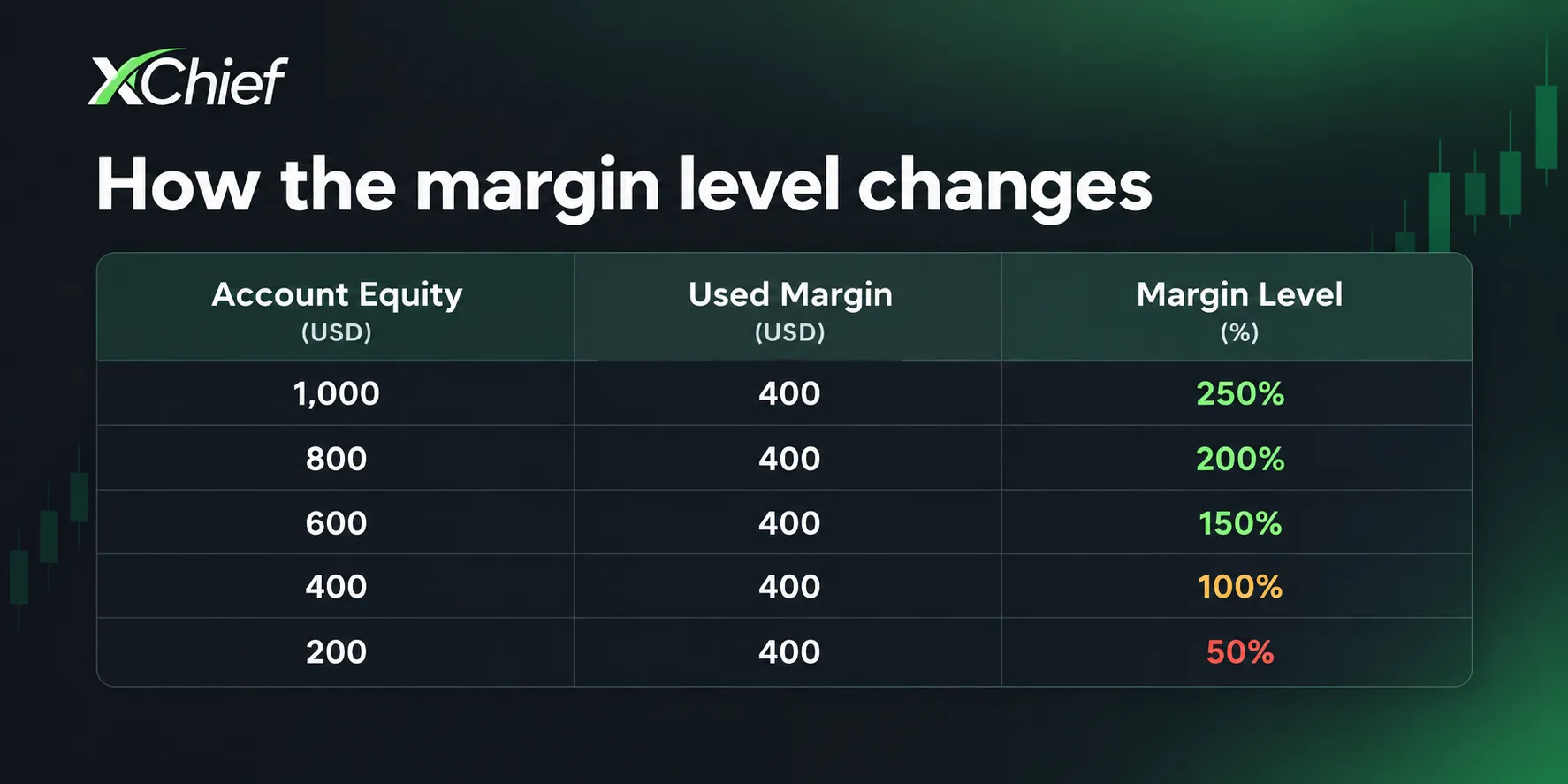
It is the margin level that shows how close the account is to Margin Call or Stop Out.
Why You Should Not Rely Only on the Balance
Relying only on the balance is a common mistake among beginners.
Suppose the terminal shows:
- balance — 2000 $;
- current loss — 1200 $.
Based on the balance, it may seem that there are still 2000 $ in the account, but for the margin level calculation, what matters is no longer 2000 $, but 800 $:
2000 − 1 200 = 800 $
If the used margin is 600 $, then the margin level is:
800 / 600 × 100% = 133%
So the account may already be quite close to a Margin Call, even though the balance still looks large.
Therefore, when trading with leverage, it is better to look at several indicators at once: balance, current profit or loss, free margin, and margin level.
What Is a Margin Call
Margin Call means that too little money remains to maintain open positions.
The term itself originated in the days when a broker could actually call a client and ask them to deposit additional funds. Hence the word Call — "call." In modern online trading, no one usually calls. Today, Margin Call generally means a warning in the terminal or a restriction on opening new trades.
For example, a broker has set the Margin Call level at 100%.
If:
- account equity — 400 $;
- used margin — 400 $,
then:
400 / 400 × 100% = 100%
Free margin in this case is zero:
400 − 400 = 0 $
That means there is no free margin left. If the market continues to move against the trader, the margin level will continue to fall.
What Happens After a Margin Call
After a Margin Call, positions do not necessarily close immediately. What happens next depends on the broker's conditions:
- a warning appears;
- it may become impossible to open a new position;
- some operations may be restricted;
- the trader may be able to close part of the trades;
- the account can be funded to increase the margin reserve.
If the market reverses in the trader's favor, the loss decreases and the margin level rises again.
But relying only on a price reversal is risky. If the market continues moving against the open positions, the margin level falls further and the account approaches Stop Out.
Can You Recover From a Margin Call
Yes. Imagine that the margin level has fallen to 100%, while Stop Out is set at 50%. The margin level can be restored in several ways.
For example, the trader can close part of the positions. Then the used margin will decrease.
Suppose:
- account equity — 400 $;
- used margin — 400 $;
- margin level — 100%.
After closing one trade, the used margin decreased to 250 $.
Then:
400 / 250 × 100% = 160%
The margin level has recovered.
Another option is to fund the account.
If 300 $ is added, account equity will increase to 700 $:
700 / 400 × 100% = 175%
The margin level can also recover on its own if the market reverses and the loss decreases. But everything here depends on price movement, so simply waiting for the market to reverse is not a method of risk management.
What Is Stop Out
Stop Out occurs when the margin level falls to a critical threshold and the broker begins forcibly closing positions.
If a Margin Call still gives the trader time to react, then at Stop Out the system intervenes automatically.
Imagine:
- Stop Out — 50%;
- account equity — 200 $;
- used margin — 400 $.
Then:
200 / 400 × 100% = 50%
The margin level has fallen to the Stop Out level — the broker begins automatically closing positions. This releases part of the margin and reduces the load on the account.
What Happens to the Account During Stop Out
Suppose a trader has several open positions.
The used margin on them is 400 $.
Account equity has fallen to 200 $.
Margin level:
200 / 400 × 100% = 50%
Stop Out is triggered. The broker closes one of the positions. After that, the used margin decreases, for example, to 250 $.
Now:
200 / 250 × 100% = 80%
The margin level is again above Stop Out. Automatic closing may stop at this point. But if the market continues to move against the remaining positions and account equity falls again, Stop Out may be triggered once more.
As a result, the broker may close not one, but several trades.
Which Position Is Closed First
There is no single rule for all brokers here.
Some brokers close the position with the largest loss first.
Others close the position that releases more margin.
In some cases, the order depends on the rules of the trading platform.
Therefore, it is better to check the broker's conditions in advance. You should not assume that the system will necessarily preserve the "most promising" position or close exactly the trade that the trader would personally want to close first.
Stop Out works automatically and does not take the trader's trading idea into account.
Margin Call vs Stop Out: What Is the Difference
Both events are related to insufficient margin, but they occur at different stages.
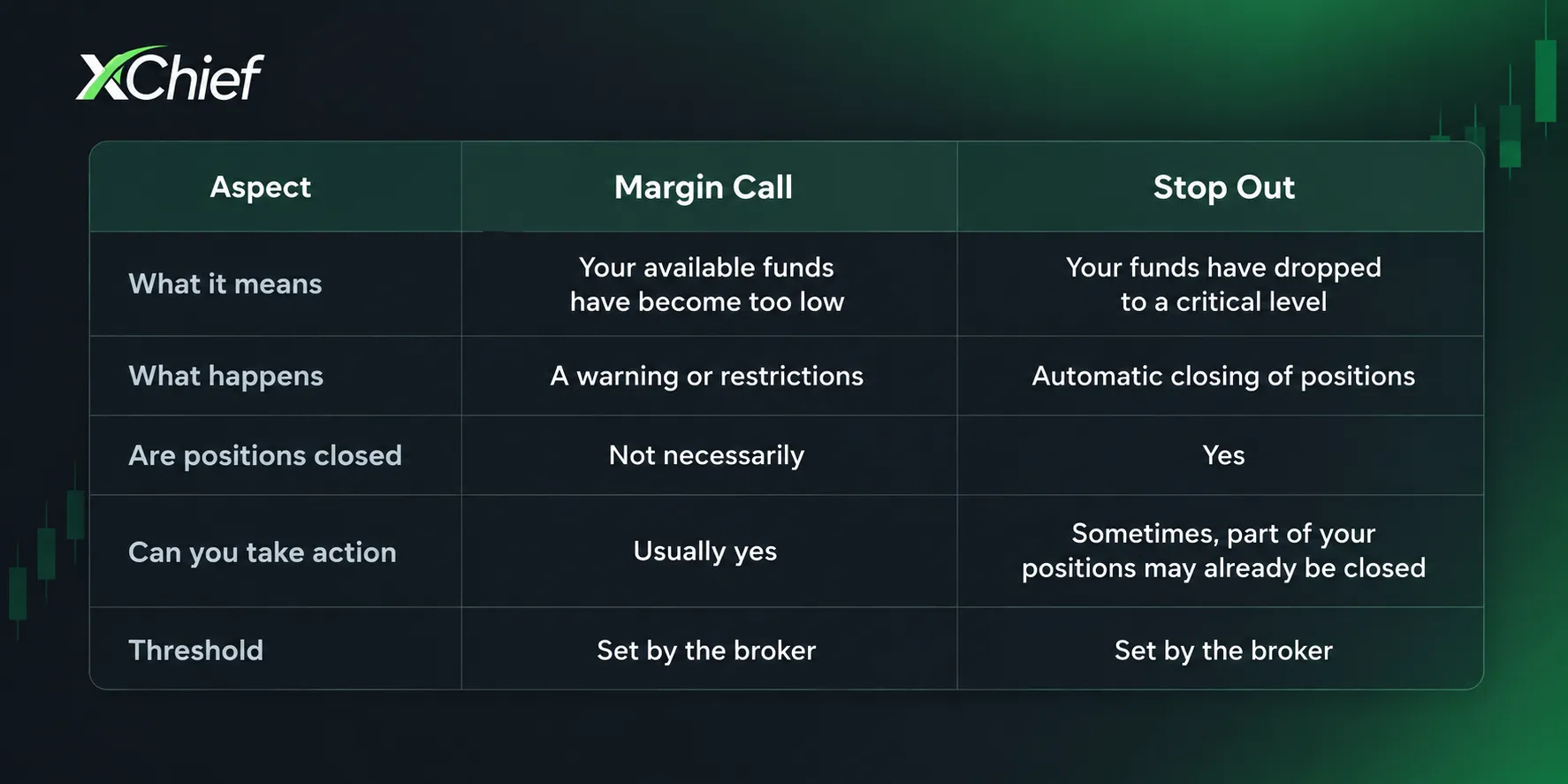
In very simple terms:
Margin Call is a warning. Stop Out is already an action.
First, the account approaches a critical level. If the loss continues to grow, the system begins automatically closing positions.
Example: How the Margin Level Falls From 250% to Stop Out
Let's look at one example of how the account changes. The trader has:
- balance — 1000 $;
- used margin — 400 $;
- Margin Call — 100%;
- Stop Out — 50%.
For simplicity, imagine that the trader does not open any new trades and that the used margin remains unchanged until Stop Out.
Step 1. No Loss
- Account equity: 1000 $
- Free margin: 1000 − 400 = 600 $
- Margin level: 1000 / 400 × 100% = 250%
Margin Call is still far away.
Step 2. Loss Increased to 200 $
- Account equity: 800 $
- Free margin: 800 − 400 = 400 $
- Margin level: 800 / 400 × 100% = 200%
The account is still far from the critical level.
Step 3. Loss Increased to 400 $
- Account equity: 600 $
- Free margin: 600 − 400 = 200 $
- Margin level: 600 / 400 × 100% = 150%
200 $ of free margin remains.
Step 4. Loss Increased to 600 $
- Account equity: 400 $
- Free margin: 400 − 400 = 0 $
- Margin level: 400 / 400 × 100% = 100%
In our example, this is the Margin Call level.
Step 5. Loss Increased to 800 $
- Account equity: 200 $
- Margin level: 200 / 400 × 100% = 50%
At this level, Stop Out is triggered, and the broker begins forcibly closing positions.
Important: the 100% and 50% levels are used only as examples. A real broker may use different levels.
What Are Margin Requirements in CFD Trading
Margin requirements in CFD trading determine how much money is required to open and maintain a position.
They may include:
- the required margin amount;
- maximum leverage;
- Margin Call level;
- Stop Out level;
- separate requirements for different instruments;
- higher requirements during certain periods.
For example, a broker may offer higher leverage for one currency pair and lower leverage for a stock or cryptocurrency. Requirements may differ because different instruments have different levels of risk and volatility.
The more sharply the price can move, the larger the reserve of funds that may be needed. Therefore, before opening a trade, it is useful to look not only at the available leverage, but also at the margin requirements for the specific instrument.
Can a Broker Change Margin Requirements
Yes, this is possible.
For example, before the release of important statistics, elections, a central bank meeting, or another event that may increase volatility, a broker may raise margin requirements.
For the trader, this means that the same position may require more margin. Suppose it previously tied up 300 $, but after the conditions change — 500 $. Even if the instrument's price has not changed, free margin will decrease and the margin level will fall.
Therefore, account conditions are better checked not only once during registration. We explained in more detail how a CFD broker works in the article "How the CFD Broker Business Model Works".
How Leverage Brings a Margin Call Closer
Leverage itself does not cause a loss, but it allows a larger position to be opened.
But the larger the position, the more strongly any price movement affects the account.
Suppose two traders each have 1000 $.
- The first opens a position of 1000 $. The second, using leverage — 10 000 $.
- The price falls by 1%.
- The first loses about 10 $. The second — about 100 $.
The price changed by the same amount, but in the second case the loss was ten times greater. If the price falls by another 2–3%, the difference becomes even more noticeable.
Therefore, risk depends not only on the leverage size, but also on the position volume relative to capital.
We examined this mechanism in more detail in the article "Leverage and Volatility: Why Traders Lose Their Deposits".
Why a Margin Call Can Happen Faster Than It Seems
Traders often assess risk based on only one position. For example: "Even if the price falls by 2%, I will lose only 100 $." But there may be several trades open in the account at the same time. If they are correlated, losses may arise on all of them at once.
For example, a trader simultaneously opened positions in oil, shares of an oil company, and the currency of a country that depends heavily on oil exports.
The instruments are different, but the same news may affect all of them at once. As a result, free margin shrinks much faster than the trader expected.
What Else Accelerates the Decline in Margin Level
The margin level can fall faster for other reasons as well.
High volatility. The faster the price changes, the faster the account value can change as well.
Several positions at the same time. Each requires margin and can generate a loss.
Correlated trades. They may look different, but react to the same news.
Increasing a losing position. If a trader keeps increasing the size of a trade that is already in the red, used margin rises at exactly the moment when account equity is falling.
An increase in margin requirements by the broker. This can also reduce the free margin reserve.
How to Reduce the Probability of Stop Out
Stop Out cannot be ruled out completely, but its probability can be reduced.
Keep a reserve of free margin. You should not tie up almost the entire account in open positions.
Do not open an excessively large position. The maximum available volume is a technical limit, not a recommendation.
Take all open trades into account. Even small positions together can place a heavy load on the account.
Do not forget about correlated instruments. Several different trades may move into a loss at the same time because of one piece of news or event.
Limit potential losses in advance. A Stop Loss helps limit losses, although during sharp price movements the execution price may differ from the specified one.
Monitor the margin level. The balance alone does not show how close the account is to a Margin Call.
Check the broker's conditions. Especially Margin Call and Stop Out levels, as well as requirements for the specific instrument.
Take news into account. Volatility can rise sharply before important events.
Do You Need to Fund the Account After a Margin Call
Not necessarily.
Funding is only one of the options. Position size can be reduced by closing part of the trades. This will reduce used margin. Sometimes this has a greater effect on the margin level than a small account deposit.
But the main thing is not to treat funding as an automatic way to "save" a losing position.
If the problem arose because the trade size was too large, an additional deposit will only increase the reserve of funds, but it will not solve the problem of an excessively large position.
Can Stop Out Close All Positions
Yes, if after part of the positions are closed, the margin level still remains too low. But Stop Out does not necessarily reduce the account to zero: after forced closing of trades, some money may remain in it. The final amount depends on the size of the loss, price movement, execution price, and broker conditions.
During sharp price gaps or very high volatility, the final amount may differ from what the trader saw at the moment Stop Out was triggered.
Key Takeaways
Margin Call and Stop Out occur for the same reason: the margin level becomes too low.
Margin Call warns that the reserve is almost exhausted.
Stop Out means that the broker is already beginning to automatically close positions.
To understand how close the account is to a Margin Call or Stop Out, you need to monitor the margin level.
Margin Level = account equity / used margin × 100%
The larger the total position volume relative to capital, the faster a loss may lead first to a Margin Call and then to Stop Out.
FAQ
What Is a Margin Call in CFD Trading?
A Margin Call in CFD trading is the moment when the margin level falls to the value set by the broker.
Usually, this means that there are few free funds left in the account.
What Is a Stop Out in CFD Trading?
Stop Out is triggered when there are no longer enough funds in the account to maintain open positions. The broker begins automatically closing trades to reduce the load on the account.
What Is the Difference Between Margin Call and Stop Out?
A Margin Call gives the trader a signal that the reserve of funds is almost exhausted. Stop Out means that the system is already intervening and forcibly reducing open positions.
At What Level Does a Margin Call Occur?
There is no single value.
With one broker it may be 100%, with another — 80%, 70%, or another level. You need to check the conditions of the specific account.
At What Level Does Stop Out Occur?
This also depends on the broker. For example, Stop Out may be set at 50%, 30%, or another level.
Can a Margin Call Occur If There Is Still Money in the Balance?
Yes.
For calculating the margin level, not only the balance matters, but also the current result of open positions.
The balance may remain at 1000 $, while account equity, taking the current loss into account, has already fallen to 400 $.
Can You Get a Margin Call Without Stop Out?
Yes.
If the trader closes part of the positions, funds the account, or the market reverses in their favor, the margin level may recover.
Then Stop Out will not occur.
What Happens to Positions During Stop Out?
The broker begins closing them automatically.
After each closed trade, used margin decreases. If the margin level recovers, the system may stop. If not, the next positions may be closed.
Which Position Is Closed First During Stop Out?
This depends on the broker and trading platform.
There is no universal rule that the most losing or the largest trade is always closed first.
Can Stop Out Be Avoided?
This cannot be guaranteed, but the risk can be reduced.
To do this, it is important to keep a reserve of free margin, avoid overloading the account with large positions, use leverage carefully, and limit potential losses in advance.
What Are Margin Requirements in CFD Trading?
These are the broker's rules that determine how much money is required to open and maintain a position.
They may include the required margin amount, maximum leverage, Margin Call and Stop Out levels, and separate conditions for different instruments.
Can a Broker Change Margin Requirements?
Yes.
For example, requirements may increase before important news or during periods of high volatility. In that case, already open positions may require more margin.


