



Long and short in CFDs: how to trade rising and falling markets

When an investor buys a stock, the logic is simple: if its price rises, they can make a profit; if it falls, they incur a loss. With CFDs, traders can open positions expecting either a rise or a fall in the market.
When an investor buys a stock, the logic is simple: if its price rises, they can make a profit; if it falls, they incur a loss. With CFDs, traders can open positions expecting either a rise or a fall in the market.
If a trader expects the price to rise, they open a long position — a long (Long). If they expect a decline, they open a short position, or a short (Short). There is no need to buy the asset itself: the result depends on how the price moves between the opening and closing of the trade.
What Is a Long Position
A long position (long) is a trade opened in anticipation of a price increase.
A trader opens a long CFD position if they believe the underlying asset will rise in price. For example, a stock currently costs 100 $, and after some time it may rise to 110 $.
If the price rises, the difference between the opening and closing prices of the trade will generate a profit for the trader. If the market moves downward, a loss will occur.
At first glance, everything looks similar to buying a stock in the usual way. But there is an important difference: when trading CFDs, the trader does not become the owner of the stock itself.
We discussed this in more detail in the article CFD vs Stocks.
How Buying a CFD Works
To open a long position, the trader selects a buy operation.
But buying a CFD and buying the asset itself are not the same thing. The trader does not buy the stock, oil, gold, or another asset itself. They open a contract whose result depends on price movements.
Suppose the quotes look like this:
- selling price — 99,90 $;
- buying price — 100 $.
A long position is usually opened at the buying price — in our example, at 100 $.
To exit the trade, the trader must perform the opposite operation — sell the CFD. The trade will be closed at the current selling price.
The difference between the buying and selling prices is called the spread. Therefore, immediately after opening, the trade may show a negative result equal to the spread, even if the market has barely moved.
For more details on how CFDs work in general, see the article CFD Demystified.
Example of a Long Trade
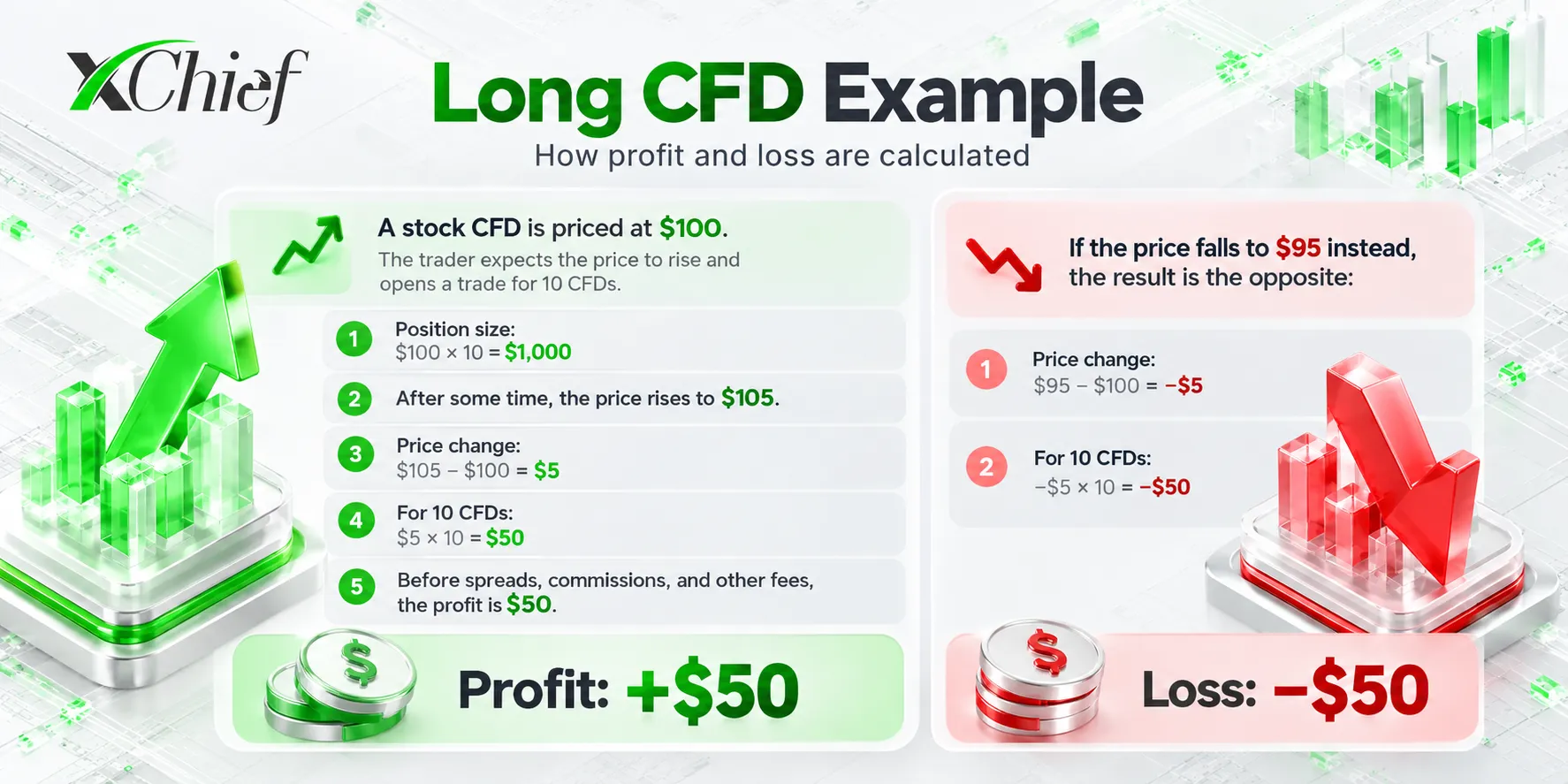
A long position will become profitable only if the price movement covers the trading costs.
What Is a Short Position
A short position (short) is opened in anticipation of a price decline.
Suppose a stock costs 100 $, and the trader expects it to fall to 90 $. In this case, they open a short CFD position.
If the price falls, the position can be closed at a lower price, generating a profit from the difference. If the price rises, there will be a loss.
This often raises a perfectly logical question: how can you sell something you do not own?
How Selling a CFD Works
When selling a CFD, the trader does not sell a stock or another asset that they own.
A CFD is a contract for difference. Therefore, a short trade can be opened immediately, without first purchasing the underlying asset.
To understand how to open a short position using CFDs, it is enough to remember one thing: the position is opened by selling a CFD and closed with the opposite trade — buying. Suppose the quotes look like this:
- selling price — 100 $;
- buying price — 100,10 $.
A short position is usually opened at the selling price. If the market then declines, the position is closed with the opposite trade — at the current buying price.
There is no need to buy or sell the underlying asset itself.
Example of a Short Trade
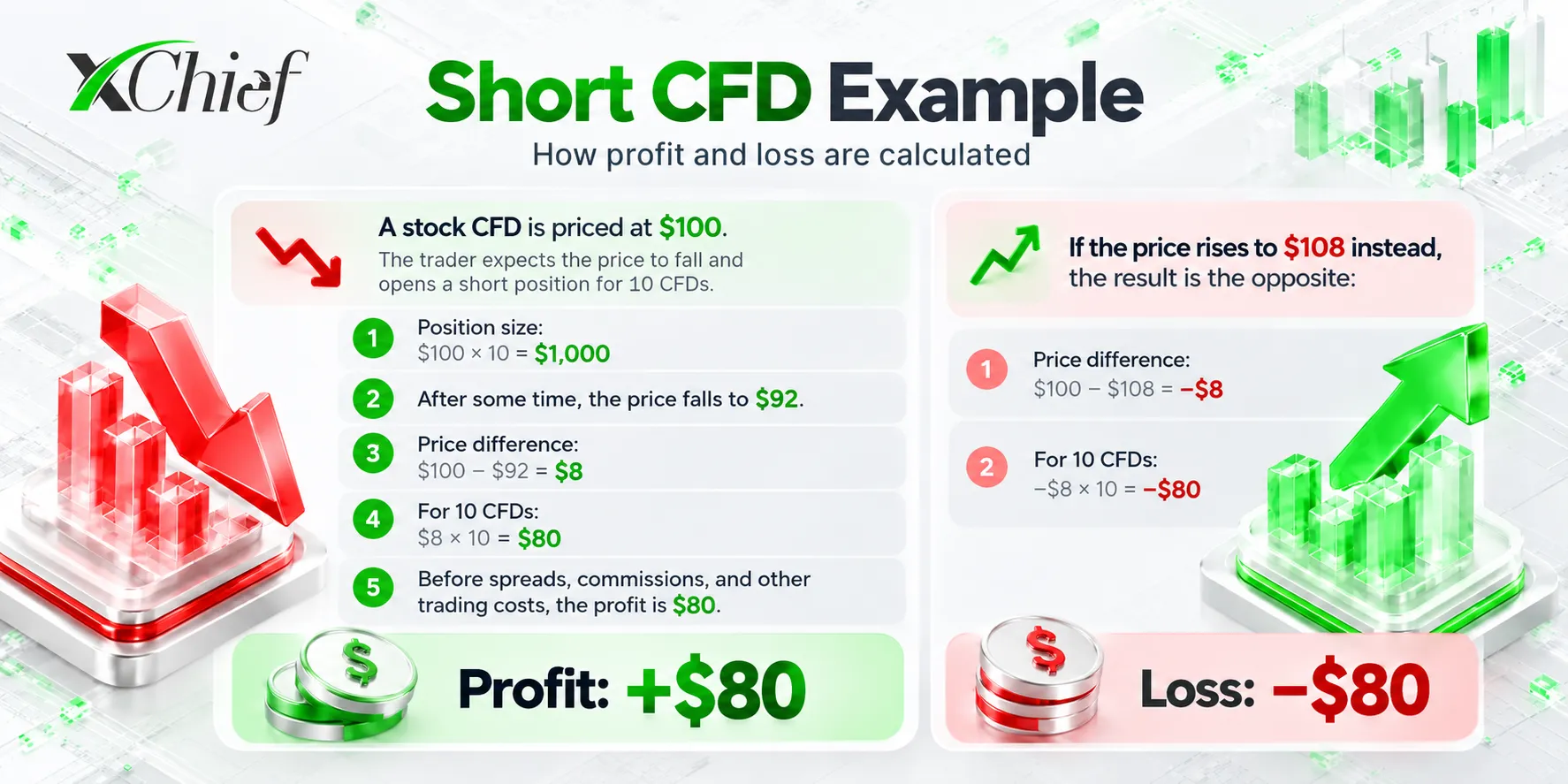
Thus, with a short position, a price decline works in the trader's favor, while a price increase works against them.
How Long and Short Positions Are Closed
The direction of the trade matters not only when opening it but also when closing it. A long position is closed with the opposite operation — selling the CFD. A short position, on the other hand, is closed by buying.
The same operation can work differently here. Buying can open a long position or close a short position. Selling can open a short position or close a long position.
But the underlying asset itself still does not become the trader's property.
Suppose a short position was opened at 100 $, and then the price fell to 94 $. To lock in the profit, the position is closed with the opposite trade.
The difference between 100 and 94 $ will generate a profit before accounting for the spread, commissions, and other costs.
If the position is not closed, its result will continue to change along with the market. The price may fall even further and increase the profit on the short position, or it may reverse and start rising. In that case, the profit will decrease, or the position may even turn into a loss. As long as the trade remains open, the result is not locked in.
Can You Change the Direction of a Trade
Sometimes, after opening a trade, a trader changes their view of the market. For example, they opened a long position expecting a price increase. But then a weak company report was released, the price began to decline, and now the trader believes the decline will continue.
You cannot simply turn an existing long position into a short position. First, you need to close the long position and then, if necessary, open a new one — this time a short position. The same applies to a short position: if the trader now expects a rise, the old position is closed and a new one is opened.
The new trade will have a different opening price. And the profit or loss on the previous trade will already have been realized by that point.
But frequently changing direction is not free either: each opening and closing involves a spread, commission, and other possible costs.
Short Selling CFDs vs Short Selling Stocks: What Is the Difference
Both short selling CFDs and traditional short selling of stocks allow traders to profit from falling prices. But their mechanics are different.
In traditional short selling, an investor usually sells stocks they do not initially own. The securities are borrowed through a broker, and later they must be bought back and returned. If the stocks can be bought back at a lower price than they were sold for, the difference may become a profit. If they rise in price, a loss occurs.
With CFDs, there is no need to borrow the underlying asset. When short selling a CFD, the trader does not receive the stock or sell it on the market. Instead, they simply open a contract based on the price movement.
For example:
- in traditional short selling, a trader may borrow and sell 10 shares;
- when short selling CFDs, they open a trade based on the price movement of the same 10 shares, but they do not own the securities themselves.
A CFD does not provide shareholder rights, such as voting rights. The trader does not receive actual dividends, but the contract terms may provide for a dividend adjustment.
In traditional short selling, the required securities must first be available for borrowing. With CFDs, everything depends on the broker's terms: for some instruments, the broker may restrict short positions or change margin requirements.
Commissions also differ. Therefore, before opening a short position, it is better to check the terms of the specific CFD rather than looking only at the potential price movement.
Long and Short CFDs: How the Trade Result Changes
The difference between a long and a short position is the direction in which the price needs to move.
For a long position:
price rises → the trader makes a profit;
price falls → the trader incurs a loss.
For a short position:
price falls → the trader makes a profit;
price rises → the trader incurs a loss.
Thus, the same price movement will produce opposite results for long and short positions.
For example, the price of an oil CFD rose from 70 to 75 $. For a long position, this is a gain; for a short position, it is a loss. This is the difference between long and short CFD positions: the first is opened in anticipation of a rise, the second in anticipation of a decline.
But predicting the direction is not enough: the price movement must also cover the spread, commissions, and other costs.
Leverage and Short Positions
Leverage is often used in CFD trading. This means that to open a trade, it is not necessary to have its full value in the account: it is enough to deposit part of the amount — the margin.
Suppose a position is worth 10 000 $, and the required margin is 1 000 $. If the price changes by 1%, the trade result will be approximately 100 $ before costs.
For a long position, a 1% price increase will generate a profit, while a decline will result in a loss. For a short position, the opposite is true.
Leverage amplifies both profits and losses. If the price moves against the position by 5%, the loss will be approximately 500 $. If the amount of equity in the account is much smaller, such a movement can significantly reduce the margin level.
Suppose a trader opened a short position worth 10 000 $, expecting a decline. But the price rose by 3%. The loss on the position will be approximately 300 $ before costs. If the account had 1 000 $ of the trader's own funds, a 300 $ loss would already have a significant impact on the account, even though the asset itself rose by only 3%. If the loss continues to grow, the amount of free funds will keep decreasing. The broker may then require the trader to deposit additional funds or begin automatically closing positions.
Therefore, when using leverage, it is especially important not to increase the position size excessively.
Why Short Positions Require Special Attention to Risk
Both long and short positions can generate losses if the market moves against the forecast, but price declines and increases have different limits.
If we are talking about a stock worth 100 $, its price cannot fall below zero. In other words, without considering leverage, the maximum decline is 100%.
But there is no such upper limit. It can rise from 100 to 150 $, 200 $, 300 $, and higher. Therefore, as the price rises, the loss on a short position may also increase.
For example, a short position was opened at 100 $. The price rose to 120 $ — the loss is already 20 $ per unit. It reached 150 $ — the loss is already 50 $. And the larger the trade volume, the more strongly this affects the account.
In practice, the broker will not necessarily allow the loss to grow indefinitely: if funds become insufficient, positions may begin to close automatically. But the risk of large losses still remains, especially during high volatility and price gaps.
When Risk Increases Particularly Sharply
Sometimes prices change sharply — within a few minutes or even seconds. This happens, for example:
- after corporate earnings reports are released;
- when important economic data is published;
- after central bank decisions;
- amid unexpected news;
- during sharp movements in commodity markets;
- after a trading break.
For a long position, a sharp price drop is unfavorable; for a short position, a similarly sharp upward jump is unfavorable.
Another unpleasant situation is a price gap: a new quote appears immediately significantly above or below the previous one.
For example, a short position is opened at 100 $, and the Stop Loss is set at 105 $. But after important news is released, trading resumes immediately at 110 $. In this case, the position may be closed not at 105 $, but at the nearest available price.
With leverage, the effect is stronger: even a small price movement can significantly change the result of the entire position.
Stop Loss and Risk Management
To limit losses in advance, traders use a Stop Loss — an order that is triggered when the price reaches a specified level.
For example, a trader opens a long position at 100 $ and decides to exit the trade if the price falls to 95 $. They can then set a Stop Loss near this level.
For a short position, the opposite is true. If a short position is opened at 100 $ and the price starts to rise, a Stop Loss can be set, for example, at 105 $.
This makes it clear even before entering the trade where to exit if the market moves in the wrong direction.
However, a Stop Loss is not always executed at exactly the specified price. If the market moves sharply or a price gap occurs, the position may be closed at the nearest available quote. Therefore, a Stop Loss alone is not enough: position size also matters. In addition, it is worth considering:
- trade volume;
- the amount of free funds in the account;
- leverage;
- instrument volatility;
- how far away the Stop Loss is set;
- commissions and other costs.
The larger the position relative to the funds in the account, the more strongly even a small market movement affects the result.
For more details about Stop Loss and other orders, see the article CFD Order Types.
What Happens If You Do Not Close a Position
A long or short position can remain open until the trader closes it themselves or it is closed automatically under the broker's terms. While the position remains open, the profit or loss continues to change along with the price. As long as the price moves in the desired direction, profit increases. If it reverses, profit decreases and at some point may turn into a loss.
Additional costs may be charged for carrying a position into the next trading day. Their amount depends on the instrument and the broker's terms. Therefore, even if the price moves in the desired direction, rollover and financing costs may eat up part of the profit.
The longer the position remains open, the more noticeable these costs may become.
Long vs Short: Key Differences
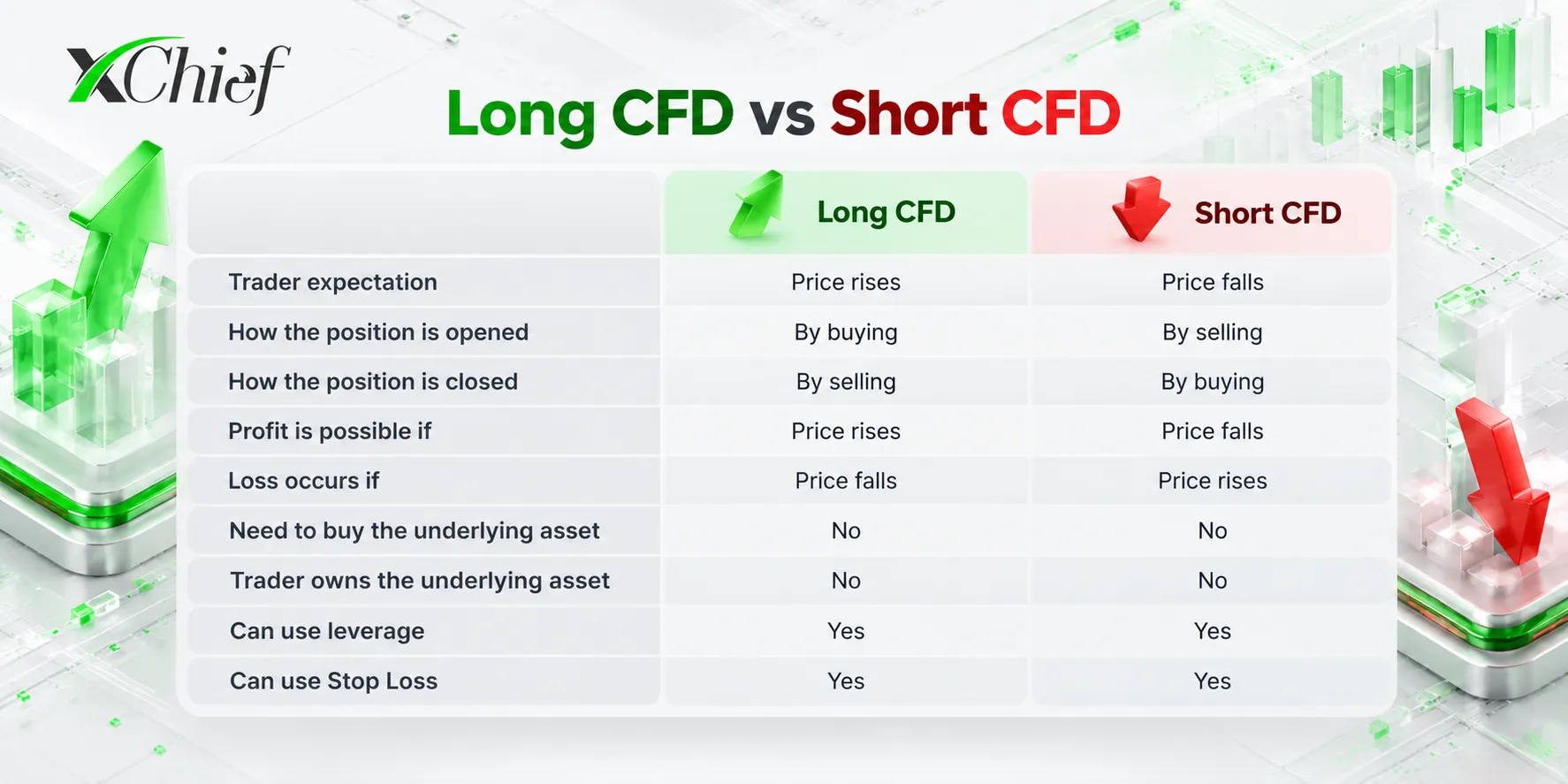
The main difference is simple: with a long position, traders expect a rise; with a short position, they expect a decline. Otherwise, the calculation is similar, and the result depends on the difference between the opening and closing prices, position size, and trading costs.
What to Remember About Long and Short CFD Positions
CFDs allow traders to open positions on both rising and falling markets. If a trader expects a rise, they can open a long position. If they expect a decline, they can open a short position. But the ability to trade falling prices does not make trading easier. Traders still need to assess price movements, choose a position size, and decide in advance how much they are prepared to lose if the forecast proves wrong.
The final result of a trade is affected not only by quotes but also by:
- spread;
- trading commission;
- rollover fees;
- financing costs;
- financing costs;
- leverage.
Therefore, before opening a trade, it is important to consider not only the price direction but also the potential loss and all costs.
Frequently Asked Questions
What Is a Long Position in CFDs?
A long CFD position is a position opened in anticipation of an increase in the price of the underlying asset. If the price rises, the trader can make a profit; if it falls, they incur a loss.
What Is a Short CFD Position?
A short CFD position is a position opened in anticipation of a price decline. It is opened by selling and closed by buying. The underlying asset itself is not needed for this.
How Do You Open a Short Position Using CFDs?
To open a short position using CFDs, the trader opens a sell trade. If the price falls, the position can be closed at a lower price, generating a profit from the difference after accounting for costs.
Can You Profit From a Falling Market With CFDs?
Yes. With a short position, it is possible to profit from a price decline. If the price rises, the position generates a loss.
How Does Short Selling CFDs Differ From Short Selling Stocks?
In traditional short selling, stocks are usually borrowed from a broker, sold, and later bought back for return. With CFDs, the trader does not receive the securities themselves but opens a contract based on changes in their price.
Which Is Riskier: Long or Short?
Both positions can lead to losses if the market moves against the forecast. A short position has one particular feature: there is no fixed upper limit to price increases. At the same time, leverage increases the risks of both long and short positions.
Can You Use Leverage in a Short Position?
Yes. Leverage works in both long and short positions: it allows traders to open a larger position than they could without it, but it increases both potential profits and possible losses.
Can You Switch From Long to Short?
Yes. To change direction, the current position is closed and an opposite position is opened. Exactly how this works in the trading terminal depends on the account type and the broker's terms.
What Happens If You Keep a Position Open for a Long Time?
Its result will continue to change along with the market. In addition, carrying a position into subsequent trading days may involve additional costs if they are provided for under the broker's terms.


