



How much does a CFD trade really cost: spread, commission, overnight fees, and other costs

A trader opens a CFD position, the price moves in the desired direction, and a profit appears on the screen. It would seem that all that remains is to close the trade and take the result.
A trader opens a CFD position, the price moves in the desired direction, and a profit appears on the screen. It would seem that all that remains is to close the trade and take the result.
In practice, the final amount may be lower.
Part of the profit may be eaten up by trading costs. Some appear almost immediately, while others arise later: for example, if a CFD is held overnight or an instrument is traded in another currency.
Therefore, the cost of CFD trading cannot be described by commission alone. Sometimes a trader pays only the spread, sometimes a commission is added to it, and if the position is held for several days — an overnight fee as well.
Let's look at what fees may apply when trading CFDs, when they arise, and how much a single trade may ultimately cost.
What Makes Up the Cost of a CFD Trade
There is no single universal fee for CFDs. Even two similar trades may cost differently. The instrument itself, the volume, and whether the trader closes the position after an hour or keeps it open for several days all matter.
The most common costs are:
- spread (Spread) — the difference between the buy and sell price;
- trading commission (Trading Commission) — a separate fee for a trading operation;
- spread (Overnight Fee / Swap) — a charge for carrying an open position into the next trading day;
- financing cost (Financing Cost);
- conversion fee (Conversion Fee) — currency exchange costs;
- additional charges, if provided for by the tariff.
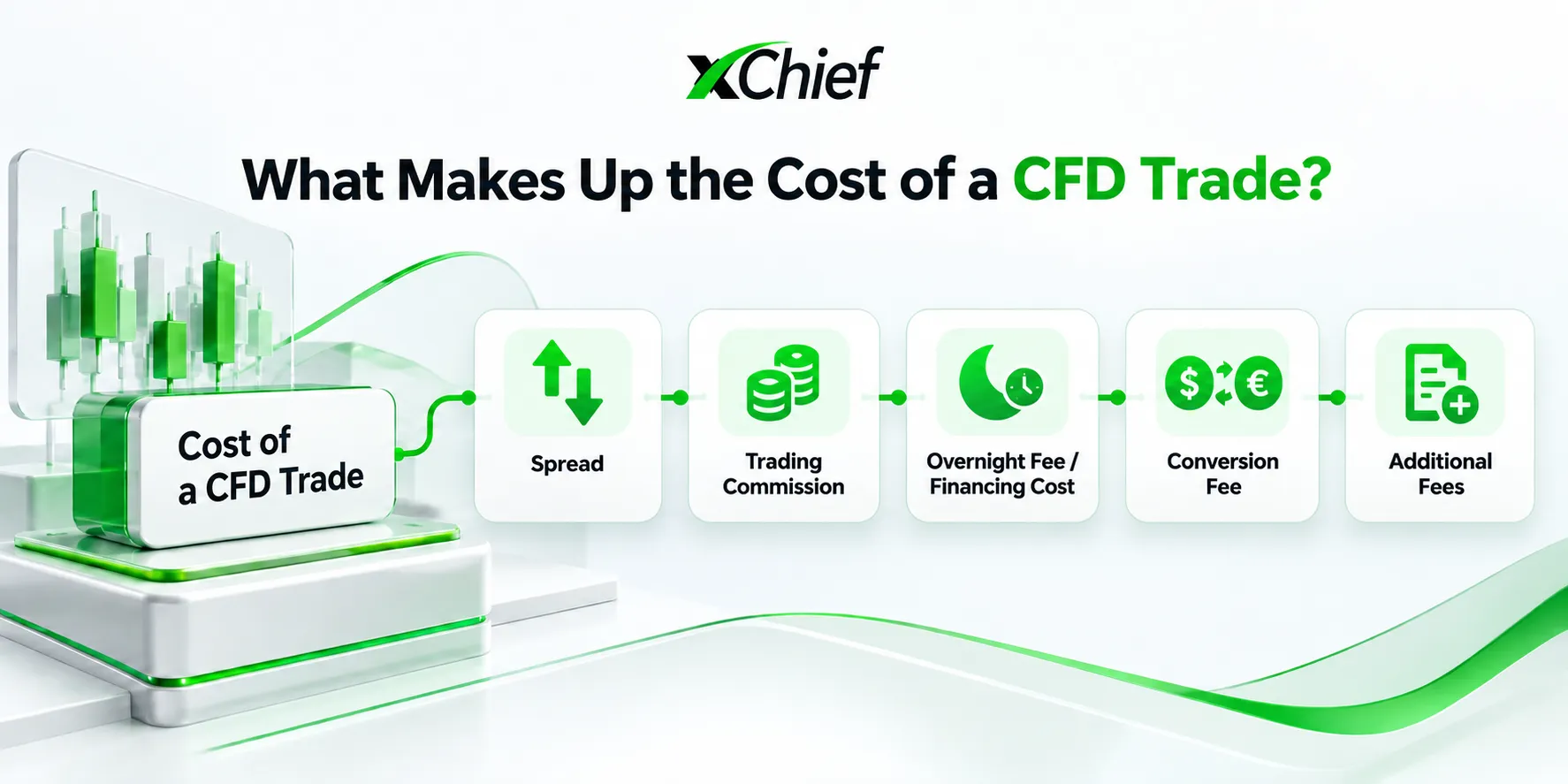
The overnight fee and financing cost may refer to the same expense. The terminology and calculation method depend on the broker, so they should not automatically be added together.
But usually, you do not have to pay all of these costs in a single trade.
For example, a CFD can be opened in the morning and closed a few hours later. In that case, there will be no overnight fee. If the instrument currency matches the account currency, no conversion will be required either.
But the spread is taken into account immediately when the trade is opened.
And here, you first need to understand the two prices — Bid and Ask.
Bid and Ask: Why CFDs Have Two Prices
In a trading terminal, one instrument usually has two prices displayed at the same time.
Ask — the buy price.
Bid — the sell price.
Suppose the quote looks like this:
Bid — 99.95 $
Ask — 100.05 $
The trader expects the price to rise and buys the CFD at 100.05 $. But if the position is closed almost immediately, the instrument can be sold only at 99.95 $.
Even if the price has not changed yet, the trade may show a small loss immediately after opening.
What Is a CFD Spread
CFD spread is the difference between Bid and Ask.
In our example:
100.05 − 99.95 = 0.10 $
Ten cents on one unit of the instrument is barely noticeable.
On one hundred units:
0.10 × 100 = 10 $
So immediately after opening, such a position will be approximately 10 $ in the red. To cover this difference, the price needs to move by about 0.10 $ per unit in the desired direction — provided the spread does not change during that time.
Why the Spread Changes
In the morning, it may be one value, and by evening — another. The spread is affected by liquidity, trading activity, and volatility.
When an instrument is actively traded, Bid and Ask are usually closer together. If there are few buyers and sellers, the difference becomes wider. Statistics are released, unexpected news appears, the market moves sharply — the spread may widen as well.
Therefore, the morning spread may be completely different by evening.
At the same time, the narrowest spread does not always mean the cheapest trade. For a trade lasting a couple of hours, it is indeed an important indicator. For a position held for a week — it is no longer the only one. Holding costs gradually start to matter.
CFD Commission: When a Separate Charge Is Added to the Spread
In addition to the spread, some instruments have a separate CFD commission. Sometimes the main charge is already built into the spread. Sometimes the broker additionally charges a commission for opening and closing the trade.
But looking only at the figure in the tariff is not enough: it is important to understand what exactly the fee is charged for and how it is calculated.
Suppose the commission is 0.05% of the position size.
The CFD is opened for 10 000 $.
On opening:
10 000 × 0.05% = 5 $
On closing — another approximately 5 $, if the rate is the same.
That comes to about 10 $.
But the commission may also be calculated differently: for example, based on the number of units of the instrument. Sometimes there is a minimum amount below which the commission does not fall.
Therefore, next to the figure 0.05%, it is worth checking one more thing: whether this is the commission for one side of the trade or for the entire round trip. Otherwise, it is easy to calculate only half of the costs.
Overnight Fee for Carrying a CFD Position to the Next Day
If the trade is closed on the same day, there is usually no overnight fee. But if the terms of a specific CFD provide for an overnight charge, after the specified time an Overnight Fee, or Swap, may be applied.
Other names may also be used: Holding Cost, Overnight Financing.
The meaning is similar: the CFD is carried into the next trading day, and a separate charge may arise for this.
If the position is kept open for only one night, the amount may be small. Suppose the overnight fee is 2 $.
Three nights:
2 × 3 = 6 $
Ten:
2 × 10 = 20 $
By this point, the trader may already have paid the spread and commission. And what if the position is held not for ten days, but for a month? Then the overnight fee for a CFD position is no longer easy to dismiss as insignificant.
Is Swap Always Deducted From the Account?
No. It all depends on the instrument, trade direction, rates, and calculation formula. One position may involve a charge, while another may involve a credit. Therefore, there is no universal rule that "you pay for a buy and receive for a sell."
If a position remains open over the weekend, the charge may be higher than usual. The market may not operate for several days, but the open position does not disappear. Therefore, on certain days, the calculation takes several calendar days into account at once.
It is better to check the exact charging time in the instrument specification.
Financing Cost: What Does Leverage Have to Do With It?
This is where the terminology starts to become confusing. Financing Cost and Overnight Fee may refer to very similar things with different brokers. Sometimes the financing cost is already included in the overnight fee, while sometimes it is shown separately.
But what matters more than the name is the amount on which the calculation is based.
CFDs are often traded with leverage. This means that you do not need to deposit the full value of the trade to open it.
For example, a CFD worth 10 000 $ may require 1 000 $ of margin. It might seem logical to assume that financing is also calculated from that thousand.
But the base may be the full nominal position size — the same 10 000 $.
Leverage allows a trader to open a position that is significantly larger than the margin deposited. Therefore, financing costs may be significant relative to the trader's own funds.
For a short-term trade, this cost may be barely noticeable, but over a week or two it becomes more significant.
We explained in more detail how margin and leverage work in the article "CFD Demystified".
What Determines the Financing Cost
The final amount is affected by the position size, trade direction, rate, broker markup, and how many days the CFD remains open.
Therefore, two trades of the same size may cost differently simply because they involve different instruments. And the longer the CFD remains open, the less representative the entry spread alone becomes.
Currency Conversion Fee
Imagine a common situation: the account is denominated in euros, while the CFD is traded in dollars. After the trade is closed, the profit or loss needs to be converted into the account currency. This is where conversion comes in.
One broker converts at its own rate with a markup. Another shows a separate Conversion Fee.
Suppose the profit is 200 $, and the broker charges 0.2% of the converted amount.
We get:
200 × 0.2% = 0.40 $
Forty cents is not much.
But one trade rarely shows the whole picture. If a trader regularly trades instruments in another currency, small conversion fees accumulate over time.
Therefore, it is important to look at the exchange rate used for conversion: a profit in dollars may look slightly different after being converted into euros.
If the account currency and the instrument currency do not match, it is worth checking in advance how conversion is carried out and whether there is a separate fee for it.
What Other Costs May Arise
CFD trading commissions are not the only possible expenses. In addition to them, the result is affected by the spread and financing, and other charges may also appear in the tariffs.
Some brokers charge separately for a guaranteed stop-loss. Such an order allows a position to be closed at a predefined level even in the event of a price gap. A separate premium may be charged for this guarantee — the terms depend on the broker.
There may also be a withdrawal fee, charges for certain services, or an account inactivity fee.
These costs are not directly related to a specific CFD trade. For example, a withdrawal fee is a charge for using the account as a whole, not for an individual position.
Therefore, it is better not to mix such charges with the spread, trading commission, and swap: otherwise, it becomes harder to understand how much the trading itself actually cost.
Why One CFD Costs More Than Another
With a currency pair, a trader may see a very narrow spread. Then they open a CFD on an individual stock — and the difference between Bid and Ask turns out to be noticeably wider.
EUR/USD, gold, a stock index, and shares of a small company are linked to completely different underlying markets. They have their own liquidity, trading hours, volatility, and currency.
In a liquid market, Bid and Ask are more often closer together. Where there are fewer trades, the spread is usually wider.
Financing costs will also differ between instruments.
As a result, one CFD may be cheap to enter but expensive to hold for several days. Another may have a wider spread, but the trader is going to close the position after a couple of hours anyway, so there will be no overnight fee.
You cannot compare two CFDs based on spread alone. A position held for a couple of hours and a position held for a week may cost very differently.
Example: How Much a CFD Position Really Costs
Let's look at one trade to see how all of these costs add up to a real amount.
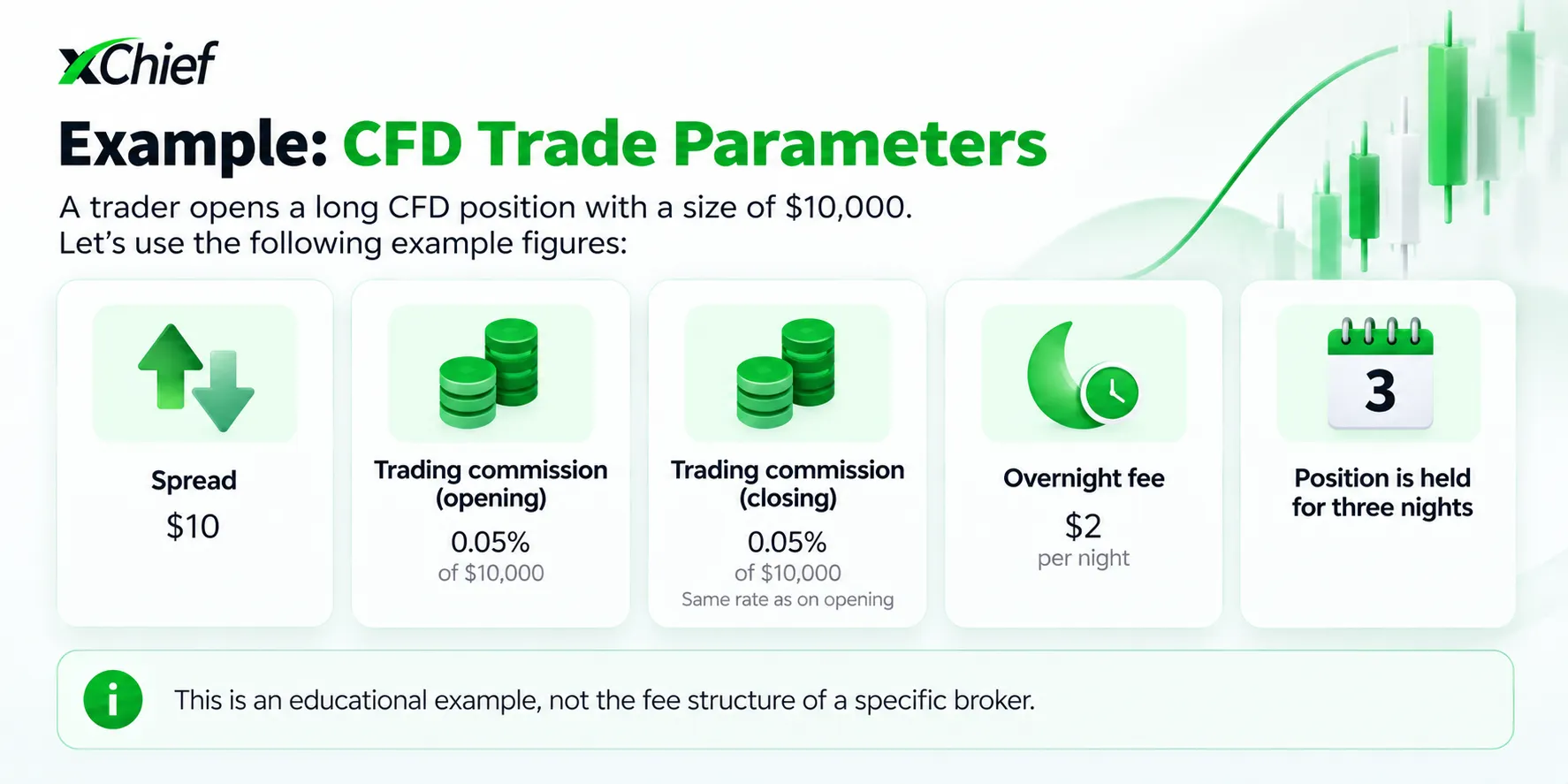
Commission on opening:
10 000 × 0.05% = 5 $
On closing — another approximately 5 $.
Over three nights, the following is added:
2 × 3 = 6 $
Total:
10 + 5 + 5 + 6 = 26 $
So even before conversion and other possible charges, the trade cost approximately 26 $.
If the price generated 100 $ over that period:
100 − 26 = 74 $
And if only 20 $:
20 − 26 = −6 $
So the trader chose the right direction, but the price movement was not even enough to cover the costs.
How to Calculate the Cost of CFD Trading in Advance
Only an approximate amount can be known in advance. A trader may plan to close the position in the evening and then decide to leave it open for another day. The spread may change during that time, and the closing commission may turn out to be different.
Some figures are visible even before entering the trade. Bid and Ask show the current spread. The tariff schedule can be used to check the commission and determine whether it is charged again when the position is closed.
If the CFD may remain open overnight, the overnight rate will also be needed. And for an instrument in another currency — the conversion terms as well.
The CFD with the smallest spread is not necessarily the cheapest. If the position is open for a week, financing may eat up much more than the initial difference between Bid and Ask.
For a trade lasting several hours, on the other hand, these costs may barely have time to accumulate.
Therefore, the question "How much does CFD trading cost?" without details does not tell you much. It is more useful to ask: how much will this specific trade cost — at this size and for this period?
Trader Costs and Broker Revenue Are Not the Same Thing
For the trader, the spread is a cost. But that does not mean that the entire difference between Bid and Ask becomes the broker's profit.
The company has its own costs, liquidity providers, hedging, infrastructure, and different execution models.
So the trader's cost and the broker's revenue are not the same thing.
We discussed separately how brokers make money on CFDs in the article "How CFD Brokers Make Money".
Key Takeaways
The price moving in the desired direction does not yet mean that this is exactly the profit the trader will see after closing the trade.
The final result is affected by the spread, commission, overnight fee, and conversion. And the longer the CFD remains open, the more important financing costs become.
They may be calculated based on the full position size, not only on the margin deposited.
Therefore, looking at one figure in the tariff schedule is not enough. It is more important to calculate everything together: how much it costs to enter the trade, hold it for the required period, and exit.
FAQ
What Fees Apply When Trading CFDs?
The main CFD fees are the spread, a separate trading commission, and the overnight fee. Financing costs, currency conversion, and additional services may also create expenses. Not all of them necessarily apply to every trade.
What Is a CFD Spread?
A CFD spread is the difference between the Ask buy price and the Bid sell price. If Ask is 100.05 $ and Bid is 99.95 $, the spread is 0.10 $ per unit of the instrument. Therefore, immediately after opening a trade, its result is usually slightly negative.
Is There a Commission on CFDs?
Not always. For some instruments, the main trading costs are already built into the spread. In other cases, the broker separately charges a commission for opening and closing the trade.
What Is an Overnight Fee on a CFD Position?
It is a charge that may arise if a CFD remains open into the next trading day. In tariff schedules, it may appear under the names Overnight Fee, Swap, Holding Cost, or Overnight Financing.
Is Swap Charged Every Day?
It depends on the instrument and the calculation method. Usually, swap is associated with a CFD remaining open after a specified time. On certain days, the charge may account for the weekend at once.
Is Financing Calculated Only From the Margin?
Not always. To open a CFD, a trader may deposit only part of the full value as margin. But the financing cost may still be calculated based on the full nominal position size.
For example, a CFD worth 10 000 $ may tie up 1 000 $ of the trader's own funds, while the base for calculating financing still remains 10 000 $.
Why Do CFD Fees Differ Across Instruments?
Because the underlying markets themselves differ. Currencies, stocks, commodities, and indices have their own liquidity, volatility, currency, trading hours, and financing costs.
How Do You Calculate the Cost of CFD Trading?
You need to add together all charges that apply to the specific trade:
Spread + trading commission + overnight fee / financing + currency conversion + other applicable costs.
Part of the amount is known immediately. The rest depends, for example, on how many days the CFD remains open.
Can the Price Rise but the CFD Trade Still Be Unprofitable?
Yes. If the price movement is small, trading costs may exceed the amount earned.
For example, the price generated a 20 $ result, while the spread, commission, and overnight fee together amounted to 26 $. After accounting for them, the result is −6 $.


