



CFDs and Futures: Two Ways to Trade Price Movements

CFDs and futures are similar in many ways. Both instruments allow traders to trade price movements, open positions on both rising and falling prices, and use leverage. At the same time, it is not necessary to buy the underlying asset itself.
CFDs and futures are similar in many ways. Both instruments allow traders to trade price movements, open positions on both rising and falling prices, and use leverage. At the same time, it is not necessary to buy the underlying asset itself.
Because of this, it is easy to put them in the same category. For example, a trader can open a CFD on oil or choose an oil futures contract and, in both cases, get a result from its price movement. But the trades themselves will be structured differently.
A CFD is a contract between a trader and a broker. A futures contract is traded on an exchange, and its main parameters are predetermined: contract size, minimum price increment, settlement procedure, and, for expiring futures, the expiration date.
This difference affects almost everything else: the choice of position size, margin amount, costs, liquidity, and what happens to the position as the contract expiration date approaches. Below, we will look at the difference between CFDs and futures and why two instruments on the same market can behave differently.
What Is a CFD
CFD is a derivative financial instrument that allows traders to trade changes in the price of an underlying asset without buying it.
CFDs can be linked, for example, to stocks, stock indices, currency pairs, gold, and oil.
For example, if a trader chooses a CFD on gold, they do not buy the metal itself and do not become its owner. The result of the trade depends on how much the price changes between opening and closing the position.
If a position is opened in anticipation of a rise and the price actually increases, the difference works in the trader's favor. If the price falls, a loss occurs. With a short position, the logic is reversed.
A CFD is usually not traded as a separate instrument on a centralized exchange. The trade is executed through a broker, which provides quotes, determines the available position sizes, and sets the trading conditions.
Therefore, CFD parameters may differ between brokers. For example, for CFDs on the same market, different brokers may have different minimum trade sizes, margin requirements, or position rollover costs.
We explained the mechanics of the instrument in more detail in the article CFD Demystified.
What Are Futures
A futures contract is also a derivative financial instrument, but its structure differs significantly from a CFD.
Such contracts are traded on an exchange. The main parameters are set in advance for each of them: which asset underlies the contract, how many units of the asset correspond to one contract, and what minimum price increment is used. Expiring futures also have a predetermined expiration date.
For example, one oil futures contract may correspond to a certain number of barrels. A stock index futures contract does not have a physical quantity of the asset, but it has a specified multiplier that determines the value of a one-point movement in the index.
A trader cannot change the size of the contract itself. If one contract is not enough, two or three can be opened. If, on the contrary, one contract is too large, the trader has to look for a smaller version, if one exists.
At the same time, opening a trade does not require depositing the full nominal value of the futures contract. As with CFDs, margin is used, but the rules for calculating it and maintaining the position differ.
Futures vs CFDs: Key Differences
If we put the main points together, the picture looks like this:
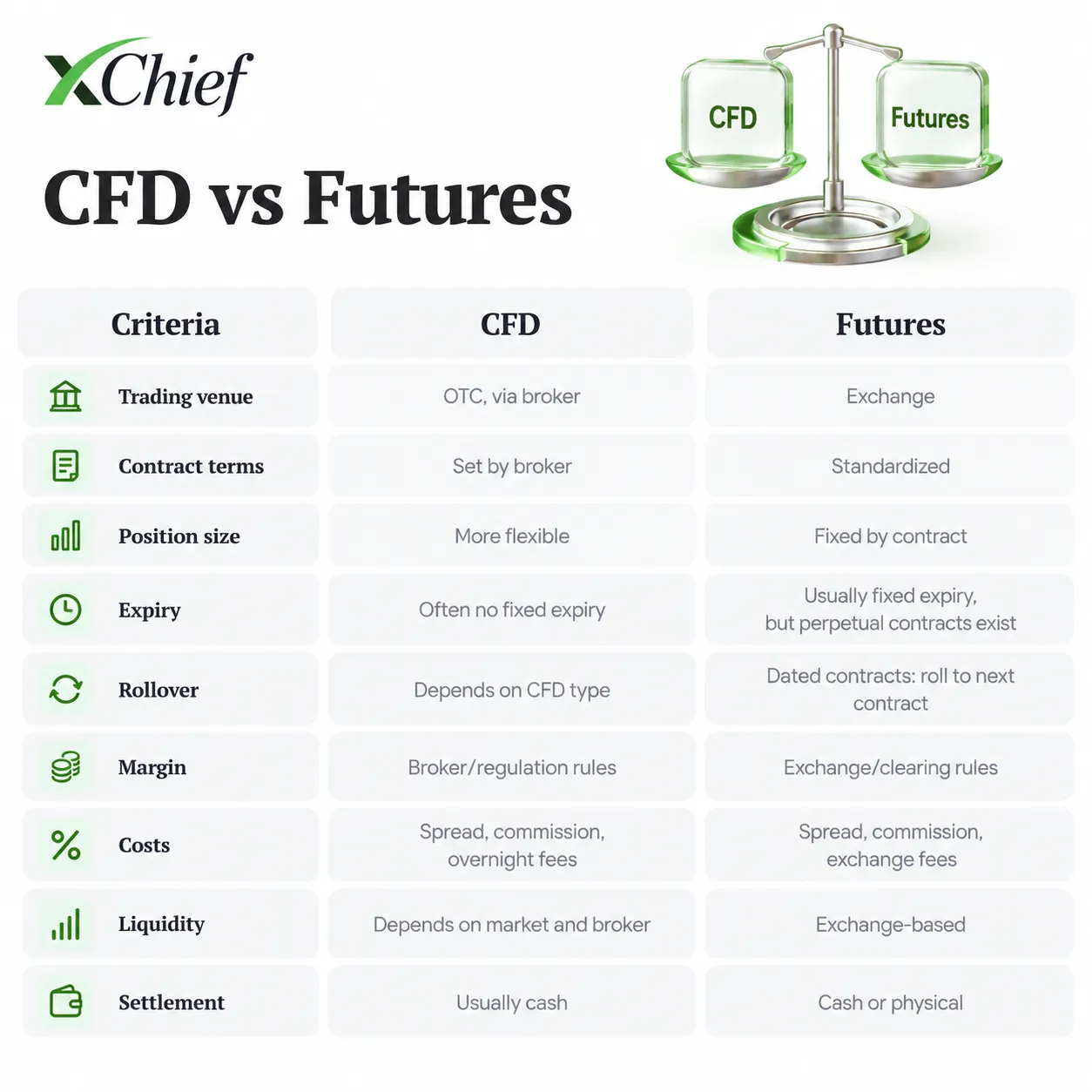
This table shows the general logic, but conditions may differ within each group.
For example, not all CFDs are perpetual. Some are linked to specific futures contracts and may also have an expiration date. Futures, in turn, may have several versions of different contract sizes for the same asset.
Contract Size
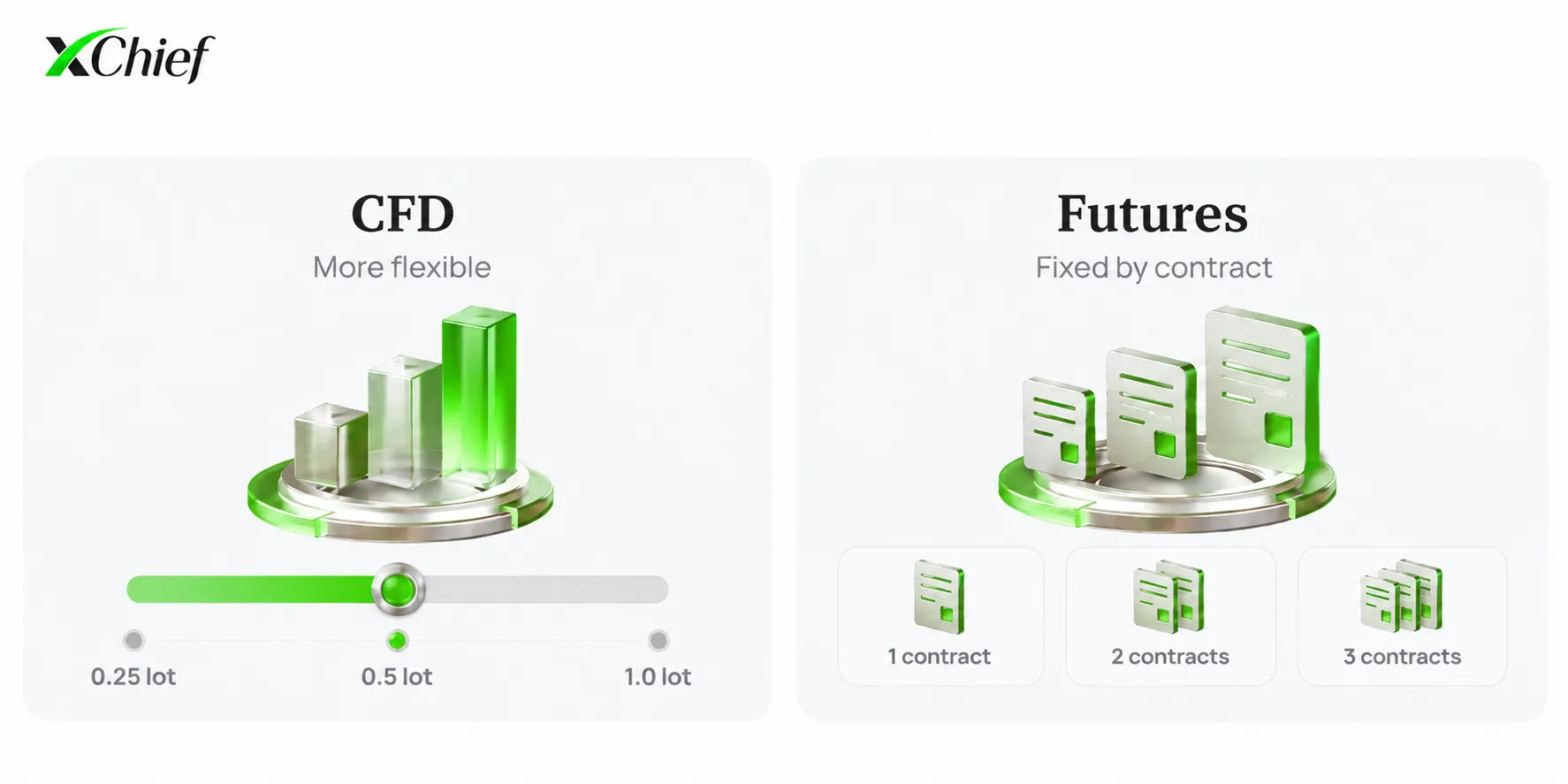
Trade size is one of the most noticeable differences between CFDs and futures.
With CFDs, the volume can usually be selected quite flexibly. Depending on the instrument, it may be specified in lots, fractions of a lot, number of shares, or other units.
Suppose a trader wants to take a small position in a particular market. If the broker's conditions allow it, the CFD volume can be reduced to a suitable size without taking an entire standard large contract.
At the same time, there is still no complete freedom. Each instrument has a specification: minimum trade volume, size of one lot, value of a one-point price movement, and other parameters.
With futures, the size is predetermined and is the same for all participants trading a particular contract.
Suppose one contract corresponds to a certain amount of the underlying asset. It is not possible to buy, say, 0.4 of such a contract. You can open one, two, or more whole contracts.
Many markets offer smaller versions of futures contracts that allow traders to work with lower volumes. But even in this case, the trader chooses from options already set by the exchange rather than setting the trade size arbitrarily.
Because of this, two seemingly similar trades may require different amounts of capital. A CFD allows the volume to be adjusted more precisely to the account, while with futures the size of the specific contract has to be taken into account before opening the position.
Expiration
A futures contract most often has a specific lifespan.
A contract may relate, for example, to March, June, September, or December. When the specified date arrives, trading in that contract ends and the settlement or delivery procedure stipulated by the rules begins.
The calendar depends on the market. Some contracts are issued every month, while others are issued only for certain months of the year. An expiring futures contract cannot be held indefinitely: it has a specified expiration date.
CFDs have different rules. Many such instruments do not have a predetermined expiration date. A position can be held for more than one trading day, week, or month, as long as there are sufficient funds in the account and the instrument remains available for trading.
But not all CFDs should be considered perpetual either.
If a CFD is linked to a particular futures contract, the broker may set its own expiration date or use a mechanism for switching to the next contract. Therefore, it is always better to check the expiration terms in the specification of the particular instrument.
We discuss this topic in more detail in the article CFD Expiry and Rollover.
Rolling Over a Position
The expiration of an expiring futures contract creates another feature — the need to move from one contract to another if the trader wants to keep the position for longer.
Suppose a September futures contract is open, but the trading idea is expected to last for several more months. As the September contract approaches expiration, it is closed and the next contract, for example December, is opened instead.
This is a position rollover.
Importantly, the price of the new contract will not necessarily be the same as that of the old one. Even if both are linked to the same asset, there may be a difference between them.
Prices for different maturities are affected by interest rates, market expectations, commodity storage costs, dividends, and other factors. Therefore, when moving from one futures contract to another, the entry price may also change.
With a perpetual CFD, there is usually no need to manually close one contract and open another. The position can continue to exist, but the broker may charge a separate fee for holding it overnight.
If the CFD is based on a futures contract, however, the conditions may be different. In this case, the broker may sometimes switch the price calculation to the next contract or set a date after which the current instrument stops trading.
Therefore, when holding a position for the long term, it is important to consider not only the direction of the market but also how the chosen contract is structured.
Margin
Both CFDs and futures allow traders to control a position whose value exceeds the amount directly deposited to open it.
Margin is used for this purpose.
Suppose the value of a CFD position is 10 000 $, and the required margin is 5%. To open the trade, 500 $ of the trader's own funds will be required. The remaining 9 500 $ are not credited to the account as a conventional loan. Margin indicates the amount that must be available to open and maintain a position of a certain size.
Profit and loss are calculated based on the full position. Therefore, a small price movement can produce a result that is significant relative to the margin deposited.
If the market moves against the open trade, the funds in the account decrease. When they become insufficient to maintain the positions, the broker may require additional funds or begin closing trades in accordance with its rules.
Margin is also used with futures, but the system itself is organized differently.
Initial margin is required to open a contract. After opening, a certain level of funds must remain in the account for the position to stay open. The futures contract is regularly revalued at the current market price. If the price moves against the position, the loss is reflected in the account. When the funds become too low, the account may need to be funded or the position reduced.
The margin amount does not necessarily remain the same all the time. During periods of high volatility, requirements may change, so the amount that was sufficient to open the trade may not always be sufficient later.
In both CFDs and futures, margin allows a larger position to be opened with a smaller amount of the trader's own funds. For the same reason, it increases the impact of each price movement on the account.
Trading Costs
The cost structure of CFDs and futures also differs. Therefore, comparing them only by the stated commission per trade is not entirely correct.
Several types of costs may arise when trading CFDs:
- spread — the difference between the buy and sell price;
- a separate trading commission;
- a fee for carrying the position into the next trading day;
- currency conversion costs;
- additional charges, if provided for by the broker's terms.
The specific set depends on the instrument and account type. In some cases, the main trading cost is already built into the spread. In others, the broker offers a narrower spread but separately charges a commission for opening or closing the trade.
For a short-term trade, the main cost may be the spread or commission. If the position remains open for several weeks, the rollover fee becomes much more noticeable.
Futures usually involve a brokerage commission, exchange fees, and clearing fees. In addition, the trader faces the usual market spread between the buy and sell price.
An exchange-traded futures contract usually does not have the daily rollover fee typical of many CFDs. However, the cost of time still affects the contract price.
For example, the futures price may reflect interest rates, expected dividends, or commodity storage costs. Therefore, the absence of a separate "rollover fee" line does not mean that holding a position over time has no effect on its cost.
When comparing two instruments, it is better to consider all costs together and take the expected duration of the trade into account.
Liquidity
Liquidity indicates how easily a position can be opened or closed at a price close to the current market price.
In futures, participants' orders meet on the exchange. Buyers and sellers form a common order book showing available prices and volumes. At the same time, liquidity is distributed unevenly among contracts with different maturities.
For example, September, December, and March futures may trade simultaneously. Usually, more trades take place in the most active contract, and as expiration approaches, participants gradually move to the next one.
Because of this, one futures contract on the same asset may trade actively, while another may trade noticeably less frequently. This matters for a trade: with lower liquidity, the spread may be wider and executing a large order may be less convenient.
CFDs do not have a common exchange order book for all market participants. Quotes and execution conditions depend on the broker's infrastructure, its liquidity providers, and the market where the underlying asset is traded. Therefore, a CFD usually follows the price of the underlying market, but its quote does not necessarily match the exchange price to the last decimal place.
For example, the final price may be affected by the broker's spread, trading hours, and the specifics of the quote source.
More details on how the value of such a contract is formed can be found in the article How CFD Prices Are Calculated.
Where CFDs and Futures Are Traded
Futures are traded on organized exchanges.
The exchange sets the contract specification and general trading rules. For all participants in the same futures contract, the contract size, price increment, and settlement procedure are the same. Expiring contracts also have a predetermined expiration date. Obligations are fulfilled through a clearing system that records participants' positions and carries out settlements.
CFDs are over-the-counter instruments. A position is opened through a broker, and it is the broker that provides access to the contract, quotes, and trading platform.
Therefore, a CFD on a stock index and a futures contract on the same index cannot be considered the same instrument simply because their charts look similar. They may share the same underlying market, but the position size, margin, expiration, costs, and execution rules will differ.
What CFDs and Futures Are Used For
Trading CFDs and futures allows traders to trade price movements without the conventional purchase of the underlying asset.
A trader can open a long position if they expect the price to rise, or a short position if they expect it to fall. Therefore, CFDs and futures are used for speculative trading in different markets.
Futures also have another common use — hedging.
Suppose a commodity producer knows that it will have to sell the commodity in several months. If the market price falls sharply by that time, future revenue will also be lower. A futures contract allows the company to lock in a price in advance or partially offset such a decline.
A company planning to buy a commodity in several months faces the opposite risk — the price may rise. For such a company, a futures contract can be used as protection against that increase.
CFDs are more common in retail trading through brokerage platforms. A single account can provide access to currencies, indices, commodities, stocks, and other markets without the need to buy the assets themselves.
For a retail trader, the ability to select the position size more precisely may be convenient here. There is no need to use an entire standard exchange-traded contract if it is too large for the account.
But the way the instrument is used does not change the risk of leverage itself.
If the position size is large relative to the funds in the account, a small market movement may be enough to produce a significant profit or loss. This applies to both CFDs and futures.
CFDs or Futures: What Is the Main Difference?
CFDs and futures may provide access to the same market, but structurally they are different instruments.
A CFD is an over-the-counter contract between a trader and a broker. The position size can usually be adjusted more flexibly, and many instruments do not have a fixed expiration date. However, rollover costs may arise when a position is held for a long time.
A futures contract is traded on an exchange and has predetermined parameters. Its size cannot be changed arbitrarily. If it is an expiring contract, the expiration date must also be taken into account: to maintain the position for longer, the trader eventually needs to move to the next contract.
The cost structure, margin system, and source of liquidity also differ.
Therefore, before opening a trade, it is useful to look not only at the chart of the underlying asset. The size of the contract itself, the value of a one-point movement, the required margin, expiration date, and costs that may arise while holding the position are equally important.
Frequently Asked Questions
CFDs vs Futures: What Is the Difference?
A CFD is an over-the-counter contract between a trader and a broker. Futures are traded on an exchange and have predetermined parameters.
The instruments also differ in position size, expiration, margin calculation rules, rollover to the next contract, and the structure of trading costs.
Do CFDs Have an Expiration Date?
Not all of them. Many CFDs do not have a fixed expiration date and can remain open as long as there are sufficient funds to maintain the position and the instrument is available for trading.
However, CFDs linked to futures may have their own expiration date or a mechanism for switching to the next contract.
Do Futures Have an Expiration Date?
Not all of them. Most traditional futures have a specific expiration date, but perpetual contracts also exist.
Before an expiring futures contract expires, the position can be closed or rolled over to the next contract. If it is held until the end, what happens next depends on the terms of the instrument: settlement may be in cash or may involve delivery of the underlying asset.
Why Roll a Futures Position to the Next Contract?
This is done with expiring futures when their expiration date approaches.
If the trading idea remains valid and the trader wants to maintain the position, the expiring contract is closed and the next contract, with a later expiration date, is opened instead.
The prices of the two contracts may differ.
Do CFDs Need to Be Rolled Over to the Next Contract?
It depends on the type.
With a perpetual CFD, there is usually no need to close one contract and open another manually. The position continues to exist, although a fee may be charged for holding it.
If the CFD is based on a futures contract, the rollover rules are determined by the broker.
Is Margin Used When Trading CFDs and Futures?
Yes. In both cases, opening a position usually does not require depositing its full nominal value.
However, the margin amount, calculation rules, and conditions for maintaining the position differ.
Can CFDs and Futures Be Traded on the Same Asset?
Yes. For example, there are CFDs and futures linked to oil, gold, stock indices, or currencies.
However, these are different contracts. Even if they react to movements in the same market, their prices, position sizes, margin, expiration dates, and trading costs may differ.
What Happens to an Expiring Futures Contract After Expiration?
It depends on the type of contract.
Some futures are cash-settled: participants receive or pay the final difference. Others provide for delivery of the underlying asset.
Retail traders usually close or roll over such positions earlier, without waiting for final settlement.
Why Can CFD and Futures Prices Differ?
They are calculated differently.
The price of an expiring futures contract depends not only on the current value of the underlying asset, but also on the time remaining until the contract expires, interest rates, and other factors.
A CFD quote is formed according to the broker's rules based on the relevant market. Therefore, the two instruments may move in the same direction but do not have to show exactly the same price.


