

















CFD vs Forex trading: key differences, risks, and advantages in 2026

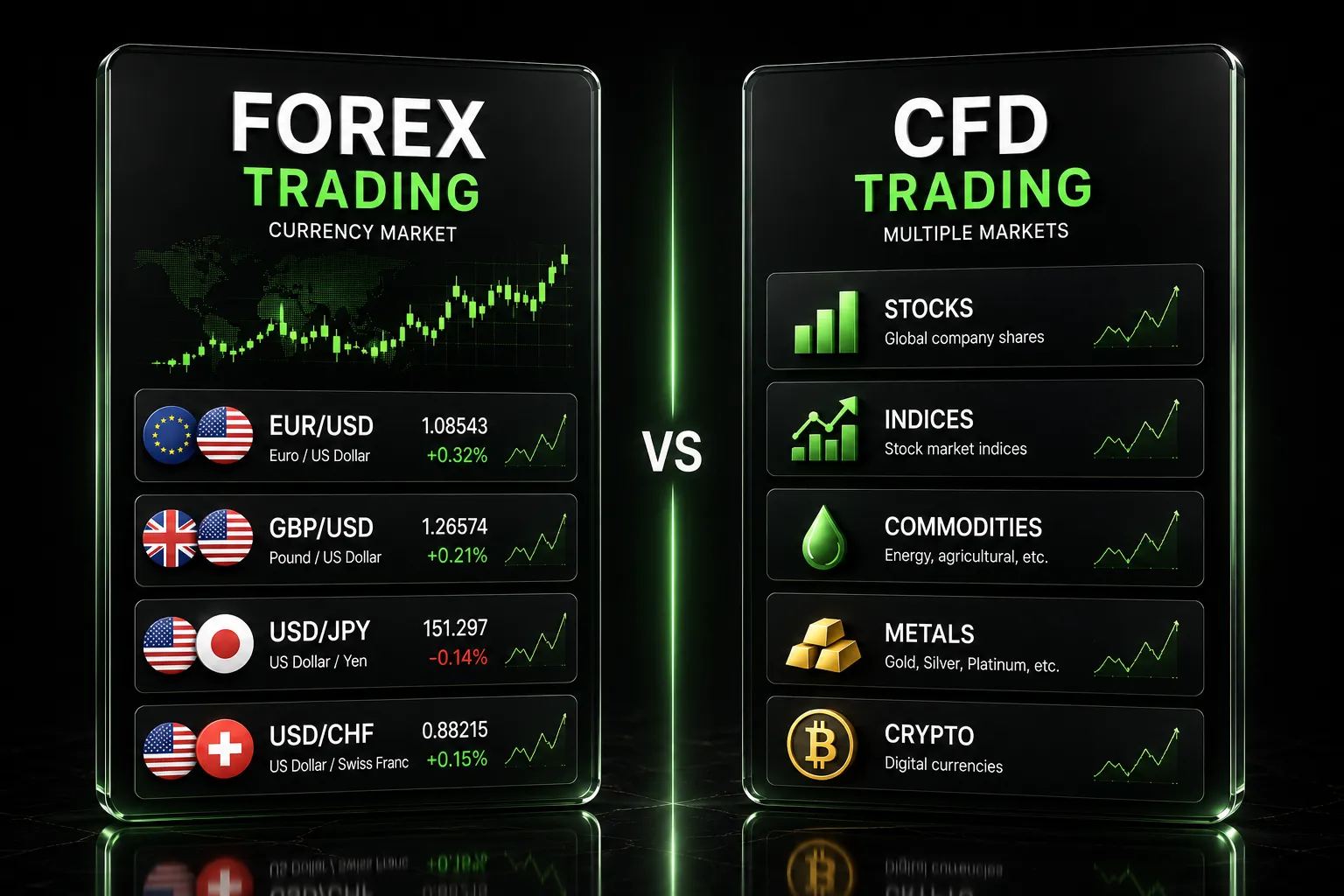
Compare CFDs and Forex: differences, advantages, commissions, leverage, risks, and available markets. Find out which is the better choice for beginner and experienced traders.
Forex and CFDs are often considered similar instruments for online trading. In both cases, traders can use leverage, open long and short positions, and profit from both rising and falling markets. Because of this, many beginners ask the question: what should they choose — CFDs or Forex?
In practice, there are important differences between these markets. They relate to the available assets, liquidity, trading characteristics, commissions, and risks. Understanding these differences helps traders choose the instrument that best matches their trading strategy and level of experience.
In this article, we will examine the main differences between CFDs and Forex, compare their advantages and disadvantages, and consider the situations in which each of these markets may be the more suitable choice.
What Is Forex Trading?

Forex (Foreign Exchange Market) is the international foreign exchange market. In terms of trading volume, it is considered the largest financial market in the world, with purchases and sales worth trillions of dollars taking place every day.
Forex trading is based on currency pairs. When a trader opens a position, they simultaneously buy one currency and sell another. For example, in the EUR/USD pair, the trader speculates on changes in the value of the euro relative to the US dollar.
The most popular instruments in the market are the following currency pairs:
- EUR/USD;
- GBP/USD;
- USD/JPY;
- USD/JPY;
- AUD/USD.
Currency prices change due to numerous factors, including central bank decisions, inflation and unemployment data, economic statistics, geopolitical events, and the overall state of the global economy.
One of the main advantages of Forex is its high liquidity. Thanks to the enormous number of market participants, trades are usually executed quickly, while the difference between the bid and ask prices often remains minimal for the most popular currency pairs.
Another feature of Forex trading is the ability to use leverage. It allows traders to open positions whose value exceeds the amount of their own capital. However, it is important to remember that leverage increases not only potential profits but also potential losses.
Forex is often chosen by traders who specialize specifically in the foreign exchange market, closely follow macroeconomic events, and prefer trading highly liquid instruments.
What Is CFD Trading?
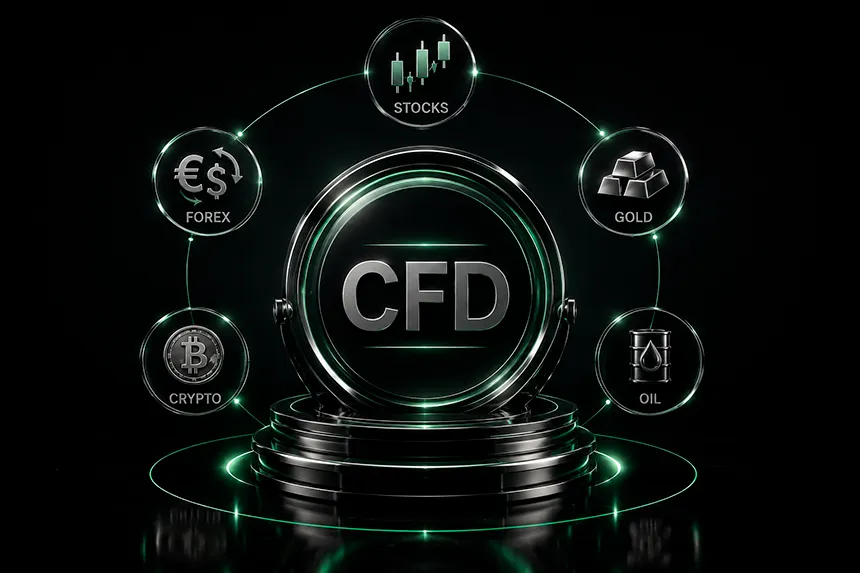
CFD (Contract for Difference) is a contract that allows traders to profit from changes in the price of an asset without actually buying or selling the underlying asset.
When trading CFDs, the trader does not become the owner of stocks, oil, gold, or any other asset. Instead, they enter into an agreement with the broker and receive a financial result based on the price movement of the instrument between the opening and closing of the position.
For example, if a trader believes that a company's shares will increase in value, they can open a long CFD position. If the forecast proves correct, the profit will equal the difference between the opening and closing prices of the trade. If the price declines, the trader will incur a loss.
CFDs are available on a wide range of financial instruments, including:
- company shares;
- stock indices;
- currency pairs;
- currency pairs;
- oil, natural gas, and other commodities;
- cryptocurrencies.
For this reason, CFD trading is often regarded as a more versatile instrument than Forex trading. A trader can apply different trading ideas and diversify strategies without opening accounts with multiple brokers.
Like the Forex market, CFD trading usually involves the use of margin and leverage, allowing traders to open positions larger than the amount of funds available in their account. However, higher potential returns are also accompanied by a higher level of risk. Therefore, money management remains one of the key factors in successful trading.
For many traders, CFDs provide a convenient way to access several financial markets through a single trading platform. You can learn more about how these instruments work in the article CFD trading in 2025.
Main Differences Between the Markets
At first glance, Forex and CFDs have a lot in common. In both cases, traders can use leverage, open long and short positions, and profit from changes in market prices. However, there are important differences between these instruments.
| Parameter | Forex | CFD |
| Underlying Assets | Currency pairs | Stocks, indices, commodities, currencies, cryptocurrencies |
| Number of Markets | Limited to the foreign exchange market | Wide selection of financial instruments |
| Liquidity | Very high for major currency pairs | Depends on the specific asset |
| Main Price Drivers | Macroeconomics and central bank policies | Depends on the selected market |
| Diversification | Limited to currencies | Broader opportunities |
CFD vs Forex: Key Characteristics
In addition to the differences in available instruments, CFDs and Forex have characteristics that affect trading style, the approach to market analysis, and diversification opportunities.
Forex has traditionally focused on the foreign exchange market. Many traders specialize in several currency pairs and thoroughly study the factors influencing their price movements. This approach makes it possible to focus on macroeconomic analysis and better understand the relationship between interest rates, inflation, and exchange rates.
CFDs offer a broader range of trading opportunities. A trader can simultaneously analyze the stock market, commodities, indices, and currencies. This makes CFDs a more flexible instrument for those who prefer to look for opportunities across different sectors of the economy.
Another difference lies in diversification. In the Forex market, the range of available instruments is limited to currency pairs. With CFDs, traders can allocate capital across several types of assets, reducing their dependence on the performance of a single market.
The factors influencing trading decisions also differ. Forex traders usually pay close attention to central bank actions, economic statistics, and changes in monetary policy. In CFD trading, the key factors depend on the specific instrument. For stocks, company financial results are important; for commodities, the balance between supply and demand; and for stock indices, the overall state of the economy and investor sentiment.
At the same time, it cannot be said that one approach is definitively better than the other. The choice between Forex and CFDs depends on the trader's objectives, experience, level of expertise, and personal preferences.
Leverage and Margin Trading
One of the reasons for the popularity of both Forex and CFDs is the ability to use leverage. This mechanism allows traders to open positions whose value exceeds the amount of their own funds.
For example, if a broker provides leverage of 1:100, opening a position worth $10,000 requires only $100 of the trader's own funds as margin. The remaining amount is effectively provided by the broker.
The use of leverage can significantly increase profits, but it is important to remember that it also multiplies the risk of losses. Even a small price movement against an open position can result in substantial capital losses.
When comparing forex vs cfd trading, many traders focus specifically on margin trading conditions.
In the Forex market, leverage has traditionally been among the highest available across financial instruments. Depending on the jurisdiction and the broker's conditions, the available leverage may vary considerably. High leverage allows traders to operate even with a relatively small deposit, but it requires strict risk management.
In the case of cfd trading vs forex trading, the amount of available leverage often depends on the selected asset. For currency pairs, the conditions may be similar to those of Forex, while for stocks, indices, or cryptocurrencies, brokers usually impose more conservative leverage limits.
Regardless of the market chosen, traders should always follow several risk management principles:
- use stop-loss orders;
- do not risk a significant portion of capital on a single trade;
- control position size;
- consider the potential increase in volatility during the release of major economic news.
Leverage remains a valuable tool for experienced market participants. However, beginner traders are advised to use it cautiously and gradually increase their trading volume as they gain experience.
Commissions and Spreads
When choosing between CFDs and Forex, it is important to consider not only trading opportunities but also the associated costs. Even relatively small commissions can have a noticeable impact on overall financial results when trading actively.
The main trading expenses typically include spreads, broker commissions, and overnight holding fees.
Spreads
A spread is the difference between the Ask price (buy price) and the Bid price (sell price) of an instrument.
In the Forex market, the tightest spreads are generally available on the most liquid currency pairs, such as EUR/USD and USD/JPY. Thanks to their high liquidity, trading costs for these instruments often remain relatively low, even during active trading.
When trading CFDs, the size of the spread depends on the specific asset. For example, popular stock indices or large-cap stocks may offer highly competitive spreads, while less liquid instruments often have wider spreads.
You can learn more about how spreads are formed in the article about the Forex market spread.
Broker Commissions
Some brokers include all of their costs entirely within the spread, while others additionally charge a fixed commission for opening and closing a trade.
Therefore, before you start trading, it is important to carefully review the instrument specifications and the broker's fee schedule. Two accounts with identical spreads may differ significantly in total trading costs due to different commission structures.
Overnight Holding Fee
If a position remains open after the end of the trading day, the broker may charge a so-called swap or overnight fee.
The amount of this fee depends on the asset, the direction of the position, and the broker's trading conditions. For short-term traders, these costs usually play only a minor role. However, when positions are held for several weeks or months, they can have a noticeable impact on the overall trading result.
What Should You Consider When Choosing?
Many beginner traders search for information using the query difference between CFD and Forex 2026 in an attempt to determine which market to choose. However, there is no universal answer. The right choice depends on your goals, experience, and preferred trading instruments.
Before opening an account, you should pay attention to:
- average spreads for the assets you intend to trade;
- whether trading commissions are charged;
- swap rates;
- additional account maintenance or withdrawal fees.
Comparing these parameters will help you objectively assess your actual future trading costs and choose the most suitable conditions for trading in the financial markets.
Risks of CFD and Forex Trading
Any trading in the financial markets involves risk. Despite the similarities in their trading mechanisms, the risks of CFD and Forex trading may manifest themselves differently depending on the selected instruments, market conditions, and the strategy used.
Understanding these potential risks helps traders make more informed decisions and avoid common mistakes, especially when using leverage.
Market Risk
The primary risk in both the Forex market and CFD trading is that the market may move against an open position.
For example, a trader may expect the euro to strengthen against the US dollar or anticipate an increase in the price of a company's shares. However, markets do not always move according to expectations. Economic data, regulatory decisions, corporate news, and geopolitical events can quickly change the direction of price movement.
For this reason, even a carefully prepared trading idea does not guarantee a positive outcome.
Leverage Risk
Leverage provides an opportunity to increase potential returns, but at the same time it also increases the level of risk.
Suppose a trader has capital of $1,000 and uses leverage of 1:100. In this case, they can open a position worth up to $100,000. Even a small movement in the asset's price can significantly affect the outcome of the trade.
The higher the leverage, the faster both potential profits and potential losses grow. That is why experienced traders recommend using a moderate level of risk and determining the maximum acceptable loss for each trade in advance.
Volatility Risk
Financial markets periodically experience periods of increased volatility, during which prices begin moving much faster than usual.
In the Forex market, such movements often occur after the release of inflation data, employment reports, or central bank interest rate decisions. For CFDs, additional sources of volatility may include corporate earnings reports, changes in commodity prices, or news affecting specific sectors of the economy.
High volatility creates additional profit opportunities but simultaneously increases the likelihood of significant losses.
Liquidity Risk
Liquidity reflects how quickly a trader can open or close a position at the current market price.
Major Forex currency pairs generally offer very high liquidity. However, some CFD instruments, especially those based on less popular stocks or commodities, may have lower liquidity. In such situations, trades may be executed at prices that differ from those expected.
This factor is particularly important for short-term traders operating with large trading volumes.
Broker Selection Risk
Regardless of whether a trader is considering CFD or Forex trading, choosing the right broker is of great importance.
Before opening an account, it is recommended to evaluate the following factors:
- the company's regulation and licenses;
- trading conditions;
- spread and commission levels;
- order execution speed;
- quality of customer support;
- available risk management tools.
In addition to trading conditions, it is also useful to consider whether the broker provides analytical materials, educational resources, and a demo account. These tools help beginner traders better understand the market and test strategies without risking real capital.
Many traders compare the offerings of different companies, including xChief broker, to find trading conditions that best match their strategy and level of experience.
A reliable broker cannot eliminate market risks, but it can provide more transparent and predictable trading conditions.
How to Reduce Risks
It is impossible to eliminate risk completely in the financial markets. However, traders can significantly reduce potential losses by following the basic principles of risk management:
- use stop-loss orders;
- limit the amount of risk per trade;
- avoid excessive leverage;
- diversify trading ideas;
- follow a predefined trading plan.
Regardless of whether a trader chooses Forex or CFDs, long-term success is usually determined not by the number of profitable trades but by the ability to control risk and maintain discipline under all market conditions.
Example of Trading: CFD vs Forex
The theoretical differences between CFDs and Forex are easier to understand through practical examples. Let's look at what a trade might look like in each of these markets.
Example of a Forex Trade
Suppose a trader expects the euro to strengthen against the US dollar and opens a long position on the EUR/USD currency pair.
At the time the trade is opened, the exchange rate is 1.1000. Some time after positive economic data from the Eurozone is released, the exchange rate rises to 1.1050.
The difference is 50 pips. If the forecast proves correct, the trader earns a profit, the amount of which depends on the size of the position.
If the market had moved in the opposite direction and the exchange rate had fallen to 1.0950, the trade would have resulted in a loss.
Such situations occur daily in the foreign exchange market under the influence of economic news, central bank decisions, and changing market expectations.
Example of a CFD Trade on Stocks
Now let's consider an example using CFDs.
Suppose a trader expects a strong quarterly earnings report from a technology company and opens a long CFD position on its shares.
The share price at the time the trade is opened is $100.
After the earnings report is published, the share price rises to $110.
Since a CFD reflects the change in the value of the underlying asset, the trader's profit is calculated based on the difference between the opening and closing prices of the position.
If the earnings report disappoints investors and the share price falls to $90, the trader will incur a loss.
The key difference from buying shares in the traditional way is that the trader does not become a shareholder and does not obtain ownership rights to the securities.
Example of a CFD Trade on Gold
CFDs allow traders to work not only with stocks but also with commodities.
For example, a trader expects demand for safe-haven assets to increase amid economic uncertainty and opens a position in gold.
If the price of gold rises, the value of the CFD also increases. If gold declines in price, the position generates a loss.
Oil, silver, stock indices, and many other instruments can be traded in exactly the same way.
What These Examples Demonstrate
When comparing CFD vs Forex trading, it is important to understand that the profit-generation mechanism is largely the same. In both cases, traders earn money from changes in the price of an asset.
The main difference lies not in the trading principle itself but in the range of available markets.
Forex is limited to currency pairs, whereas CFDs allow traders to apply the same trading mechanics to stocks, indices, commodities, and many other financial instruments.
Available Markets
One of the key differences between CFDs and Forex is the number of available trading instruments.
In the Forex market, traders work exclusively with currency pairs. The primary focus is usually on the most liquid instruments, such as EUR/USD, GBP/USD, USD/JPY, and other major currency pairs.
This approach is suitable for traders who prefer to specialize in a single market and develop an in-depth understanding of the factors affecting exchange rates, including central bank policies, interest rates, inflation, and macroeconomic data.
CFDs offer a significantly broader selection of instruments. Through a single broker, traders can gain access to multiple asset classes:
- currency pairs;
- company shares;
- stock indices;
- precious metals;
- energy commodities;
- agricultural commodities;
- cryptocurrencies.
For example, a trader may open a position on the S&P 500 index in the morning, trade gold during the day, and analyze the movement of the EUR/USD pair in the evening. All of these operations can be carried out through a single trading platform.
That is why, when comparing cfd or forex trading, many investors and traders first consider their own objectives. If their interest is limited to the foreign exchange market, Forex may offer all the opportunities they need. If they require access to different sectors of the global economy, CFDs provide greater flexibility.
A broad selection of instruments also makes it easier to diversify trading ideas. Instead of concentrating exclusively on currency pairs, traders can allocate capital across several markets, thereby reducing their dependence on the performance of a single asset.
When CFDs Are Better Than Forex
It cannot be stated unequivocally that CFDs are better than Forex, or vice versa. Each market has its own characteristics, advantages, and limitations.
However, there are situations in which CFDs may prove to be a more convenient solution.
CFDs may be suitable if:
You want to trade different markets.
CFDs provide access not only to currencies but also to stocks, commodities, indices, precious metals, and other instruments. This allows traders to look for trading opportunities across various market segments.
Diversification is important to you.
Trading only currency pairs limits the number of potential opportunities. CFDs allow traders to spread risk across multiple asset classes.
You follow individual companies or sectors of the economy.
For example, if a trader is interested in technology stocks, the energy sector, or precious metals, CFDs provide direct access to these instruments without the need to purchase the underlying asset.
You prefer using a single trading platform for different strategies.
Many brokers provide access to a wide range of markets through a single account, making capital management much easier.
Forex may be suitable if:
You are interested exclusively in the foreign exchange market.
Forex remains the largest and most liquid financial market in the world.
You actively use macroeconomic analysis.
Changes in interest rates, inflation data, and central bank decisions undoubtedly have a significant impact on currency exchange rates.
You prefer specialization over a broad range of instruments.
Many professional traders work exclusively with a small number of currency pairs and focus on gaining a deep understanding of their behavior.
When choosing between cfd trading vs forex trading, it is important to consider not only potential profitability but also your own experience, level of knowledge, and attitude toward risk. An instrument that suits one trader may not necessarily be suitable for another.
When Forex May Be the More Suitable Choice
Despite the versatility of CFDs, the Forex market remains one of the most popular areas for active trading. Many professional traders deliberately limit themselves to currency pairs and do not seek to trade several asset classes simultaneously.
One of Forex's greatest advantages is its high liquidity. Major currency pairs are traded twenty-four hours a day, five days a week, and attract an enormous number of market participants. As a result, trades are generally executed quickly, while spreads on the most popular instruments remain relatively low.
In addition, the foreign exchange market is characterized by a high degree of transparency. Exchange rates are influenced by well-known factors, including central bank decisions, inflation data, labor market statistics, and the overall macroeconomic environment. Many traders prefer precisely this environment because it allows them to focus on a limited number of variables and gradually deepen their expertise.
Forex may also be a good choice for traders who do not want to constantly switch between different markets and instruments. Working with a limited number of currency pairs makes it possible to develop a clear trading system and concentrate on improving it.
Ultimately, the choice between CFDs and Forex depends not only on the available instruments but also on the trader's personal preferences. Some market participants prefer the broad selection of assets and flexibility offered by CFDs, while others value the specialization and high liquidity of the foreign exchange market.
Conclusion
A comparison of CFD vs Forex trading shows that both instruments enable traders to profit from changes in market prices while using leverage. However, the differences between them remain significant.
Forex is focused exclusively on the foreign exchange market and attracts traders with its high liquidity, enormous trading volume, and clear specialization. CFDs, on the other hand, provide access to a much broader range of assets, including stocks, indices, commodities, and cryptocurrencies.
When choosing between CFD vs Forex, it is important to consider your trading objectives, experience, and preferred markets. Traders who want to focus on currency pairs may find Forex more suitable. Those seeking greater diversification and access to multiple asset classes should consider CFDs.
Regardless of the instrument you choose, before you start trading it is recommended to carefully review your broker's trading conditions, evaluate all trading costs, and develop a sound risk management strategy. In the long run, these factors often have a greater impact on trading success than the choice between CFDs and Forex itself.
FAQ
What Should Beginners Choose: CFDs or Forex?
There is no definitive answer to this question. Forex is often considered easier to understand because of its limited number of instruments and the high liquidity of major currency pairs. CFDs, in turn, provide access to a much wider range of assets through a single trading platform.
For beginners, it is less important to choose between CFDs and Forex than to learn how to manage risk, maintain trading discipline, and understand the characteristics of the market they choose to trade.
Can You Trade Currencies Through CFDs?
Yes. Many brokers offer CFDs on currency pairs. In this case, traders gain exposure to the foreign exchange market through a Contract for Difference rather than through the traditional Forex trading model.
As a result, in practice, the distinction between CFDs and Forex is sometimes less obvious than it may appear to beginner traders.
Which Is Riskier: CFDs or Forex?
The level of risk depends less on the chosen market than on the trading strategy, the amount of leverage used, and the quality of money management.
For example, trading CFDs on highly volatile cryptocurrencies can be significantly riskier than trading major currency pairs. However, using excessive leverage in the Forex market can also result in substantial losses.
In both cases, the level of risk is determined by the trader's own decisions and the current market conditions.
Can Leverage Be Used in Both Markets?
Yes. Both Forex and CFDs generally allow traders to use margin trading.
The amount of available leverage depends on the broker, the account type, the jurisdiction, and the selected instrument. Before opening a trade, it is recommended to carefully review the trading conditions and assess the potential risks.
How Do CFDs Differ from Buying Stocks?
When purchasing stocks, an investor becomes the owner of the securities and receives shareholder rights in accordance with applicable legislation and the terms established by the issuing company.
When trading CFDs, the trader does not own the underlying asset. Instead, they receive only the financial result generated by changes in the instrument's price.
For this reason, CFDs are more commonly used for short- and medium-term trading, whereas purchasing stocks is often regarded as a long-term investment.
Can You Profit from Both Rising and Falling Markets?
Yes. Both Forex and CFDs allow traders to open both long and short positions.
If a trader expects the price to rise, they open a long position. If they expect the asset's price to decline, they can open a short position and potentially profit from a falling market.
This flexibility is one of the key reasons why both instruments are popular among active traders.
What Should You Consider When Choosing a Broker?
Before opening an account, it is recommended to pay attention to the following factors:
- the broker's regulation and licensing;
- spread and commission levels;
- order execution speed;
- the range of available trading instruments;
- the availability and quality of customer support;
- deposit and withdrawal conditions.
Comparing these factors will help you choose a broker that matches your trading objectives and trading style.


