

















CFD leverage and volatility: why traders lose their deposits

Many beginner traders are convinced that if a trade ends in a loss, leverage is to blame. Indeed, it allows traders to open positions whose size is many times greater than their own capital. Because of this, even a small price change can significantly affect the outcome of a trade.
Many beginner traders are convinced that if a trade ends in a loss, leverage is to blame. Indeed, it allows traders to open positions whose size is many times greater than their own capital. Because of this, even a small price change can significantly affect the outcome of a trade.
But leverage itself does not make trading either profitable or unprofitable. It only increases the potential profit and loss on a trade.
The main risks of CFD trading arise when high leverage is combined with market volatility and a lack of risk management. In this case, even an ordinary market movement can have a significant impact on the outcome.
In this article, we will examine how leverage works, why volatility plays an important role in CFD trading, why traders lose money and which basic risk management principles help avoid serious losses.
What Is Leverage
Leverage is a mechanism that allows a CFD trader to open a position whose value exceeds the amount of their own capital. Part of the funds is provided by the broker, while the trader contributes only the required collateral — margin.
For example, if there is 1000 dollars in the account and leverage of 1:10 is used, the trader can open a position of up to 10 000 dollars. At the same time, potential profit and potential loss are calculated based on the full value of the position, not only on the trader's own funds.
Leverage in CFDs does not increase the probability of a successful trade and does not affect the direction of market movement. It only changes the scale of the financial result. If the price moves in favor of the open position, the profit increases proportionally to the position size. If the market moves in the opposite direction, the loss increases in the same way.
Leverage alone does not explain why even a small price movement can sometimes lead to large losses. To understand this, it is important to understand what market volatility is.
Why Volatility Matters
Volatility is the degree to which the price of a financial instrument changes over a certain period of time. The more strongly the price changes, the higher the market volatility is considered to be.
Market volatility is a normal part of how financial markets operate. Prices constantly react to new data and events: the release of macroeconomic statistics, corporate earnings reports, central bank interest rate decisions, geopolitical events, and other news. Sometimes the market reaction is so strong that the price moves a significant distance in a short period of time or opens with a price gap.
Volatility itself is neither a positive nor a negative phenomenon for a trader. It is precisely price movement that gives traders the opportunity to make a profit. But the stronger the market fluctuations, the faster the value of an open position can change. And if that position is large due to the use of leverage, even a relatively small price movement can lead to a significant change in the financial result.
As long as the position size remains small, normal market fluctuations rarely lead to significant changes in the account value. The situation changes when these same price movements are combined with the use of leverage.
How Leverage Amplifies the Impact of Volatility
A small market movement rarely becomes a problem. Everything changes when a trader uses leverage and opens a position that is many times larger than their capital.
Suppose two traders start with the same deposit — 1 000 dollars each. The first opens a position without using leverage for the full amount of the deposit. The second uses leverage of 1:10 and opens a position of 10 000 dollars.
If the price of the underlying asset falls by just 1%, the results will be different:
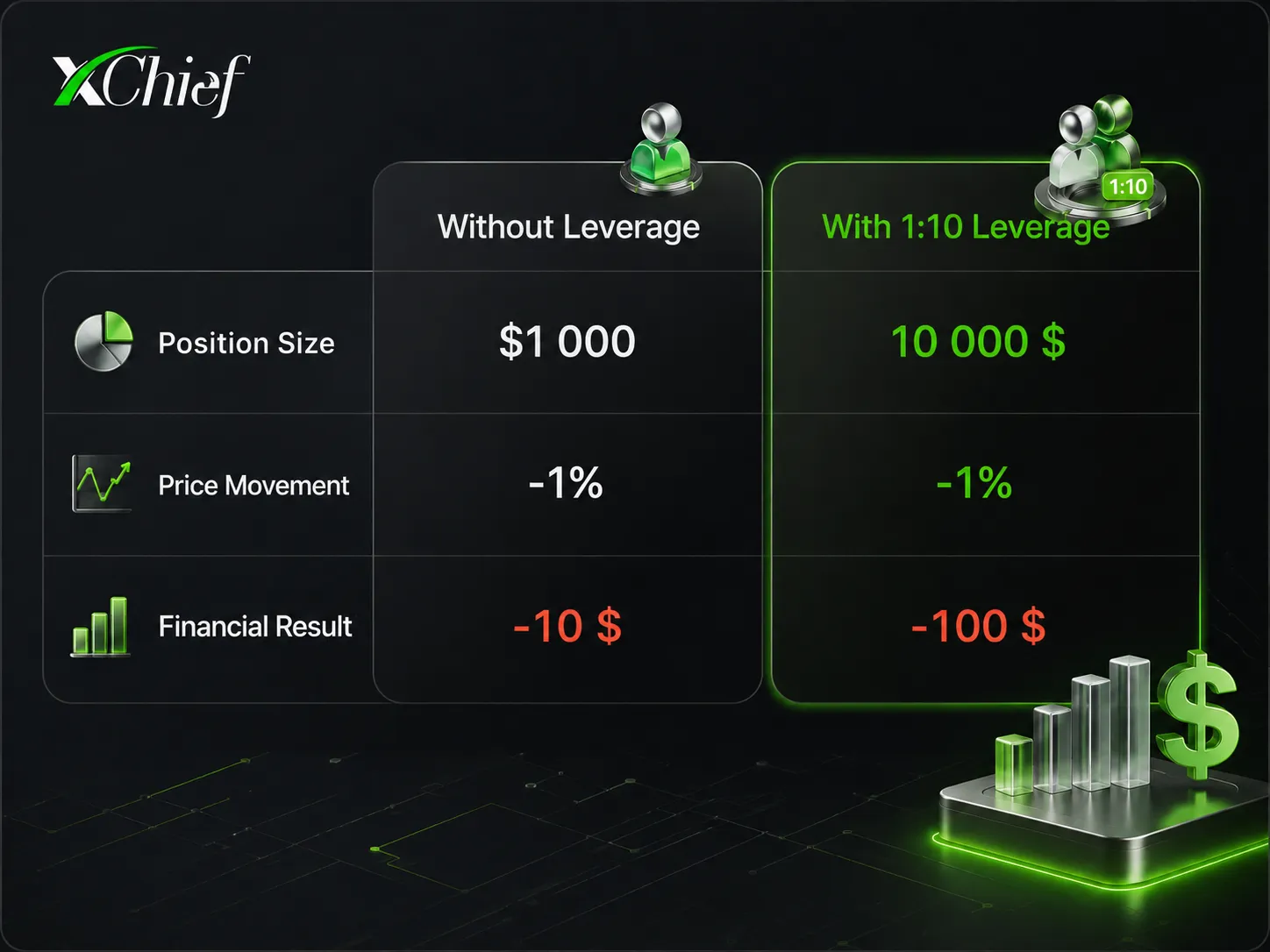
The market moved by the same amount in both cases. But for the second trader, the consequences were ten times more severe — simply because the position size was larger. This is exactly how leverage amplifies the impact of even small price fluctuations.
During periods of increased volatility, this effect becomes even more noticeable. When the price moves rapidly in an unfavorable direction, the loss also increases faster. If the position size is too large and the risk has not been limited in advance, losses can reach a significant portion of the deposit within a relatively short period of time.
At the same time, the market does not become more volatile simply because the trader uses leverage. What changes is the sensitivity of the position itself to these fluctuations.
But what happens if the market continues to move against the open position? Let's consider a simple example that shows how the combination of leverage and volatility can lead to substantial losses and why Margin Call and Stop Out occur.
Example of Losing a Deposit
Let's consider a simple situation.
Suppose a trader deposits 1000 dollars into an account and uses leverage of 1:20. This allows them to open a position of 20 000 dollars.
After the trade is opened, the market begins to move against the trader's position. The price of the underlying asset falls by just 3%.
At first glance, such a decline may seem insignificant. But for a trader using high leverage, this is already enough to lose more than half of the deposit.
If the market continues to move against the position, the loss will increase. At a certain point, there may no longer be enough funds in the account to maintain the position. This is when the trader faces a Margin Call and then, if the situation continues to deteriorate, a Stop Out. Let's take a closer look at what these terms mean.
The issue is not leverage itself. A large position simply reacts much more strongly to even small price changes.
What Are Margin Call and Stop Out
Margin Call (margin call) is a warning from the broker that the funds in the trading account are becoming insufficient to maintain open positions. After receiving such a additional margin requirements , the trader can deposit additional funds, reduce the position size, or close some trades independently.
If the loss continues to increase and the level of funds becomes critically low, a Stop Out (forced position closure) may occur. In this case, the broker automatically closes some or all open positions to limit further losses and prevent a negative balance (depending on the broker's terms and the protection mechanisms in place).
Therefore, when using leverage, it is important to consider not only potential profit but also the size of the potential risk. Even an ordinary market movement can lead to a Margin Call or Stop Out if the position size is too large relative to the size of the deposit.
Even if the automatic closing of a position helped prevent further losses, the deposit may already have decreased significantly. This creates a new challenge — recovering the capital. And this usually turns out to be much more difficult than it may seem at first glance.
Why Recovering a Deposit After Large Losses Is More Difficult Than It Seems
After a large loss, it may seem that it is enough to earn the same percentage that was lost. But the mathematics works differently.
The reason is that after a loss, the amount of capital itself decreases. Therefore, recovering the deposit requires a return that is always greater than the percentage of the loss incurred.
For example, if the deposit was 1000 dollars and then decreased by 50%, 500 dollars would remain in the account. To return to 1000 dollars, another 500 dollars must be earned. This means that the remaining capital must now grow by 100%, not by 50%.
The greater the initial losses, the faster the required return for account recovery increases. This is why recovering a deposit becomes significantly more difficult after large losses.
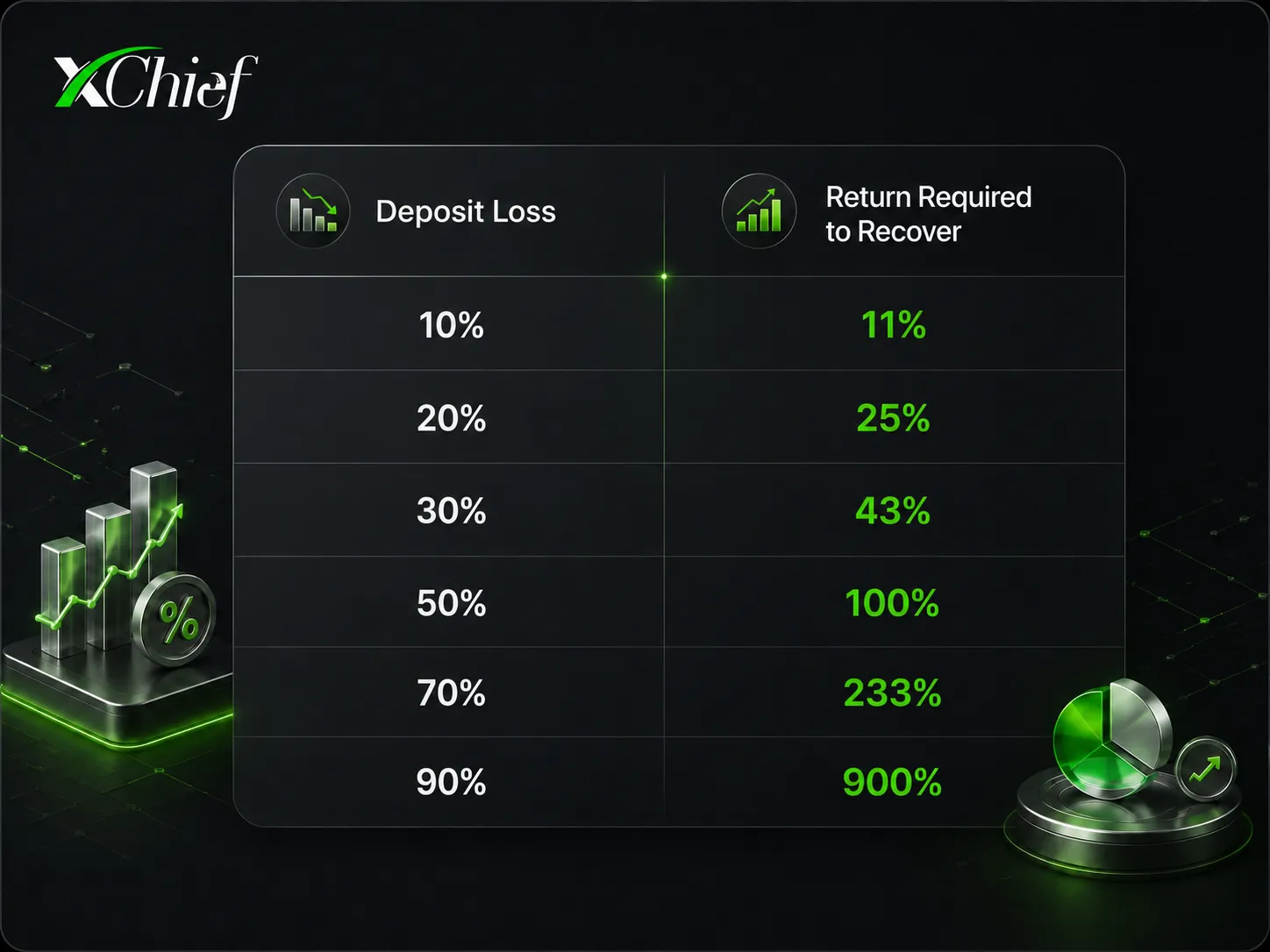
For this reason, experienced traders think first not about how much they can earn, but about how much they can lose on a single trade. Losing a small portion of capital is usually much easier to compensate for with subsequent successful trades. A deep drawdown, however, requires a disproportionately high return and makes recovering the deposit significantly more difficult.
The main conclusion is simple: profit is important, but avoiding large losses is no less important. Preserving capital is often easier than trying to recover it after a serious drawdown.
This raises a logical question: if the consequences of large losses are so serious, why do traders continue to find themselves in such situations? Most often, the reason lies in several common mistakes.
Common Mistakes Made by Beginner Traders
Loss-making trades happen to everyone — both beginners and experienced CFD traders. The only difference is that experienced market participants try to limit potential losses in advance. Beginners, however, often make mistakes that turn an ordinary market movement into a serious drawdown of the deposit.
- Using excessive leverage. The higher the leverage, the larger the size of the open position and the stronger the impact even a small price change has on the financial result. Using the maximum available leverage increases the account's sensitivity to market volatility.
- Not using a Stop Loss. Some traders expect the market to eventually reverse in their favor, so they do not limit the potential loss in advance. If the price continues to move against the position, losses can increase rapidly.
- Taking too much risk in a single trade. Sometimes a trader opens a position so large that one unsuccessful trade results in the loss of a significant portion of the capital. After that, recovering the deposit becomes much more difficult.
- Trying to quickly recover losses. The desire to immediately recover lost money often leads to opening even larger positions and making poorly considered decisions. As a result, the risk increases even further.
- Increasing the position as losses grow. Some traders continue buying or selling an asset in an attempt to improve the average entry price. Such a strategy can be extremely risky if the market continues moving in the same direction.
Most major losses occur not because of one mistake, but because of a combination of several mistakes. High leverage, the absence of a predefined risk level, and emotional decisions during periods of strong volatility significantly increase the probability of serious losses.
Most risks of leveraged trading can be significantly reduced. This does not require complex capital management strategies — it is enough to follow several basic risk management principles.
Basic Risk Management
CFD trading always involves a certain level of risk. That is why risk management in CFD trading plays a key role. It helps limit potential losses and preserve capital.
One of the main principles is to determine the maximum acceptable risk for each trade in advance. If the potential loss is limited to a small portion of the deposit, even a series of unsuccessful trades will not lead to a critical account drawdown.
It is equally important to use a Stop Loss — a protective order that automatically closes a position when a predetermined loss level is reached. This approach helps avoid situations where emotions prevent a trader from exiting a trade in time.
Another important principle is choosing the correct position size. Even if the broker allows high leverage, this does not mean it should be used to the maximum. The position size should correspond to the deposit and to the level of risk the trader is prepared to accept.
Finally, it is important to follow a predefined trading plan. Impulsive decisions, attempts to quickly compensate for losses, or opening trades without a clear strategy often lead to risk getting out of control.
Risk management does not guarantee profits and does not eliminate losing trades. Its purpose is to prevent a situation in which one or several unsuccessful trades result in the loss of a significant portion of the capital.
Conclusion
Leverage in CFD trading is not a cause of losses by itself. It only increases the impact of price movements on the financial result of a trade. CFD trading requires particular attention to risk management. That is why position size, market volatility, and adherence to risk management rules are of key importance. The better a trader understands the relationship between leverage, position size, and volatility, the easier it becomes to control risk and make more balanced trading decisions.
Frequently Asked Questions
Is It Dangerous to Use Leverage?
The danger is determined not by leverage itself, but by how it is used. It simply allows a trader to open a position larger than the amount of their own funds. Risk depends not so much on the leverage ratio itself as on the position size, the level of market volatility, and compliance with risk management rules.
Can High Leverage Be Used Safely?
High leverage does not automatically mean high risk. If a trader opens a small position and limits the potential loss in advance, the level of risk can remain under control. Conversely, even relatively low leverage can lead to significant losses if the position size is too large in relation to the deposit.
How Can You Tell If the Position Size Is Too Large?
There is no single universal value. If even a small market movement can result in the loss of a significant portion of the deposit or trigger a Margin Call, the position size is most likely too large. Before opening a trade, it is important to assess the potential loss in advance and make sure that it is consistent with your trading plan.
Does High Volatility Always Mean High Risk?
Not necessarily. Volatility shows how actively the price of an asset changes, but by itself it does not cause losses. For a trader, risk increases when high volatility is combined with a large position size or excessive leverage.
Can Margin Call and Stop Out Be Avoided?
It is impossible to completely eliminate this possibility, but it can be significantly reduced. To do this, it is important to use a reasonable position size, limit potential losses in advance with a Stop Loss, and avoid risking a significant portion of the deposit in a single trade. This approach helps maintain a reserve of free margin even when the market moves unfavorably.
Does a Stop Loss Always Limit Losses?
In most cases, a Stop Loss helps automatically close a position when a specified price level is reached. However, during periods of high volatility or price gaps, the trade may be executed at a price different from the specified level. Therefore, a Stop Loss significantly reduces risk, but does not always guarantee the exact closing price of a position.
Can You Lose More Money Than Is Available in Your Account?
The answer depends on the terms of the specific broker and the applicable regulation. Many modern brokers provide negative balance protection, under which losses are limited to the funds available in the trading account. Before starting to trade, it is advisable to review the broker's terms of service and balance protection policy.
Why do traders lose their deposits?
Most often, the cause is not a single factor but a combination of several factors: using excessive leverage, the absence of risk management, attempts to quickly recover losses, and opening positions that are too large. Leverage itself does not cause the loss of a deposit, but when combined with high volatility and mistakes in risk management, it can significantly increase losses.
Why Do Experienced Traders Continue to Use Leverage?
Leverage allows capital to be used more efficiently and enables more flexible position size management. When risk management rules are followed, it can be a useful tool for implementing a trading strategy. At the same time, experienced traders usually pay more attention to risk control and position size than to the maximum leverage available.


