


















Why Nvidia’s Records No Longer Shock the Market
AI Future Frightens Investors
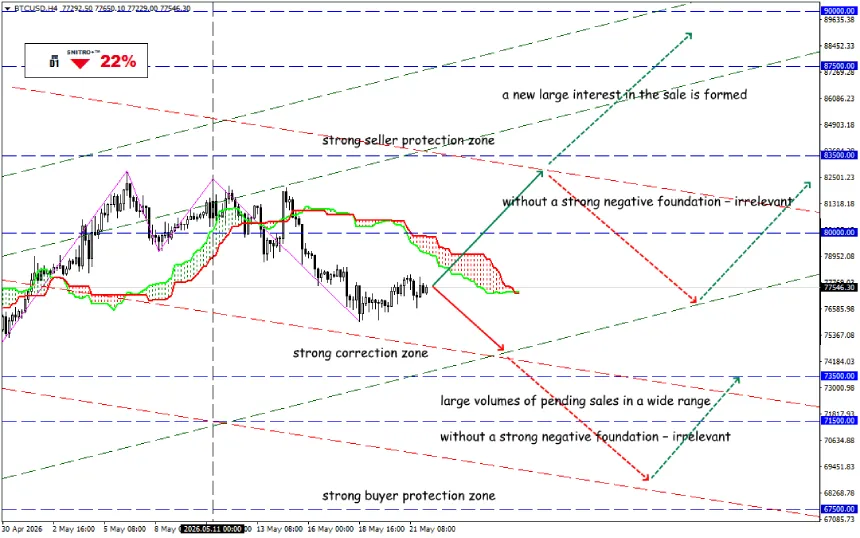
BTC/USD
Key zone: 75,000 - 78,000
Buy: 78,500 (on strong positive fundamentals); target 83,500-87,500; StopLoss 77,500
Sell: 75,000 (on a pullback following a retest of 76,500); target 71,500-70,000; StopLoss 76,000
Just two years ago, any quarterly report from Nvidia triggered a storm in the market. The company demonstrated fantastic revenue growth, its market capitalization reached new all-time highs, and the stock could gain 10–20% in a single day after earnings releases. Now the situation has changed — the reaction is becoming increasingly restrained.
Reminder:
Nvidia once again posted a strong quarter, a confident forecast, and confirmation that demand for AI infrastructure remains high. The company’s revenue in the first fiscal quarter of 2026 increased by 85% to $81.6 billion, exceeding analysts’ expectations. The forecast for the next quarter also came in above consensus: Nvidia expects around $91 billion in revenue versus a forecast of $87 billion.
Nevertheless, investors are no longer impressed by new records in profit, margins, or sales volumes of AI accelerators. Moreover, during some periods Nvidia shares declined even after strong reports. The reason is that the market is gradually moving from the stage of “AI euphoria” to the stage of assessing real risks, demand sustainability, and future growth rates.
Nvidia’s main problem is extremely inflated expectations.
Over recent years, the company has transformed from a gaming GPU manufacturer into a key supplier of infrastructure for artificial intelligence. Virtually all of the world’s largest AI projects — OpenAI, Microsoft, Amazon, Meta, Google, and Tesla — use Nvidia solutions for neural network training.
However, the market lives on expectations of the future, not the past. And the higher a company rises, the harder it becomes to surprise investors.
If earlier revenue growth of 50% seemed fantastic, now the market demands:
- maintaining growth rates;
- a constant shortage of AI chips;
- new technological breakthroughs;
- expansion into new segments.
Most positive expectations are already priced into the stock value in advance, which is precisely why even record-breaking figures no longer trigger the previous reaction.
In 2023–2024, artificial intelligence was the main driver of the stock market. Any company associated with AI automatically received a valuation premium.
Today the situation is becoming more mature:
- AI has already ceased to be an experiment;
- corporations have integrated neural network spending into their budgets;
- infrastructure investments are becoming routine.
This reduces the emotional effect of Nvidia-related news.
Another factor is Nvidia’s dependence on several gigantic clients: Microsoft, Amazon, Google, Meta, and Oracle. But these same companies are now actively developing their own AI chips. This does not mean an immediate rejection of Nvidia; however, the market understands that Nvidia’s monopoly will not last forever.
Even a slight reduction in market share could significantly affect the company’s future growth rates, especially given its current enormous capitalization.
Another strategic risk is China. Nvidia effectively remains cut off from one of the largest markets for semiconductors and AI infrastructure. U.S. export restrictions were intended to limit China’s access to advanced accelerators, yet a side effect was the acceleration of the local semiconductor ecosystem.
Demand in China remains high, Huawei is strengthening, and local chip manufacturers are feeling increasingly confident precisely because Nvidia has effectively left this market.
For investors, this creates a difficult contrast. On the one hand, Nvidia demonstrates that it can continue growing even without a significant contribution from China to data-center revenue. On the other hand, the company is losing access to a market that previously was an important part of its business and potentially could have generated tens of billions of dollars annually.
And what is the result?
Nvidia’s records no longer impress the market not because the company is weakening. On the contrary, Nvidia remains one of the strongest technology businesses in the world.
Investors are beginning to look deeper: how sustainable the AI boom is, whether clients will be able to recoup their spending, how quickly competition will intensify, and whether Nvidia will be able to maintain its monopoly. The market’s reaction is becoming colder and more rational.
For long-term investors, Nvidia still remains a key company of the AI era. But the era of unconditional euphoria surrounding its earnings reports is becoming a thing of the past.
So we act wisely and avoid unnecessary risks.
Profits to y’all!


