



Wall street is reallocating capital
Which stocks will benefit from the new congress
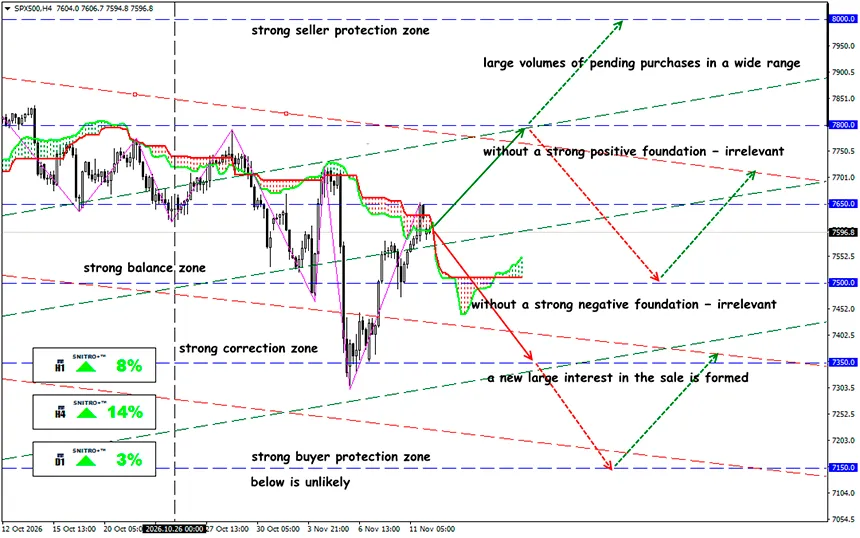
SP500
Key zone: 7,550 - 7,650
Buy: 7,700 (on strong positive fundamentals); target 7,950; StopLoss 7,630
Sell: 7,500 (on a pullback following a retest of 7,600); target 7,250; StopLoss 7,570
Democrats gained control of both chambers of Congress, changing expectations for U.S. trade policy, budget spending, and business regulation. But a significant gap remains between campaign promises and actual changes in corporate profits. A change in the composition of government officials does not yet mean a change in the laws.
The November 3, 2026, midterm elections changed the political configuration of the United States, while Trump retains presidential power. For financial markets, this means a transition from unified Republican control to divided government, in which budget decisions, legislative initiatives, and trade policy become subjects of more complex negotiations.
Lawmakers elected in November will take office in January 2027. Until then, the market is trading primarily on expectations of future decisions rather than regulatory changes that have already been enacted.
A reminder:
During the first full session after the elections, on November 4, the S&P 500 gained 1.6%, the Nasdaq rose 1.4%, and the Dow Jones advanced 3.1%. However, the reaction of individual industries was considerably less uniform than the movement of the broad indexes. Investors were simultaneously assessing the likelihood of tariff relief, reduced geopolitical tensions, and changes in federal spending priorities.
By November 11, U.S. stock indexes had partially recovered from the initial volatility. The S&P 500 gained 1.3%, the Nasdaq Composite rose 1.6%, and the Dow Jones advanced 0.5%. Political uncertainty did not lead to a sustained withdrawal of investors from U.S. equities.
Relative sector performance remains uneven.
- Growing interest in funding Medicaid and Affordable Care Act programs.
- Renewable energy producers are hoping for a revision of budgetary and regulatory priorities.
- Defense and oil and gas companies came under pressure amid expectations of a change in the approach to the war with Iran.
- Producers of alcoholic beverages and household goods, as well as retail chains, benefited from expectations of easing import restrictions.
By November 11, the technology sector was already participating in the broader market recovery. The initial negative reaction to the election results merely closed out speculative positions and did not break the medium-term trend.
A majority in government does not guarantee the repeal of tariffs, as Trump retains veto power. This creates a fundamental constraint on large-scale legislative reform. And it is far from certain that Democrats will risk repealing tariffs. Import restrictions may be supported by lawmakers from both parties, especially when it comes to manufacturing, semiconductors, metallurgy, and national security.
The investment conflict lies in the fact that political expectations can quickly change stock valuations, while the actual impact of new laws on corporate profits becomes apparent much later. It is precisely this time gap that creates both opportunities for sector rotation and the risk of premature positioning.
So What Is the Outcome?
Before the new Congress takes office on January 3, 2027, it is worth focusing on stocks that are already responding to political expectations, without waiting for legislative changes. Interest in NVIDIA, Lam Research, and AI infrastructure remains intact.
Defense companies faced a reassessment of expectations regarding federal spending and geopolitics, but speculative trading opportunities remain. Following the elections, on November 4, Northrop Grumman (NOC) shares lost 2.7%, while Lockheed Martin (LMT), RTX Corporation (RTX), and L3Harris Technologies (LHX) each declined by more than 2%.
U.S. producers of steel, aluminum, and certain industrial components, including Caterpillar (CAT), Deere & Company (DE), and Boeing (BA), will seek to defend their market share, and this can also present profit opportunities.
The performance of Healthcare (HCA), Universal Health Services (UHS), and Centene (CNC) shares is also of interest, as investors expect a Democratic Congress to push for the restoration or expansion of healthcare programs.
The fundamental performance of U.S. stocks will continue to depend on corporate earnings, technology investment, the state of the economy, and Federal Reserve decisions. Therefore, the main question for investors is not which industries are politically closer to the new Congress, but which companies will actually see improved cash flows following changes in trade and financing rules.
So we act wisely and avoid unnecessary risks.
Profits to y’all!


