



Trump vs. Xi: Tariffs, Chips, and the Yuan
Trade Deal or Escalation?
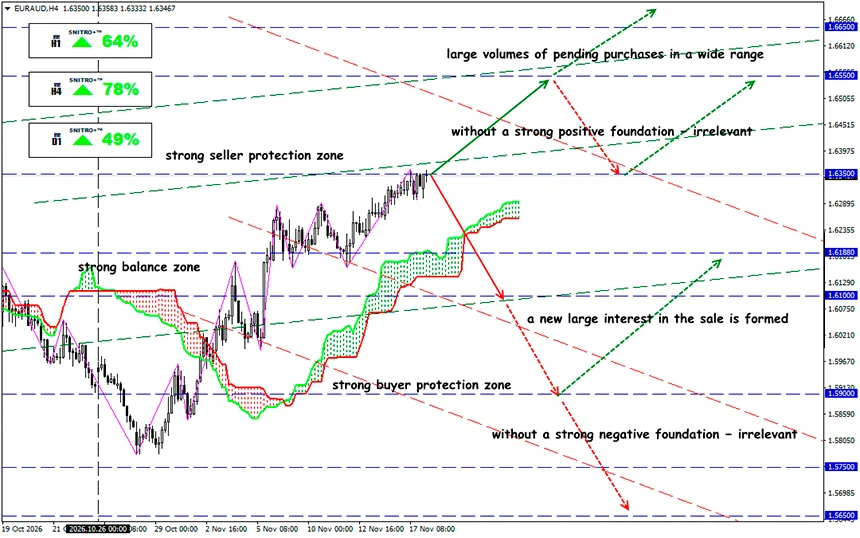
EUR/AUD
Key zone: 1.6300 - 1.6400
Buy: 1.6420 (on a pullback after a retest 1.6350) ; target 1.6550-1.6650; StopLoss 1.6370
Sell: 1.6250 (on strong negative fundamentals) ; target 1.6100-1.6050; StopLoss 1.6320
The summit in Shenzhen will test the resilience of the U.S.-China trade truce. Tariffs, exports of advanced chips, rare earth metals, and investment restrictions could change demand for the yuan, yen, and commodity currencies. But sustained market movements will require concrete decisions rather than diplomatic statements.
The Asia-Pacific region is approaching the event with a fundamental contradiction. On November 18–19, China will host the APEC summit, while talks between Trump and Xi Jinping are expected on November 19. Both sides say they are ready to negotiate, and the existing truce limits the likelihood of immediate escalation, but the key issues of tariffs, chips, and critical minerals remain unresolved.
For the foreign exchange market, the mechanism through which these risks are transmitted is particularly important. Easing trade restrictions could improve expectations for Chinese exports, support Asian equities, and boost demand for industrial metals. An escalation of the conflict could trigger the opposite reaction — a weakening yuan, a reduction in carry trades, and increased demand for safe-haven currencies.
The main question for traders is whether the summit will mark the beginning of practical changes to trade rules or merely prolong the existing uncertainty.
A reminder:
On November 9, China announced a two-month extension of certain measures under its trade truce with the United States. In particular, the suspension of an additional 24% tariff on American goods was maintained. The baseline 10% rate remained in effect. In September, Washington and Beijing discussed a package of reciprocal tariff concessions worth approximately $60 billion, but by mid-November, the process had stalled.
- For China, lower U.S. tariffs could potentially improve export competitiveness, reduce pressure on manufacturing companies, and support economic growth expectations.
- For the United States, tariff concessions could reduce the cost of imported components and consumer goods. This could improve the margins of certain companies and ease imported inflation.
The claim that lower tariffs benefit all market participants is incorrect.
For us, it is fundamentally important to distinguish between three types of news:
- Political statement: a willingness to continue negotiations without changing existing tariffs.
- Framework agreement: an agreement on principles and timelines that could change expectations.
- Regulatory decision: a published change in tariff rates, exemptions, or procedures that directly affects businesses.
It is the third option that can deliver the most sustainable repricing of corporate cash flows.
Control over rare earth metals, magnets, and specialized chemical materials remains an important tool in trade negotiations. A short-term positive reaction in Asian equities is possible, but its sustainability will depend on subsequent official decisions.
For EUR/AUD, SELL is of interest if an improvement in China's trade outlook and a rise in industrial metals are confirmed. BUY is of interest if expectations for Chinese demand deteriorate and the AUD weakens relatively. Confirmation should be sought in the movements of iron ore, copper, and Australian interest rate expectations.
So What Is the Outcome?
The main risk is that diplomatic rapprochement on tariffs could be accompanied by further tightening of technology restrictions. In that case, Asian stock indexes and the U.S. semiconductor sector could react in opposite directions.
The base-case scenario assumes continued diplomatic dialogue without an immediate large-scale revision of trade rules. For USD/CNH, this means the likelihood of a limited reaction to general statements. GBP/JPY will primarily reflect changes in global risk appetite, while EUR/AUD will reflect expectations for Chinese industrial demand and commodity market movements.
A positive outcome from the negotiations could support the yuan, Australian dollar, Asian equities, and industrial metals. The market could react quickly to a diplomatic signal, but if tariff concessions are accompanied by new restrictions on advanced technologies, market reactions could prove contradictory.
So we act wisely and avoid unnecessary risks.
Profits to y’all!


