

















Tokens instead of paper: new opportunities and complex risks
The IMF warns about the risks of tokenization
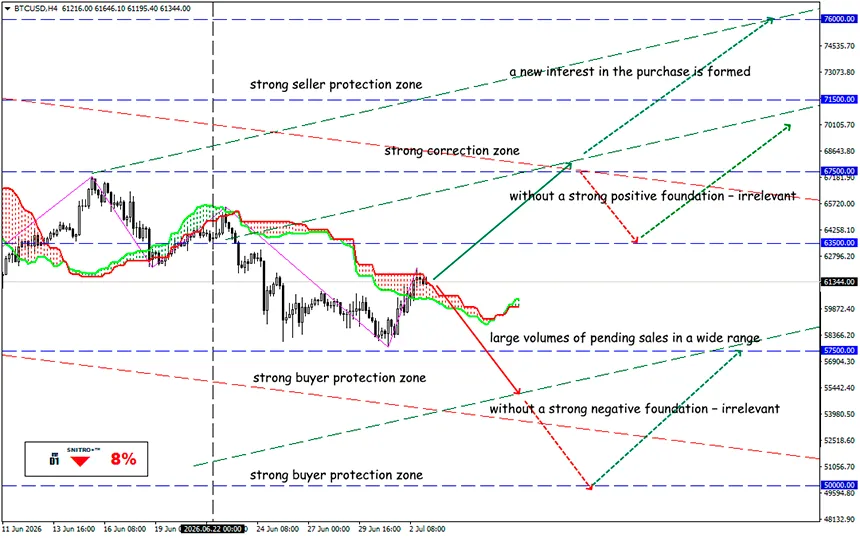
BTC/USD
Key zone: 60,000 - 63,000
Buy: 63,500 (on strong positive fundamentals); target 67,500-70,000; StopLoss 62,500
Sell: 57,500 (on a pullback following a retest of 60,000) ; target 53,500-51,500; StopLoss 58,500
The IMF's latest report examines emerging trends in the digital economy and concludes that tokenization has the potential to reshape the architecture of the global financial system. In this highly respected financial publication, tokenization is described not as an isolated technological improvement but as a structural shift capable of increasing market fragmentation and systemic risks.
New concepts require new standards.
Reminder:
Payments, securities, and derivatives have long existed in digital form, yet they still rely on centralized databases and sequential processing. A transaction is executed first, then goes through clearing, settlement, and reconciliation.
Tokenization fundamentally changes this sequence. If assets and liabilities are transferred to shared digital ledgers, execution, clearing, and settlement can occur almost simultaneously and be managed by software. This reduces costs and accelerates transactions, but it also removes some of the traditional safeguards. In the conventional financial system, delays between processing stages give market participants and regulators time to intervene in the event of errors or financial stress.
In such an economy, liquidity needs arise in real time, collateral requirements can be fulfilled automatically, and disruptions spread much faster. According to the IMF, risk shifts away from the balance sheets of banks, funds, and other financial institutions toward platforms, smart contracts, infrastructure providers, and data quality.
The primary challenge is selecting the settlement asset for final payments. Historically, this role has been performed by central bank money, primarily reserves held by financial institutions in accounts at systemically important banks. Within a tokenized financial system, three alternative models are emerging:
- Tokenized bank deposits — a bank liability represented in digital form that preserves the existing banking and regulatory framework but requires significantly stricter 24/7 liquidity management.
- Stablecoins — offer programmability and global accessibility but depend on the issuer's promise of redemption at par into other forms of money. Their stability depends on reserve quality, market liquidity, and the issuer's financial strength.
- Tokenized central bank reserves — eliminate the credit risk of the settlement asset but require central banks to play a much deeper role within programmable financial infrastructure.
- New risks arise through both concentration and fragmentation. If platforms are incompatible, liquidity may become "trapped" or even effectively "lost" within isolated financial ecosystems. In that case, tokenization would not eliminate fragmentation—it would create a new form of it: technological, legal, and regulatory.
- Another important risk involves oversight of software code. If transaction rules are embedded in smart contracts, regulatory supervision must also extend to the underlying programming logic.
- The legal framework remains a separate challenge. Market participants must clearly understand whether a ledger entry constitutes legal proof of ownership, whether blockchain-based settlement has full legal validity, and which jurisdiction's laws apply in the event of disputes.
- Risks increase further if private global stablecoins become the dominant means of payment. In such a scenario, part of a country's monetary infrastructure could effectively migrate into an ecosystem operating beyond the direct control of its regulators.
All three models are legally viable, but in practice only stablecoins have so far achieved meaningful technological implementation.
What does this mean?
The transition of the global economy onto on-chain infrastructure is no longer an experiment. It is already advancing rapidly through stablecoins and is gradually expanding to U.S. Treasuries and other real-world assets.
Tokenized money and assets have the potential to accelerate cross-border capital flows, strengthen currency substitution, and weaken monetary sovereignty.
As a result, the future architecture of tokenized finance will depend not only on transaction speed and programmability. The decisive factors will be the choice of a secure settlement asset, platform interoperability, legal certainty, code governance, and international coordination.
So we act wisely and avoid unnecessary risks.
Profits to y’all!


