



The Pound against the Dollar: Britain faces another stress test
Why the BoE is ready to raise rates
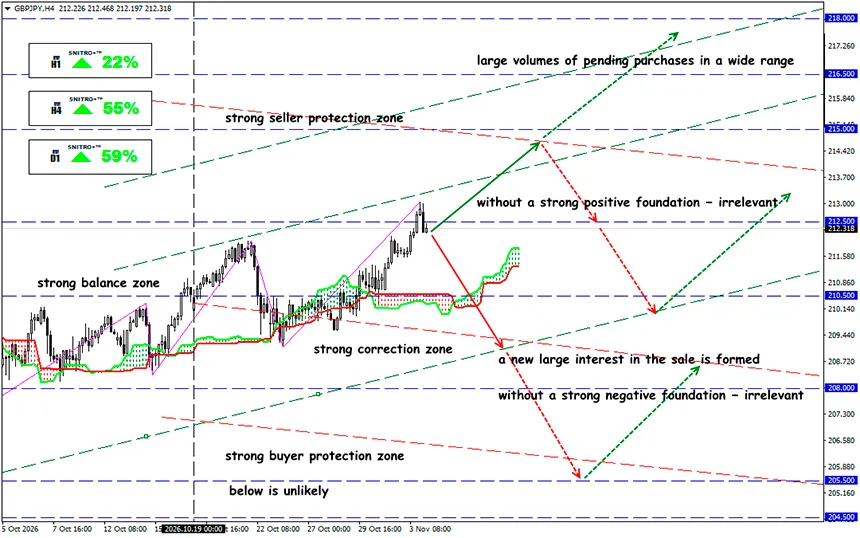
GBP/JPY
Key zone: 211.50 - 213.00
Buy: 213.50 (on a decisive break of 213.00); target 216.50-217.00; StopLoss 212.80
Sell: 211.00 (on strong negative fundamentals) ; target 207.50; StopLoss 211.70
The central bank's meeting will be a serious test for the pound. The market is assessing the likelihood of monetary tightening, but the decisive factor will be not only the interest rate, but also the inflation forecast and the trajectory of British bond yields. Different scenarios are possible.
The Bank of England approaches its November meeting facing a conflict between two objectives: containing inflation and preventing excessive cooling of the economy. The situation is complicated by the energy shock, high borrowing costs, and geopolitical uncertainty.
A reminder:
On September 17, the Monetary Policy Committee kept the interest rate at 3.75% by a vote of 6 to 3. Three committee members favored an immediate increase of 25 basis points. This is an important signal: a group of supporters of additional tightening has already formed within the BoE. An increase from 3.75% to 4.00% has now become analysts' base-case scenario, but it cannot be considered guaranteed.
The main threat to the British economy is not so much the initial rise in energy prices as its transmission to wages, services, and inflation expectations.
Monetary tightening becomes justified if the energy shock turns into persistent domestic inflation. But if price increases remain predominantly external and temporary, raising rates could deepen the decline in consumption and investment without eliminating the underlying cause of inflation.
For the pound, the reason why the BoE raises rates is fundamentally important. For example, an increase to 4.00% would bring the British rate level with the upper bound of the Fed's target range and put it 12.5 basis points above the midpoint. However, this does not mean an automatic advantage for the pound. Money markets expect an additional Fed rate hike in December, so the U.S. yield curve also includes a premium for further tightening.
- A rate hike against the backdrop of a resilient economy and domestic inflation supports the currency more strongly than a forced response to an imported energy shock.
- The political factor compounds the problem, but a weaker dollar amid political uncertainty and a declining premium on U.S. assets would support the pound.
- The pound has already strengthened in anticipation of the BoE decision. This reduces the likelihood of a sustained rally based solely on a 25-basis-point rate hike.
- The market could respond by selling GBP if the increase is accompanied by a signal of a prolonged pause. Conversely, upward revisions to inflation forecasts and continued hawkish rhetoric could create conditions for further gains.
- Rising British yields increase the attractiveness of long positions in GBP/JPY. However, the Japanese yen can strengthen sharply during periods of deleveraging and selloffs in risk assets. Therefore, even a BoE forecast favorable to the pound does not guarantee a sustained rise in this cross.
And What Was the Result?
A BoE rate hike to 4.00% is already largely priced in. Therefore, a strong GBP rally requires additional hawkish signals, not simply a 25-basis-point rate change.
The main medium-term threat to the pound is stagflation. If the energy shock continues to accelerate inflation while the economy slows, a high interest rate will no longer be viewed as an unequivocal advantage for the British currency.
The most dangerous scenario for pound buyers is a rate hike accompanied by downward revisions to economic growth forecasts and no signals of further increases. Such a decision could trigger the classic "buy the rumor, sell the fact" reaction: the market takes profits on GBP because the rate hike, once implemented, was already priced in.
For event-driven trading, it is advisable to wait for the market's initial reaction. At a meeting accompanied by the publication of the Monetary Policy Report, the initial move could be completely reversed following Andrew Bailey's comments.
The main idea: the market is not trading the November 5 interest rate decision, but the cost of money in 2027. It is the BoE's forecast that will determine whether the November hike becomes the beginning of sustained pound appreciation or a reason to close already accumulated long positions.
So we act wisely and avoid unnecessary risks.
Profits to y’all!


