

















The market no longer belongs to traders
Social media posts have become more important than fundamental analysis
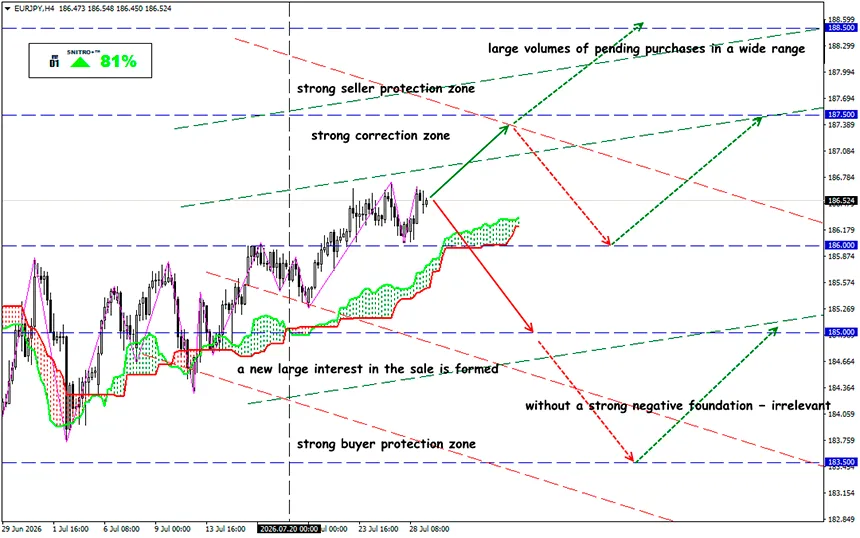
EUR/JPY
Key zone: 186.00 - 187.00
Buy: 187.20 (on strong positive fundamentals); target 188.50; StopLoss 186.60
Sell: 185.80 (on a pullback after retesting 186.50) ; target 184.00; StopLoss 186.40
Just a few years ago, a trader's greatest advantage was considered to be knowledge, experience, an understanding of macroeconomics, and the ability to read price charts. Today, that is no longer enough. Increasingly, asset prices are determined not by the quality of analysis, but by the speed at which information is received.
Until recently, financial markets were believed to provide relatively equal access to information.
But if a single political post can change the capitalization of the U.S. stock market by $4 trillion within a matter of hours, then the market has entered a new phase in which the most valuable asset is no longer capital, but access to information.
Let's recap.
On April 7, 2025, journalists asked Donald Trump whether a pause in tariffs was being considered. His answer was no.
A White House representative also stated that such reports were false. Two days later, on April 9, Trump posted a brief message on Truth Social: "THIS IS A GREAT TIME TO BUY!!! DJT".
Less than four hours later, the U.S. administration announced a 90-day pause on reciprocal tariffs with China. The consequences were historic. The S&P 500 surged 9.5%, while the U.S. stock market regained approximately $4 trillion in market capitalization, recovering most of the losses recorded during the previous trading sessions.
Similar patterns have since repeated multiple times:
- Announcements of new tariffs triggered sell-offs.
- Comments suggesting tariff easing brought buyers back into the market.
- Statements regarding Iran instantly moved oil prices.
Political headlines began influencing asset prices faster than corporate earnings reports, inflation statistics, or Federal Reserve decisions. Today, competitive advantage is measured not by knowledge, but by milliseconds. The key question is: who receives the information first?
Analysis of trading activity revealed a sharp increase in call option purchases roughly ten minutes before the tariff pause announcement was published. Major Wall Street trading firms rely on high-frequency algorithms, specialized news services, and expensive information platforms that analyze news flows and execute trades almost instantly.
Situations like these cannot be evaluated using traditional analytical methods. They cannot be predicted from charts. They cannot be incorporated into financial models. The market begins moving before the news becomes public for most participants. Retail investors find themselves at the very end of the information chain: by the time a notification appears on their smartphone, prices have already adjusted.
According to the Financial Times, the Truth API service, scheduled to launch on August 1, will allow subscribers to receive posts from Donald Trump and other popular Truth Social accounts before other users.
According to Reuters, the subscription could cost as much as $100,000 per month, while long-term contracts may reduce the monthly fee to around $60,000. Information inequality is becoming the new normal.
Financial markets are gradually becoming two-tiered.
- The first tier belongs to those who receive information before everyone else.
- The second belongs to those who are forced to react after prices have already changed.
This means that risk management, macroeconomic understanding, liquidity analysis, and the ability to assess market structure rather than individual headlines are becoming increasingly important. Everything else is simply informational noise.
So, what's the bottom line?
The problem with modern trading is not the emergence of the so-called "Trump Indicator."
The market has entered an era of information inequality, where political statements and the speed of receiving information have become independent drivers of investment returns. A professional trader succeeds not because they are the first to read Donald Trump's latest post. They succeed because they understand how the market is likely to behave after everyone else has already seen it.
Ultimately, a trader's greatest competitive advantage remains the ability to correctly interpret how new information will affect price.
So we act wisely and avoid unnecessary risks.
Profits to y’all!


