









South Korea: a rescue program for the kospi
How the country turned into a casino
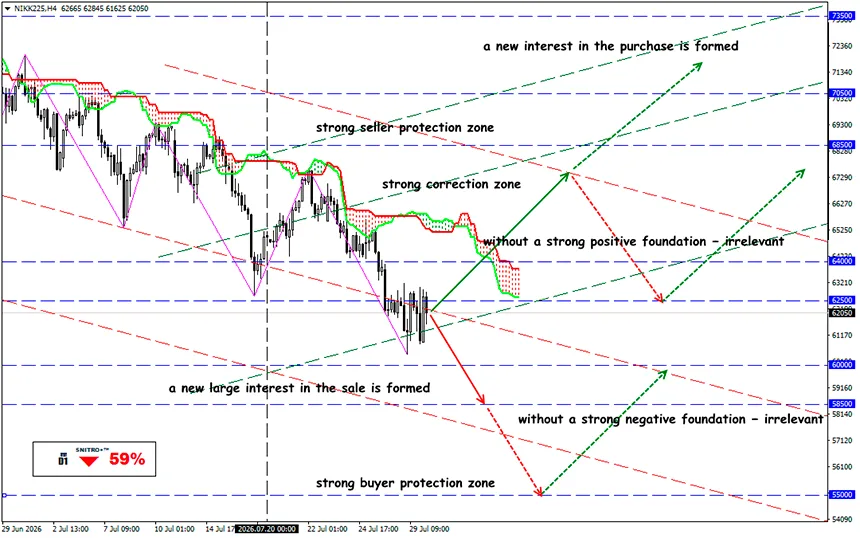
NIKK225
Key zone: 61,800 -63,500
Buy: 64,000 (on strong positive fundamentals); target 67,500; StopLoss 63,300
Sell: 61,300 (on a confident break above 61,500); target 58,500; StopLoss 62,000
Business leaders have questioned the government's response to the market turmoil triggered by the introduction of leveraged single-stock ETFs earlier this year. Following an emergency F4 meeting attended by the finance minister, the governor of the Bank of Korea, and the heads of the country's two financial regulators, the authorities decided against launching a large-scale stock market intervention. Instead, they focused on limiting the primary source of volatility — high-risk ETF products.
Let's recap:
- On July 28 and 29, South Korea's benchmark Kospi index lost 16%, with exchange circuit breakers halting trading on both days. The sell-off was driven by growing doubts over the profitability of AI infrastructure investments and concerns about intensifying competition in the memory chip industry.
- The index has fallen by approximately 40% from its June peak.
- On Wednesday, the decline accelerated after SK Hynix released earnings that disappointed investors and reinforced concerns that enthusiasm for AI-related spending may be fading.
Government officials acknowledged that leveraged single-stock ETFs, introduced in May, may have contributed to increased market volatility, although they emphasized that these products were only one of several factors behind the broader market decline.
Meanwhile, South Korean retail investors — often referred to domestically as "gambling investors" — have begun organizing to defend their interests after suffering significant losses. Some traders have even ended up owing money to their brokers, prompting discussions about filing collective complaints.
Key decisions from the emergency meeting:
- Restrictions have been introduced on investments in leveraged single-stock ETFs. Retail investors will now be allowed to allocate no more than 20% of their investment portfolio to such funds.
- Trading costs for transactions involving these ETFs will increase in order to curb excessive speculative activity.
- Beginning July 31, a minimum deposit requirement of 30 million won (approximately $20,600) will take effect for trading these instruments.
- The previously imposed ban on launching new leveraged single-stock ETFs and advertising existing ones will remain in force.
- Financial regulators announced round-the-clock market monitoring and confirmed their readiness to introduce additional stabilization measures if necessary.
According to regulators, the market collapse was caused not by fundamental economic weaknesses, but by a combination of several factors:
- large-scale forced liquidations triggered by margin calls;
- heavy concentration of retail investors in Samsung Electronics and SK Hynix through double- and triple-leveraged ETFs;
- disappointment following SK Hynix's earnings report, which was strong in absolute terms but failed to meet the market's excessively high expectations;
- the global correction in AI-related stocks.
The debate has expanded beyond market losses to broader questions surrounding financial regulation. Lawmakers criticized the approval process for leveraged investment products, arguing that concerns about market stability had been ignored when the products were authorized.
Finance Minister Koo Yun-cheol publicly acknowledged that the government had underestimated the risks associated with approving these ETFs. He apologized to investors and announced plans to establish a legal framework for market stabilization mechanisms similar to those used in Hong Kong.
So, what's the bottom line?
Most analysts believe the new restrictions could reduce speculative activity in the future, but:
- they do not solve the problem of existing leverage already accumulated in the market;
- they do not apply to similar foreign ETFs;
- they do not eliminate the main issue — declining investor appetite for overvalued AI companies.
The outcome of the emergency meeting can be viewed as the first stage of the government's response, aimed more at reducing future systemic risks than at delivering an immediate recovery of the KOSPI index. The authorities have chosen market regulation over direct financial support for stock prices.
So we act wisely and avoid unnecessary risks.
Profits to y’all!


