

















San Francisco is trading homes for AI stocks
In the U.S., people are buying real estate with shares that don't yet exist
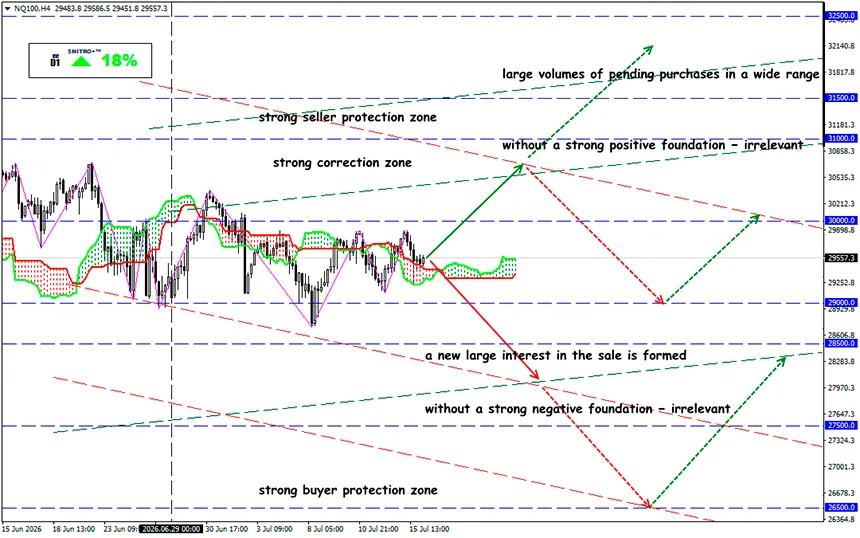
NQ100
Key zone: 29,000 -29,500
Buy: 30,000 (on a positive fundamental basis); target 31,500-32,500; StopLoss 29,400
Sell: 28,500 (on a pullback following a retest of 29,000); target 26,500; StopLoss 29,200
In San Francisco, it is now possible to buy a house using shares of OpenAI or Anthropic. There is just one problem: neither company has completed an IPO, and their shares are not yet publicly traded. Analysts are already drawing comparisons with previous asset bubbles.
Real estate is once again becoming a derivative of the technology market. Property listings are already appearing in which sellers are willing to accept private shares of OpenAI or Anthropic as payment for a home. This demonstrates that the expected valuation of future IPOs is beginning to influence real assets long before a liquid public market even exists.
Reminder:
The frenzy in the housing market is reflected in prices. During the first half of 2026, 144 homes in San Francisco sold for at least $1 million above their original asking price. A year earlier, there had been only eight such transactions, meaning the figure increased eighteenfold. In June alone, 44 such sales were recorded.
- This does not mean that the number of homes worth more than $1 million increased from 8 to 144. Rather, it refers to homes selling for at least $1 million above their initial listing price.
- There is another important nuance: local sellers often deliberately list homes below market value to trigger bidding wars among buyers. Nevertheless, the scale of the premiums clearly reflects the strength of speculative demand.
- At the same time, the number of available listings has fallen by approximately 40–45%, meaning that even a relatively modest inflow of technology wealth is producing a disproportionate surge in home prices.
- The most active segment of the market remains homes priced between $2 million and $5 million, while the number of transactions above $5 million has more than doubled.
Employees of these companies are borrowing against their private shares, selling stakes through specialized secondary-market vehicles, or purchasing homes before an IPO out of concern that thousands of colleagues could enter the market simultaneously after a public listing. According to rough estimates, the combined wealth of current and former employees of OpenAI and Anthropic following potential IPOs could, in theory, be sufficient to purchase roughly 29% of San Francisco's entire housing stock.
This remains a hypothetical scenario. It is not a nationwide housing boom but rather a localized repricing of real estate around the centers where AI-related wealth is being created.
The problem is that private shares of non-public companies cannot be valued with the same confidence as publicly traded securities. The secondary market lacks transparency, transactions occur with varying discounts and restrictions, and the ultimate IPO valuation may differ substantially from prices implied by SPV transactions.
If OpenAI or Anthropic receive lower valuations, postpone their IPOs, or impose stricter lock-up restrictions preventing employees from selling shares quickly, the expected flow of capital into the housing market could be far smaller than investors currently assume. Buyers would then be left owning homes purchased at prices reflecting future technological success while facing today's mortgage payments, taxes, and maintenance costs.
Today, thousands of investors in San Francisco are closely watching secondary-market valuations, IPO timelines, tender offer activity, lending secured by private shares, sales of homes priced above $5 million, and the premium of final transaction prices over original listing prices. Any decline in secondary-market valuations or postponement of IPOs would likely become an early signal that the market is cooling.
What does this mean?
Today's San Francisco is not yet repeating the pattern that led to the housing crisis associated with 2007. At that time, the investment bubble was fueled by widespread mortgage lending, weak underwriting standards, excessive household leverage, and the securitization of low-quality loans.
Today, demand in San Francisco is concentrated among highly paid technology employees and capital owners, while the shortage of housing remains structural. As a result, the current situation more closely resembles the late 1990s: real estate is capitalizing expected technological wealth that has not yet become liquid.
However, the market is already exchanging real homes for faith in the future valuation of companies whose shares still cannot be freely traded. The real question is not whether the AI boom exists, but how many years of future growth have already been priced into every square foot of San Francisco real estate.
Is faith in technology becoming too expensive?
So we act wisely and avoid unnecessary risks.
Profits to y’all!


