











Oil on the blockchain: new standards for the commodity market
Can digital oil make our lives easier?
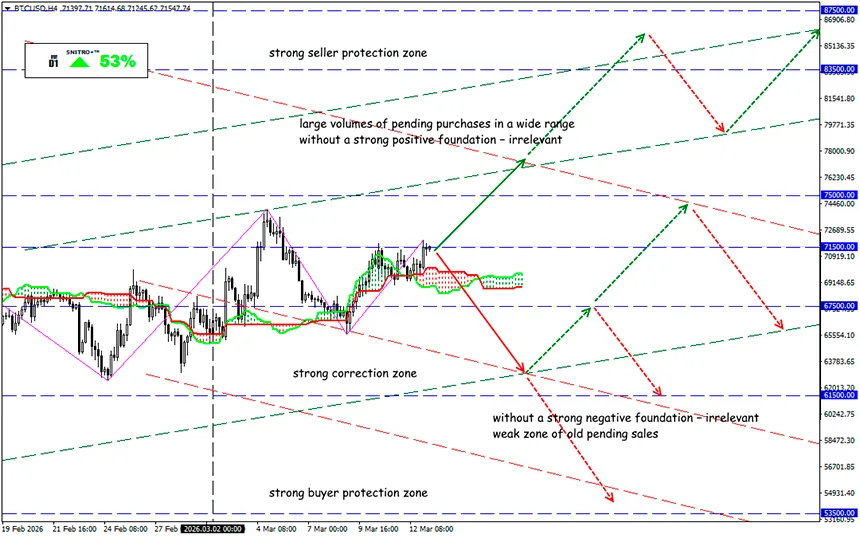
BTC/USD
Key zone: 67,500 - 73,500
Buy: 75,000 (on strong positive fundamentals) ; target 78,500; StopLoss 74,000
Sell: 67,500 (on a confident breakout of 68,500) ; target 63,000-61,500; StopLoss 68,500
The digitalization of financial markets is gradually moving beyond traditional assets and spreading to real physical resources. One of the most promising directions is the tokenization of commodities (RWA), and oil is one of the most convenient targets.
Let us recall:
Tokenized oil is a blockchain-based digital asset that reflects ownership rights or the economic value of physical oil or revenues from its extraction and is directly linked to the market price.
By 2026, the volume of the tokenized oil market is estimated at approximately $500 million, making it one of the key segments of energy assets.
- At the moment, such tokens must be backed by physical oil (1 token corresponds to a certain number of barrels), and this volume is typically stored in warehouses or reservoirs of verified suppliers that guarantee the availability of physical reserves. The token guarantees rights to extraction or revenues from a field, or reflects a share in a production project.
- The price is tracked through smart contracts or derivatives.
- Public or corporate networks (Ethereum, Solana, XRPL, Hedera, etc.) are used for oil tokens, ensuring immutability of records, transparency of ownership, and global accessibility. This reduces the entry threshold and expands access for retail investors.
- Digital oil is traded like a regular token — around the clock and without exchange restrictions on global platforms.
- In the context of the oil market, this could lead to the emergence of global decentralized oil exchanges, tokenization of national oil reserves, and integration of commodity markets with DeFi.
Large oil projects may attract capital through digital assets:
- Tokenization of production — tokens backed by future revenues from oil fields.
- Tokenized funds may issue tokens backed by portfolios of oil assets.
- On some crypto platforms, tokenized oil markets are already demonstrating significant trading volumes.
Several examples:
PetroCoin
A security-token project focused on tokenizing proven oil and gas reserves. The token is implemented in the ERC-20 format on Ethereum and is backed by oil and gas reserves, production revenues, and related energy-sector assets.
OilChain
A platform for tokenizing oil assets through Security Token Offering (STO). The main goal is to create bridge infrastructure between the traditional oil sector and digital financial markets.
Zoniqx / One World Petroleum (OWP)
The first tokenized oil fund operates on the Hedera blockchain and represents tokenized shares in oil assets as well as loans to oil operators.
Chevron Energy Tokenization Ecosystem
Platforms of this type offer tokenization of oil reserves, digital trading, and automated smart contracts.
And what is the result?
The widespread adoption of tokenized oil requires solving a number of institutional and technological challenges, including regulatory restrictions, verification of physical assets, and standardization of infrastructure.
International regulators warn about the risks of tokenization, including legal issues regarding ownership rights, counterparty risks, and integration with the crypto market. This process requires continuous auditing and a transparent legal structure.
Such tokens are subject to double volatility — both from the oil market and the crypto market simultaneously. At the same time, forecasts show that the tokenized asset market could reach $16–24 trillion by 2030.
Tokenized systems may face scalability problems, cyber threats, and dependence on blockchain infrastructure.
In the long term, oil tokenization could become an important stage in the transformation of global commodity markets, but its practical implementation will depend on the interaction of technological innovations, institutional reforms, and market mechanisms.
So we act wisely and avoid unnecessary risks.
Profits to y’all!


