



Oil in Panic: The Market Believes the War Is Ending
Why the Recovery of Exports Matters More Than Diplomatic Promises
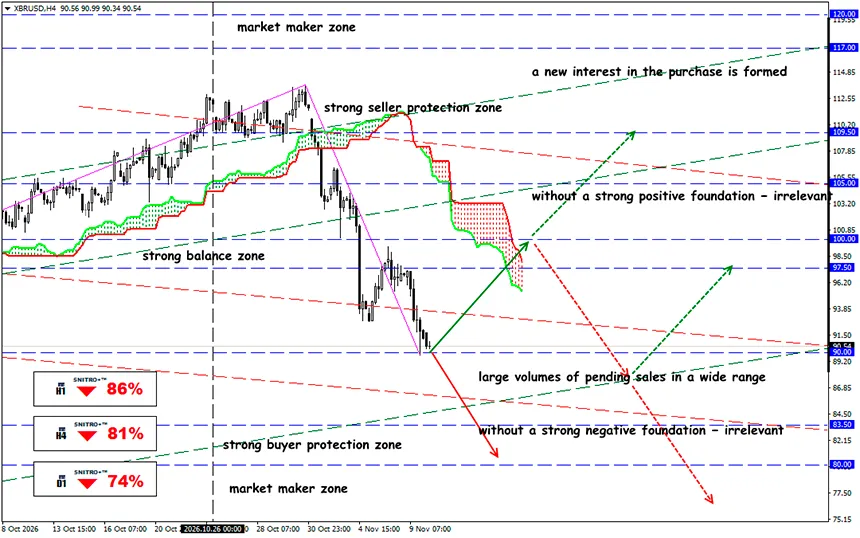
XBR/USD
Key zone: 88.50 - 91.50
Buy: 92.50 (on strong positive fundamentals); target 95.50-97.50; StopLoss 91.80
Sell: 87.50 (on a decisive break above 90.00); target 85.50-83.50; StopLoss 88.20
Brent lost almost 6% in a single day following Trump's statements about a reduced risk of further strikes against Iran. The market is cutting the war risk premium, although attacks on vessels continue and the terms of a peace agreement have not been agreed upon.
The main risk is another repricing of oil if negotiations collapse. However, the Strait of Hormuz remains a military risk zone, and the positions of the US and Iran continue to diverge.
It is fundamentally important to distinguish between three indicators: oil production, export shipments, and the actual delivery of crude to end buyers. Their dynamics can differ significantly. It is precisely this divergence that makes it possible to determine how justified...
A reminder:
Before the military conflict began, the Strait of Hormuz handled the transportation of approximately 20 million barrels of crude oil and petroleum products daily. According to an IEA study published in February, 14.95 million barrels of crude oil and condensate and 4.93 million barrels of petroleum products passed through the strait in 2025. The combined flow amounted to 19.87 million barrels per day, or approximately one-quarter of global seaborne oil trade.
The market is reacting primarily to changes in political rhetoric, while the physical safety of shipping remains limited. Actual supply flows offer little reason for optimism.
Iraq and Kuwait are particularly vulnerable because their ability to redirect significant volumes through existing bypass pipelines is limited. Saudi Arabia and the UAE have alternative routes, but their capacity is also insufficient to fully replace prewar transit volumes. Moreover, Saudi Arabian infrastructure remains vulnerable to strikes.
How Much Oil Is Actually Leaving the Persian Gulf?
Shipping data from early November show an unusual divergence between visible tanker activity and estimates of actual exports. There are reasons why AIS statistics may underestimate actual flows.
- Some vessels navigate dangerous sections with their transponders switched off.
- Oil may be transferred between vessels outside the strait, after which the final tanker is no longer recorded as a conventional outbound voyage from the Persian Gulf.
- Exports through Fujairah and Yanbu do not require tankers to pass through Hormuz at all.
According to an independent analytical study by Reeve Hayward dated November 8, an average of approximately 11.5 million barrels per day passed through the strait and associated opaque routes during the seven days ending November 3, equivalent to 67% of the corresponding prewar level. An even broader measure of regional supplies, including alternative terminals, reached 19.3 million barrels per day, or 83% of the previous volume.
For the oil market, this is a fundamental distinction.
If one relies exclusively on the number of vessels with active AIS, one could mistakenly conclude that almost all regional exports have stopped. Using broader estimates of cargo flows reveals a less critical picture, although logistics remain significantly disrupted.
The difference between Brent and WTI performance is particularly revealing. The international benchmark lost 1.47 percentage points more than its American counterpart. This is consistent with Brent's greater sensitivity to risks affecting seaborne supplies from the Persian Gulf.
So What Is the Outcome?
A decline in the physical price does not yet prove that the global oil balance has normalized. Supplies may move through protected corridors, alternative export terminals, or by drawing on accumulated inventories.
Eliminating a short-term shortage does not mean that the risk of logistical problems has disappeared.
The return of tankers to the main supply route depends not only on a political decision to reopen the strait. Shipowners and insurers must receive acceptable security guarantees. If freight rates and insurance premiums remain high, physical oil will continue reaching buyers at elevated logistical costs, even if Brent futures prices decline.
Ending the war risk premium requires more than a halt to major strikes, but as long as the market receives optimistic signals about the end of the conflict, the oil sell-off may continue. However, repeated attempted attacks are forcing market participants to maintain defensive positions.
So we act wisely and avoid unnecessary risks.
Profits to y’all!


