



NVIDIA: positive earnings report, but shares are falling
The AI boom is becoming a threat to the S&P 500
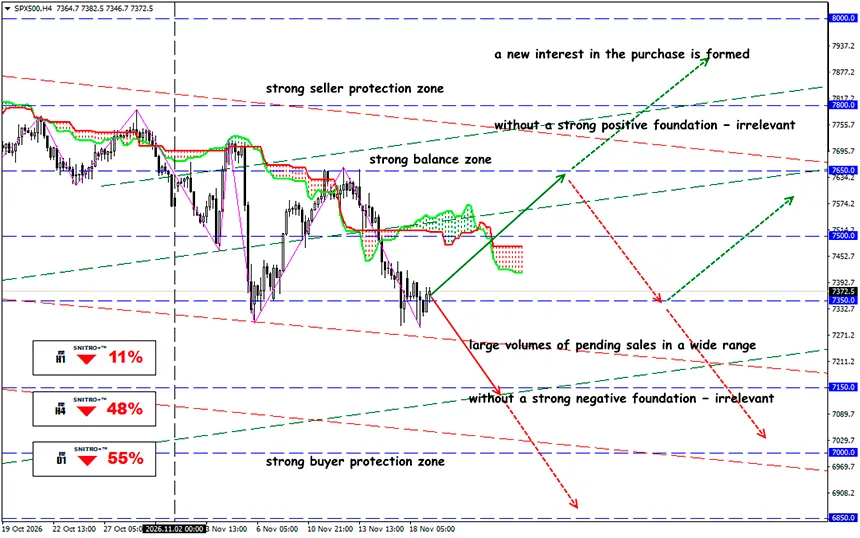
S&P500
Key zone: 7,300 - 7,450
Buy: 7,500 (on strong positive fundamentals); target 7,650-7,750; StopLoss 7,430
Sell: 7,250 (on a pullback after retesting 7,350); target 7,100-7,000; StopLoss 7,320
NVIDIA's record financial results no longer guarantee rising share prices. Investors are reassessing the profitability of AI infrastructure, the capital expenditures of technology giants, and the sustainability of debt financing for data centers.
NVIDIA remains the leading publicly traded indicator of demand for AI hardware.
The main question is not how much NVIDIA earns from selling AI accelerators, but whether its largest customers will be able to recoup hundreds of billions of dollars in infrastructure investments. For NVDA, this is a question of future growth rates and acceptable valuation multiples; for the Nasdaq 100 and SOX, it concerns the sustainability of the technology cycle; and for the S&P 500, it represents the risk of a large-scale repricing of the index's largest constituents.
A reminder:
NVIDIA is already generating revenue from hardware deliveries today. But Microsoft, Alphabet, Amazon, Meta, and specialized data center operators must recover their investments through future revenue from cloud computing, enterprise AI products, and automation. If commercial returns fall short of expectations, companies may revise their capital expenditure budgets.
For NVIDIA, this means the risk of slowing orders, and for the stock market, a possible reduction in earnings forecasts for several of the largest corporations at once.
Even if a company exceeds analysts' consensus forecasts, this does not mean its shares must necessarily appreciate. Market value depends on expected future cash flows and the multiples investors are willing to pay for them.
For NVIDIA, gross margin trends are particularly important. A decline may reflect changes in the product mix, production costs, and the competitive environment. Even a moderate deterioration in profitability can significantly change the long-term valuation of a business with high growth expectations.
For NVIDIA, gross margin trends are particularly important. A decline may reflect changes in the product mix, production costs, and the competitive environment. Even a moderate deterioration in profitability can significantly change the long-term valuation of a business with high growth expectations.
The expansion of AI infrastructure and the growth of AI industry profitability are not the same thing. Until investors see sustained growth in end-user cash flows, the share prices of hardware suppliers will continue to fall.
The most unfavorable scenario develops approximately as follows:
- Declining expected returns on AI projects
- Revision of CapEx and deterioration of financing conditions
- Reduction in orders for chips and infrastructure
- Downward revision of earnings forecasts across several industries
- Broadening correction in the S&P 500
An additional risk is associated with the credit market. If investors begin to doubt data center operators' ability to service their debt, credit spreads may widen and financing costs may increase.
For NVDA, the main risk remains a decline in valuation multiples amid uncertainty over future profitability and management succession.
For the Nasdaq 100 and SOX, the risk is a possible spread of repricing across the entire semiconductor and technology sector.
So What Is the Outcome?
Investors are gradually shifting from evaluating hardware sales volumes to analyzing the economic efficiency of capital expenditures by the largest buyers of that hardware.
The base-case scenario for the next 1–2 trading weeks assumes elevated volatility in NVDA and technology indexes, with the risk of further multiple compression remaining. A transition to a sustainable recovery requires confirmation of customers' investment plans, stabilization of NVIDIA's profitability, and restoration of confidence in its leadership.
NVIDIA's problem is no longer exclusively about the valuation of a single technology company. The market is testing whether the AI investment boom can generate sufficient profits for the entire chain of participants. The answer will determine not only NVDA's future performance but also the sustainability of the S&P 500's growth.
So we act wisely and avoid unnecessary risks.
Profits to y’all!


