



NASDAQ vs. the Fed: the risks of expensive money
Can technology stocks withstand high interest rates?
NQ100
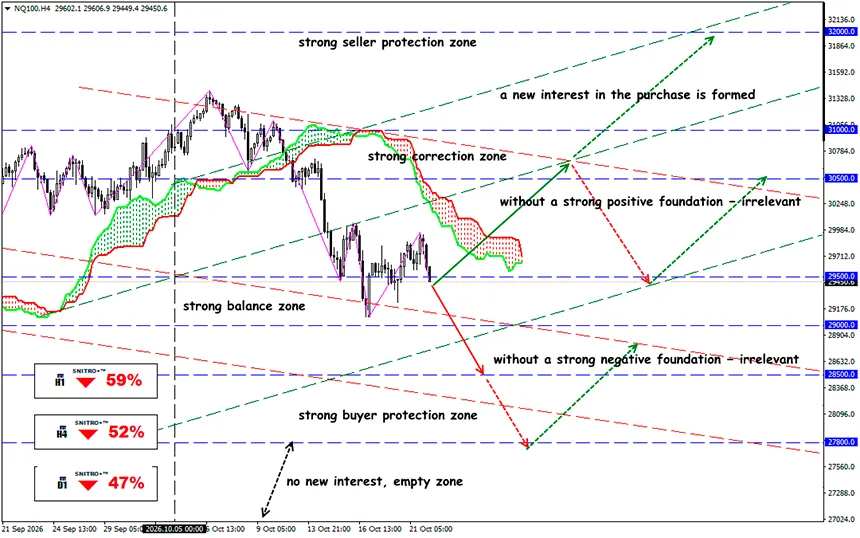
Key zone: 29,300 -29,800
Buy: 30,000 (on strong positive fundamentals); target 31,500; StopLoss 29,600
Sell: 29,000 (on a decisive break above 29,500); target 27,500; StopLoss 29,400
The U.S. technology sector is caught between record investments in artificial intelligence and the Fed's restrictive monetary policy. Treasury yields above 5% threaten Big Tech valuations, while corporate earnings will test the returns on AI investments and determine the Nasdaq 100's next trend.
A quick recap:
The next FOMC meeting will take place on October 27–28, coinciding with the release of earnings reports from major technology companies. The federal funds target range stands at 3.75–4.00%. Markets are discussing the possibility of further tightening. The scenario of unchanged rates is already priced in, which is being interpreted as a negative for the Nasdaq. Results from Microsoft, Alphabet, and Amazon could reverse the global trend.
The technology sector's main problem is the contradiction between high earnings growth expectations and expensive capital. Investors continue to finance AI infrastructure, anticipating long-term revenue growth. However, the yield on 10-year U.S. government bonds exceeds 5%, raising the required future returns on equities.
- From October 6 to 16, the Nasdaq 100 fell from an all-time high of 31,361 to 29,073 points — approximately 7.3%. The subsequent recovery to 29,881 points offset only part of the losses.
- This is not yet a confirmed bear market, but it is already a substantial correction, particularly given the index's high concentration in technology megacaps.
- A particularly worrying signal was the sell-off in semiconductor and software stocks. On October 16, Microsoft shares lost approximately 2.6%, Salesforce fell 3.2%, and the software industry ETF declined about 4.9%.
The geopolitical situation in the Middle East is creating additional inflationary pressure. Oil above $100 per barrel increases production and transportation costs, complicating inflation's return to target.
For Microsoft, Alphabet, Apple, and other multinational corporations, a stronger USD may reduce the dollar value of overseas revenue and profits. However, the impact varies, so earnings reports should be assessed by comparing revenue growth in U.S. dollars with growth in constant currencies.
If the Fed continues shrinking its balance sheet or maintains restrictive financial conditions, investors may demand a higher risk premium.
For short-term traders, the most important indicator will be the Nasdaq 100's reaction to changes in U.S. bond yields.
- If the 10-year Treasury yield begins to rise sustainably above its recent high of around 5.31%, this will intensify pressure on technology stocks, especially if real interest rates rise simultaneously.
- Falling yields combined with strong guidance from Microsoft and Alphabet could support an index recovery.
However, trading exclusively on Treasury yield movements is not advisable. A decline in yields driven by recession fears may coincide with falling stock prices.
To confirm market direction, traders should simultaneously monitor the Nasdaq 100, two-year and 10-year Treasury yields, the SOX
So What Is the Outcome?
The U.S. technology sector retains long-term growth potential thanks to AI, cloud computing, and automation. Investors need projects capable of converting investments into sustainable profits and free cash flow.
However, the high cost of capital is changing investment logic. This means the Fed poses a greater threat to the Nasdaq than weak earnings reports from major companies. If the Fed keeps real interest rates high, technology companies will need to demonstrate substantially higher profitability to justify their current valuations.
Over the next four weeks, the main risk for the Nasdaq 100 is a possible strengthening of expectations for further monetary tightening in December and 2027.
Technically, the index has not yet confirmed the end of its correction. A recovery above 30,000–3,000 would create conditions for a return to October's highs, while a break below 29,070 would increase the likelihood of another wave of selling.
Given the current balance of fundamental and technical factors, a wait-and-see strategy with a moderately bearish bias is preferable while the Nasdaq 100 remains below 30,600 points.
So we act wisely and avoid unnecessary risks.
Profits to y’all!


