

















Money is tired of geopolitics

The market prefers pre-war levels
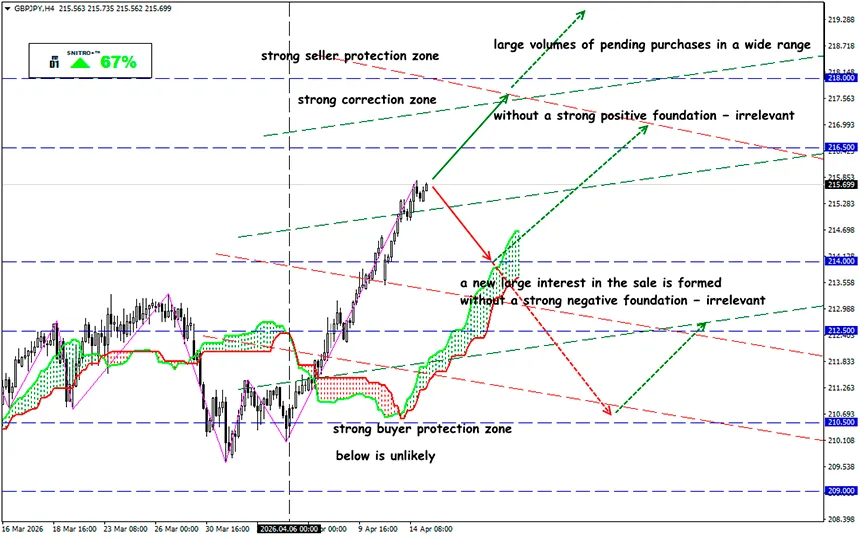
GBP/JPY
Key zone: 215.00- 216.00
Buy: 216.50 (on strong positive fundamentals); target 218.50; StopLoss 216.00
Sell: 216.00 (after retesting the 217 zone) ; target 214.50-213.50; StopLoss 216.50
European currencies are confidently recovering the positions lost in March; the S&P 500 and the British pound are already trading above their pre-conflict levels seen before the Middle East escalation. The US dollar is no longer able to capitalize on its safe-haven advantage.
Trump, who is interested in rising stock indices, is making the greatest effort to end the conflict: at times he claims Iran has called him and wants to make a deal. At other times, he states that the right people in Tehran are willing to return to the negotiating table. Pakistan is making titanic efforts to resolve disagreements.
China is ready to offer its assistance in achieving peace in the Middle East. Iran itself also notes that compromises with the US have been reached on various issues.
Investors are catching even potentially positive news from the Middle East and ignoring the negative.
- The US equity market has returned to pre-war levels on expectations of a strong Q1 earnings season and undervalued fundamentals. Traders are trying to ignore both high Fed rates and stagflation risks.
- Even oil has not risen as much as it could have amid news of failed US-Iran negotiations: Brent is trading only $30 per barrel above pre-conflict levels.
- According to Wall Street forecasts, S&P 500 earnings per share are expected to grow by 12.5% in Q1, marking the sixth consecutive quarter of double-digit growth. At the same time, the number of companies with optimistic guidance is set to reach its highest level since 2021.
- Treasury yields are 35–40 bps higher, and traders have largely abandoned hopes that the Fed will cut rates in 2026. Conditions are much worse than at the end of February, yet this does not prevent the S&P 500 from rising.
- Despite historically high Fed rates, accelerating inflation keeps real US Treasury yields relatively low, which does not support the narrative of excessively tight monetary policy.
European currencies are performing strongly. The pound has returned to pre-war levels, while the Swiss franc and Swedish krona are very close. The Norwegian krone is even poised to reach new highs since June 2022. However, rising energy prices have pushed the ECB’s forecast away from its baseline scenario.
Yesterday, ECB President Christine Lagarde stated that rising energy prices have significantly altered the ECB’s outlook and that the baseline scenario will need adjustment. Nevertheless, the current situation has not yet reached a critical point that would clearly indicate the need for rate hikes. This reflects the complexity of assessing the economic consequences of the geopolitical crisis.
It is that the ECB is considering necessary measures: inflation in Europe has already significantly exceeded the 2% target.
Market participants believe that European rate hikes are only a matter of time. However, major players do not expect a rate increase at the next meeting on April 29–30. Traders are pricing in two 0.25% hikes this year, with about a 30% probability of a third.
Markets believe more in de-escalation than in a breakdown of the ceasefire and renewed bombings in the region. Moreover, the US blockade of the Strait of Hormuz already represents a reduction in conflict intensity compared to active military operations.
Despite uncertainty, hopes for peace in the Middle East are growing, allowing speculators who had built up net long USD positions to 14-month highs to unwind them. The sell-off in the greenback is gaining momentum, supporting purchases of EUR and GBP, including in cross-assets. For example, the yen remains vulnerable, while GBP/JPY is heading toward 18-year highs. The technical picture is gradually becoming more stable.
So we act wisely and avoid unnecessary risks.
Profits to y’all!


