












The Goals of the Conflict in the Middle East Have Not Been Achieved
Trump Lost Another War
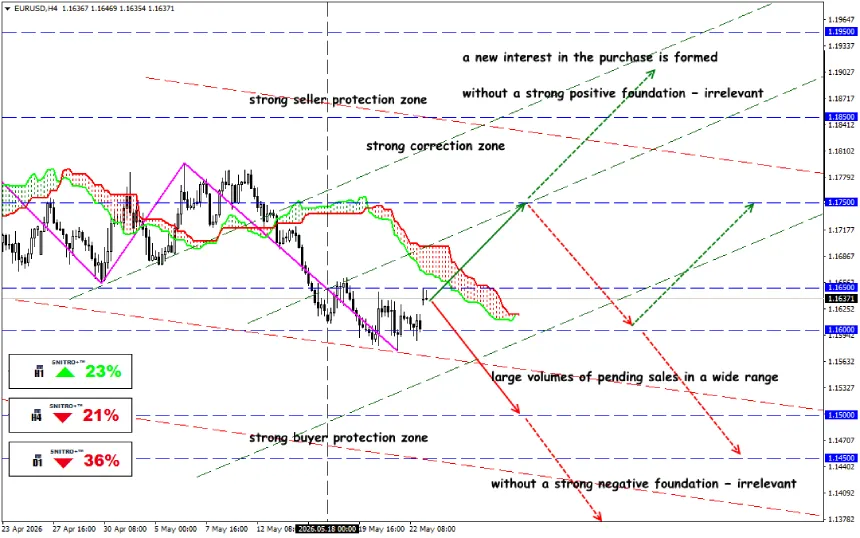
EUR/USD
Key zone: 1.1600 - 1.1650
Buy: 1.1680 (on strong positive fundamentals); target 1.1800-1.1850; StopLoss 1.1620
Sell: 1.1550 (on a confirmed break above 1.1600); target 1.1400-1.1350; StopLoss 1.1620
The war, conceived as Trump’s short-term victory, is turning into a long-term strategic failure. Donny risks the possibility that the United States and its Arab allies from the Persian Gulf will emerge from the conflict with a negative result. Although Iran has suffered serious military and economic losses, it may gain far greater political benefits and leverage.
The main military objective — an Iran without a nuclear program — also remains unfulfilled, and Tehran shows little desire to substantially limit its nuclear ambitions.
Given Iran’s control over the Strait of Hormuz and the preserved political theocratic system of government, it is unlikely that Trump will be able to turn the tactical successes of the American military into a geopolitical victory.
Let us recall:
While running for a second term, Donald promised to avoid unnecessary military interventions, but he dragged the United States into a conflict that could inflict irreparable damage on his foreign-policy reputation and authority abroad.
As a result, the conflict has lasted twice as long as the maximum possible six-week period that Trump outlined when he joined Israel on February 28. Trump’s political support base (MAGA) backed him, but now his Republican Party is struggling to retain control of the U.S. Congress.
So, after yet another series of loud statements:
- Trump claims that the Strait of Hormuz will be opened immediately after the signing of a preliminary framework agreement, while the final agreement, whose text will be drafted later, will include the transfer of enriched uranium reserves to the United States.
- The IRGC claims that the Strait of Hormuz will remain under Iran’s control.
- Iran’s reconstruction will take place at the expense of payments for passage through Hormuz.
- Iran wants to postpone the issue of the nuclear program and uranium reserves to the second stage of negotiations.
- Trump demands the opening of Hormuz before the lifting of the blockade and is prepared to immediately unfreeze only 25% of Iran’s funds — this quite suits Tehran.
- It remains unclear how the “nuclear issue” will be resolved. Iran continues to insist that the nuclear problem should be discussed after the end of hostilities, after the opening of the Strait of Hormuz and the lifting of the blockade of Iranian ports, after the unfreezing of Iranian accounts abroad, and after the payment of reparations.
- Tehran has so far not confirmed the success of the negotiations, has not confirmed the possibility of concluding a framework agreement with the United States, has not confirmed its readiness to lift the blockade of the Strait of Hormuz, and has provided no comments on the matter at all.
And what is the result?
The most likely outcome at the moment is the signing of a brief framework agreement during the coming week.
Whether Iran retains uranium reserves or not is currently of little concern to the markets. This matters for the possibility of repeated strikes against Iran and the destruction of Middle Eastern infrastructure in the future, but at the current stage investors will be satisfied with the opening of Hormuz.
In addition, Trump has to deal with new Iranian leaders who are considered even more radical than their predecessors. He also faces the threat of further deterioration in relations with traditional European allies, who largely refused his requests for assistance in the war.
Europe once again faces an unpleasant choice: economic growth is slowing while prices are rising due to the energy shock caused by the war around Iran. EU ministers are seeking a balance between support and discipline.
EUR/USD maintains the bullish opening gap, remaining strongly demanded around 1.1650, as renewed optimism regarding a possible peace agreement between the United States and Iran is putting strong pressure on the safe-haven U.S. dollar. However, further growth depends on confirmation of a peace agreement.
So we act wisely and avoid unnecessary risks.
Profits to y’all!


