














Life beyond USDT
Where the crypto billions are being invested
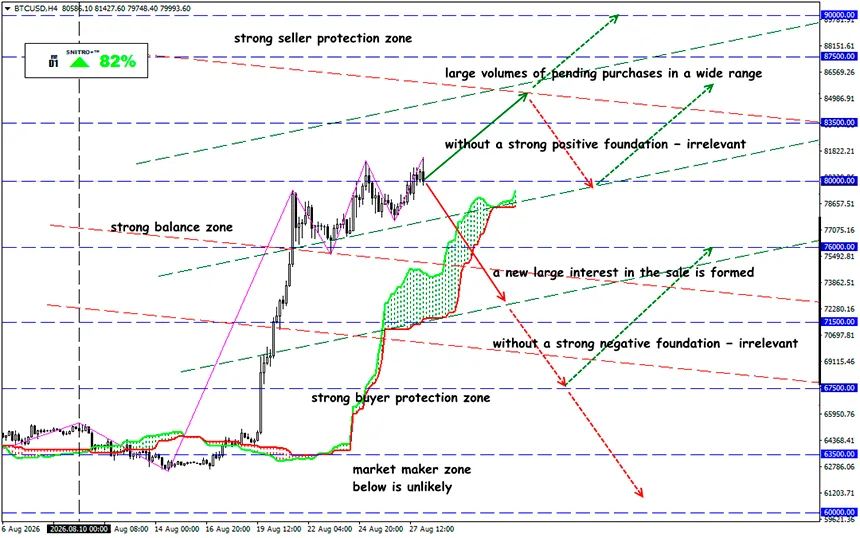
BTC/USD
Key zone: 78,500 - 81,500
Buy: 83,500 (on a pullback after retesting 80,000); target 87,500; StopLoss 82,500
Sell: 78,500 (on strong negative fundamentals) ; target 75,500-73,500; StopLoss 79,500
Tether has long ceased to be just the issuer of the largest stablecoin. Tether is gradually becoming one of the largest private capital allocators within the digital economy. In August 2026, about $184.6 billion in USDT was in circulation, while the stablecoin’s market share exceeded 60%.
This gives Tether something that traditional crypto companies practically do not have: an enormous and relatively predictable cash flow.
A reminder:
There are two streams of Tether capital: the reserves backing USDT and the company’s own investments funded by profits. Treasury securities and gold affect the stability of USDT, while Bitcoin, mining, AI, energy, media, and fintech represent separate corporate risks and sources of potential returns.
At the beginning of 2026, Tether officially valued its own investment portfolio at more than $20 billion, separately from USDT reserves. At the same time, in Q2 2026, the company maintained a $4.11 billion reserve buffer and generated about $1.5 billion in operating profit — meaning that the expansion is being financed not by diluting USDT backing, but by excess capital and profits.
The company has effectively built an extremely profitable financial machine:
USDT → reserves → interest income → Tether profit → investments in new assets.
· Assets Backing Issued USDT
U.S. Treasury securities, repos, and other liquid instruments dominate here. At the end of Q1 2026, Tether’s total direct and indirect exposure to U.S. Treasuries amounted to about $141 billion. In addition, the reserves included approximately $20 billion in physical gold and about $7 billion in Bitcoin.
· The Group’s Own Capital and Profits
By the end of 2025, Tether valued this proprietary investment portfolio at more than $20 billion. Tether had participated in approximately 140 investments — ranging from robotics and satellite technologies to agribusiness. The company separately emphasized that these investments in AI, energy, media, fintech, precious metals, agriculture, land, Bitcoin companies, and P2P technologies are not part of the reserves backing USDT.
· Bitcoin
Back in 2023, Tether announced that it could allocate up to 15% of realized operating profit to purchasing BTC. In Q2 2026, according to CoinDesk, the company added approximately 1,800 BTC to its reserves. Tether is becoming more than just a major BTC holder. It is gradually investing across the entire chain:
Bitcoin — energy → mining → custody → financial infrastructure → payments.
· Gold
By the end of Q2 2026, Tether reported that its total gold holdings had reached more than 146 metric tons. In February 2026, the company invested $150 million in Gold.com, acquiring about 12% of the company. The partnership includes the integration of tokenized gold XAU₮ and the development of the ability to purchase physical metal using digital currencies. Earlier, Tether acquired approximately 31.9% of Elemental Altus Royalties, a company associated with gold-mining assets and royalty streams.
Thus, the strategy once again follows the Bitcoin model:
ownership of the asset itself + control over part of the infrastructure surrounding it + tokenization.
So, what does this mean?
USDT remains the foundation of the business. But as its portfolio expands, Tether increasingly resembles a private investment group for which crypto assets provide capital for projects across a wide range of industries.
Some of these areas complement one another: energy can support mining, while payments and tokenization remain close to Tether’s original expertise.
But the downside of the model is also becoming increasingly clear: the further Tether moves beyond USDT, the more its financial results depend not only on U.S. interest rates, but also on Bitcoin, gold, AI infrastructure, commodity markets, and the value of acquired companies.
Having the money to enter an industry and understanding how to succeed in it are two different things. As Tether’s ambitions grow, the question becomes increasingly pressing: will the company be able to invest its billions as successfully as it earned them?
So we act wisely and avoid unnecessary risks.
Profits to y’all!


