

















Korea is buying bitcoin again
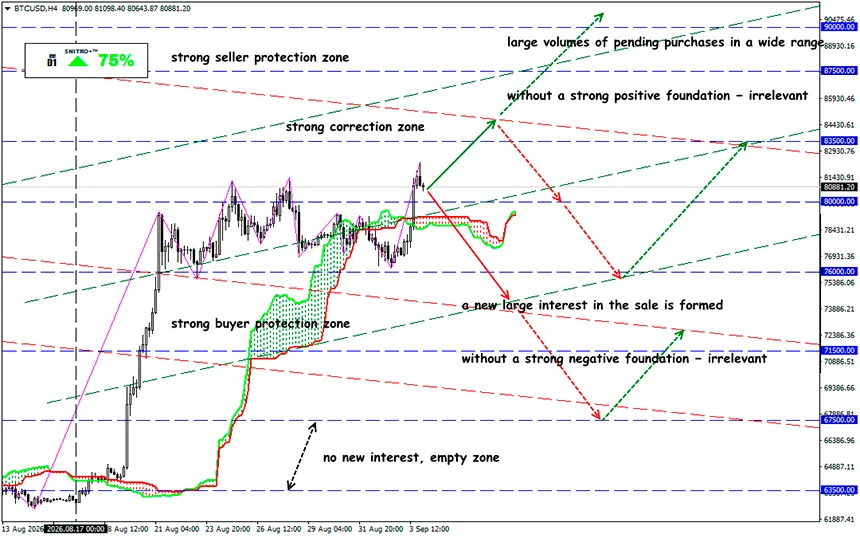
The “Kimchi Premium” gives BTC a signal for a new breakout
BTC/USD
Key zone: 78,500 - 82,000
Buy: 83,500 (on a pullback after retesting 80,000); target 87,500-90,000; StopLoss 82,500
Sell: 78,000 (on strong negative fundamentals) ; target 73,500; StopLoss 79,000
Korean retail investors have shifted from a discount to a premium, while U.S. Bitcoin ETFs received $731 million in a single day. The South Korean crypto market is providing one of the first signs of a return in retail risk appetite. Two sources of demand are beginning to work simultaneously, but BTC/USD still has to prove its ability to hold above $80,000 and break through the key resistance zone.
The “Kimchi Premium” has returned after the summer discount. As recently as September 1, some estimates showed the “Kimchi Premium” widening to approximately 1.37%. Today, Bitcoin on Upbit is trading at roughly a 1.05% premium to the global price: BTC/KRW stood at around ₩110.73 million, while the comparable international Bitcoin price was around $81,065 with USD/KRW at approximately 1,352.
A reminder:
The “Kimchi Premium” is not an ordinary exchange spread. It is the difference between the Bitcoin price on South Korean exchanges, primarily Upbit and Bithumb, and the international BTC price after adjusting for the won exchange rate. Historically, during strong risk-on phases, this gap could widen to several percent, while during extreme episodes it reached double-digit levels.
In a fully open market, such a difference should disappear quickly. For example, if Bitcoin is priced at $81,000 on a global platform and the equivalent of $82,000 on Upbit, arbitrageurs have an opportunity to buy BTC more cheaply outside the country, transfer the coins to Korea, and sell them at a higher price. But this is precisely where the specifics of the South Korean market come into play.
Currency regulation, restrictions on cross-border capital flows, bank account identification rules, and restrictions on foreign participants make instant arbitrage more difficult.
Therefore, the Korean market is partially isolated from global liquidity.
When domestic demand rises sharply, additional Bitcoin supply cannot enter the market instantly. As a result, the local price rises relative to global trading venues.
This is why the “Kimchi Premium” is not merely a technical price anomaly, but an indicator of the imbalance between domestic demand and available local liquidity.
On its own, a spread of 1% looks small, but the direction of its change is much more important. In early June, BTC in South Korea traded at a discount of up to 3.1% relative to international platforms, while the average discount in August was around 0.25%.
Now the discount has turned into a sustained premium — for BTC, this means that one of Asia’s largest retail markets has shifted from relative weakness to increased demand.
This does not yet indicate mass FOMO. But the market has crossed an important psychological threshold.
Therefore, the current market is more logically interpreted as follows:
- 0–1% — normalization and early growth in demand;
- 1–3% — noticeable strengthening of retail interest;
- 3–5% — pronounced risk-on;
- Above 5% — potential FOMO and, at the same time, a growing risk of overheating.
The problem with the current move lies in volumes. Upbit notes that the positive premium has not yet been accompanied by a comparable increase in trading activity. This significantly reduces the value of the signal.
- If the premium increases simultaneously with BTC/KRW volumes, the market receives confirmation of a genuine capital inflow.
- If the premium rises while volumes remain weak, the move may reflect a local liquidity imbalance rather than the beginning of a new wave of mass buying.
Therefore, the current +1% is better viewed as an early indicator of improving sentiment, but not as a standalone signal to buy BTC/USD.
So, What Does This Mean?
There is no FOMO yet. For that, the premium needs to increase and, most importantly, Korean spot volumes need to rise. As a result, for the first time in a while, a potentially powerful combination is taking shape:
- U.S. institutions are buying through ETFs;
- Korean retail investors are returning to risk-on;
- The Asian market has an enormous pool of stablecoin liquidity.
A sustained breakout, with ETF inflows continuing and the Korean premium widening, could open the way for BTC toward $90,000–95,000 and then bring $100,000 back into focus. A drop below $77,000 accompanied by deteriorating ETF flows would mean the opposite: the “Kimchi Premium” turned out to be merely a local burst of retail optimism.
Therefore, a professional trader should now watch not just one indicator, but the synchronization of four signals: BTC price, U.S. ETFs, Kimchi Premium, and Korean spot volumes.
So we act wisely and avoid unnecessary risks.
Profits to y’all!


