

















Inflation and oil are the main sources of market anxiety
Views on the Fed's interest rate path are divided
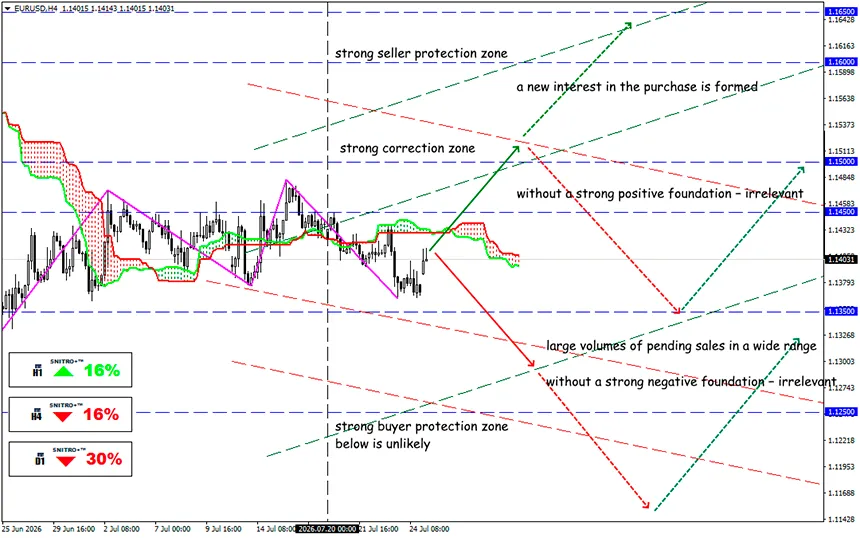
EUR/USD
Key zone: 1.1380 - 1.1450
Buy: 1.1450 (on strong positive fundamentals) ; target 1.1650-1.1700; StopLoss 1.1380
Sell: 1.1350 (on a pullback following a retest of 1.1400) ; target 1.1150; StopLoss 1.1420
Major market participants remain convinced that the Federal Reserve's next move will ultimately be an interest rate cut, even though higher borrowing costs by the end of this year appear almost inevitable. This sharp divergence in expectations reflects an exceptionally high degree of uncertainty surrounding inflation, energy prices, and the resilience of U.S. economic growth.
To recap:
- Economists expect a 25-basis-point rate cut in the third quarter of 2027.
- Financial markets are pricing in the possibility of a rate hike as early as September.
- Core inflation remains elevated at 3.4%.
- Oil prices near $100 continue to increase the risk of renewed inflationary pressure.
A rate cut in the third quarter of 2027 is one quarter later than economists projected in June. Nevertheless, this outlook remains sharply at odds with financial markets, where traders are already assigning a meaningful probability to another rate hike within the next couple of months.
Inflation continues to keep the debate wide open. In its July report, the Federal Reserve explicitly acknowledged that:
- The PCE price index increased to 4.1%.
- The energy component of the PCE index rose by 24% year over year.
- The conflict in the Middle East remains one of the primary inflation risks.
Several Federal Reserve officials have warned that another rate hike could become necessary if inflation proves to be more persistent than expected.
At the same time, the current situation differs fundamentally from the inflation shock of 2022. Back then, rising prices were accompanied by a strong recovery in demand following the pandemic. Today, the primary source of inflationary pressure comes from the supply side, as higher oil prices gradually feed through into fuel costs, logistics, aviation, chemicals, and food prices.
For a central bank, this type of inflation is considerably more dangerous because raising interest rates has little ability to increase the global supply of oil.
Through the end of the third quarter, investors should closely monitor the following indicators:
- U.S. CPI.
- Core PCE.
- Labor market data.
- Brent and WTI price movements.
- Inflation expectations reflected in the bond market.
- Comments from Federal Reserve and European Central Bank officials regarding the secondary effects of energy-driven inflation.
It is especially important to monitor not only the inflation rate itself, but also whether higher energy prices begin to spread into the services sector. This process could ultimately persuade the majority of FOMC members to support a more restrictive monetary policy.
The divergence in expectations matters because interest rate forecasts directly influence Treasury yields, mortgage rates, corporate borrowing costs, and equity valuations. A delayed rate cut would keep financing costs elevated through 2027.
What does this mean?
The market is effectively facing a rare situation in which the same economic data support two completely opposite conclusions. That is precisely why every new CPI, PPI, or PCE release triggers such significant repricing of interest rate expectations.
The most interesting development remains the growing divergence between the Federal Reserve and the European Central Bank. Today, this policy gap has a much greater influence on EUR/USD than traditional macroeconomic indicators.
As long as the Federal Reserve appears more committed to maintaining a restrictive stance than the ECB, the fundamental balance remains supportive of the U.S. dollar. Global investors are likely to continue increasing allocations to dollar-denominated assets, placing additional downward pressure on EUR/USD.
However, if inflation in the United States begins to slow more rapidly than in Europe, the situation could reverse. Any sustained cooling of U.S. inflation or a meaningful shift in Federal Reserve rhetoric could quickly reshape investor expectations and become the catalyst for a new phase of euro appreciation.
So we act wisely and avoid unnecessary risks.
Profits to y’all!


