



Huang's resignation: The AI industry on the brink of the abyss
NVIDIA becomes a global risk
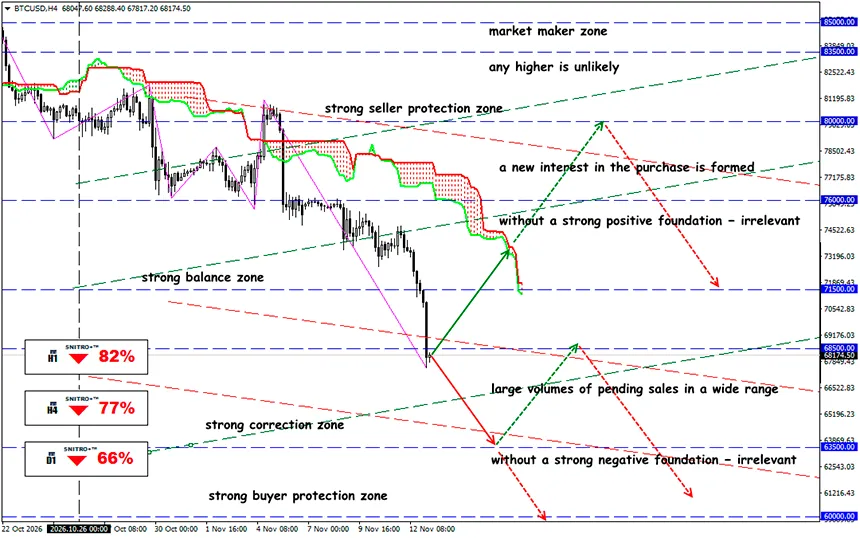
BTC/USD
Key zone: 66,500 - 69,500
Buy: 71,500 (on strong positive fundamentals); target 76,500; StopLoss 70,500
Sell: 66,500 (on a pullback following a retest of 67.500) ; target 63,500-61,500; StopLoss 67,500
The leadership crisis within NVIDIA is increasing pressure on the company's shares and calling into question the sustainability of technology sector valuations. The main threat is not the change of CEO, but the loss of confidence in AI's future growth rates.
The resignation took effect immediately, and the board of directors began searching for a successor. At the center of the crisis were reports about Huang's personal relationships, involving individuals whom U.S. authorities suspect of spying for China. At the same time, it is important not to confuse the confirmed fact of the resignation with allegations and circumstances that remain the subject of investigations and media reports.
A Reminder:
NVDA lost more than 5% in a single session, approximately 12% over the week, and more than 30% from its October high. The forward P/E fell to approximately 12, its lowest level since 2012. Notably, on November 12, NVDA reduced its initial intraday decline from approximately 14% to 4.3% by the close. This indicates the presence of buyers following the sharp selloff, but does not yet confirm that the downward movement has ended.
Huang had led NVIDIA since its founding in 1993. His role extended far beyond operational management: investors associated him with technological leadership, the consistent development of GPUs, and strategic relationships with the largest cloud providers.
- The company risks losing part of its keyperson premium — the valuation premium associated with confidence in a particular executive. Even without an immediate deterioration in financial results, the shares may trade at lower multiples until the new management demonstrates its ability to maintain the previous pace of development.
- An additional risk is associated with China. If the management crisis increases political pressure in favor of export restrictions, uncertainty could shift from reputational concerns to commercial consequences. However, the resignation itself does not automatically mean the loss of contracts or changes to existing export regulations.
A decline in NVIDIA's share price could spread to semiconductor companies, server equipment manufacturers, data center infrastructure suppliers, and major technology indexes.
If investors begin to question the sustainability of NVIDIA's growth, they may reassess acceptable valuation multiples for other AI companies, even if those companies' own financial results have not deteriorated.
If NVIDIA's problems coincide with a reassessment of capital expenditures by Microsoft, Alphabet, Amazon, and Meta, the market could shift from evaluating an individual corporate crisis to repricing the entire economics of AI infrastructure.
NVDA's quarterly earnings report (November 17) could determine whether Huang's resignation remains a shortterm management shock or becomes a catalyst for a prolonged repricing of the shares.
If:
- NVIDIA confirms revenue growth, stable orders, and the sustainability of its technology strategy, the shares gain a basis for recovery, supporting the Nasdaq 100 and the AI sector.
- Financial results are strong, but uncertainty regarding the successor and future orders persists. High volatility without a sustained recovery is possible.
- Cautious guidance, signs of slowing AI investment, or deteriorating customer relationships increase pressure on NVDA. The selloff could spread to semiconductor and infrastructure companies.
If even positive earnings fail to deliver sustained growth in NVDA, this could indicate a deeper decline in confidence in AI company valuations.
So What Is the Outcome?
NVIDIA has extensive technological infrastructure, a customer base, and a business built over decades. A change in leadership does not, by itself, destroy these competitive advantages.
But the market evaluates not only what the company has today, but also how successfully it will be able to achieve its future objectives.
Potential beneficiaries of the redistribution of orders include AMD, which could increase sales of AI accelerators; Broadcom, which develops specialized AI chips and networking solutions; and Marvell Technology, which operates in the data transmission infrastructure segment.
However, competitors' growth is possible primarily if overall demand for AI remains intact. If investors begin to question the return on investment in data centers, AMD, AVGO, and MRVL will also come under pressure.
So we act wisely and avoid unnecessary risks.
Profits to y’all!


