



Gold ahead of CPI: the dollar retreats
The Market caught between an inflation shock and a geopolitical risk premium
XAU/USD
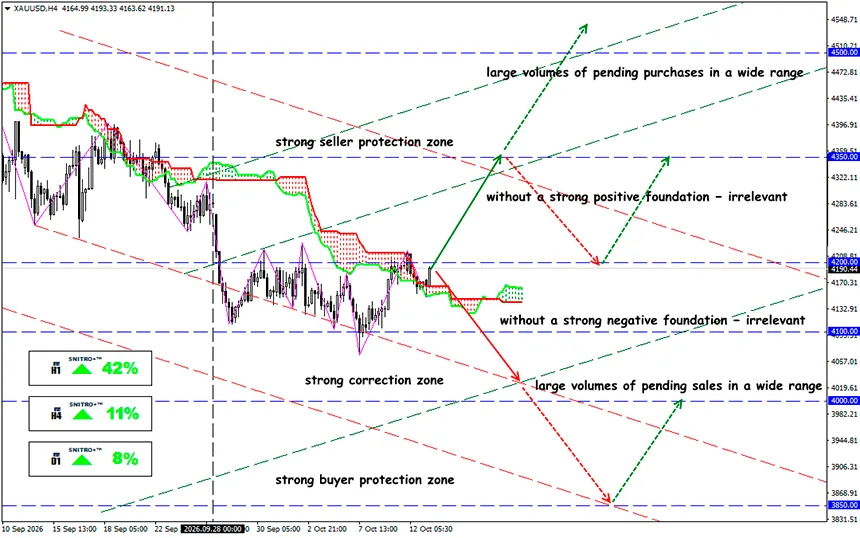
Key zone: 4,130.00 - 4,200.00
Buy: 4,250.00 (on a decisive break above 4,200); target 4,500.00; StopLoss 4,150.00
Sell: 4,050.00 (on strong negative fundamentals); target 3,850.00; StopLoss 4,150.00
Gold is attempting to recover as the dollar weakens, but elevated Treasury yields and the prospect of another Federal Reserve rate hike are limiting its upside potential. Geopolitical uncertainty supports safe-haven demand, while the inflationary consequences of the energy crisis are prompting investors to anticipate a shift toward tighter monetary policy.
The traditional safe-haven asset remains under pressure from monetary factors despite the weakening U.S. currency. U.S. inflation will be the decisive test for XAU/USD: the market is preparing to break out of consolidation, while geopolitical tensions increase the risk of sharp price swings. Volatility confirms that buyers have yet to establish a sustained advantage.
A Quick Recap:
The September FOMC meeting concluded with a 25-basis-point rate hike, bringing the federal funds target range to 3.75–4.00%. The minutes, released on October 7, confirmed policymakers' concerns about persistent inflation. Market participants view another rate hike in December as a likely scenario, although the minutes do not suggest that the start of a prolonged tightening cycle is inevitable. The next meeting is scheduled for October 27–28.
For XAU/USD, the critical factor is not a Fed pause itself, but the direction of real yields. If nominal yields rise faster than inflation expectations, gold faces downward pressure even when the stock market weakens.
The investment boom in artificial intelligence remains another source of pressure on gold. Large-scale data center construction is increasing demand for electricity, natural gas, copper, transformers, cooling systems, and high-performance semiconductors. This creates the risk of a new investment-driven inflationary impulse that could complicate the Federal Reserve's efforts to contain rising prices.
U.S. CPI: The Week's Main Catalyst
An acceleration in core inflation would increase the likelihood of another rate hike in December, supporting the dollar and Treasury yields. A weaker CPI reading could trigger short covering in gold.
The reaction of two-year U.S. Treasury yields will be particularly important. A decline in those yields accompanied by a weaker DXY would provide a more convincing signal to buy XAU/USD than a positive reaction in gold prices alone.
Oil and Geopolitics: Safe-Haven Demand Under Threat
On October 13, Brent crude fell to $104.49 per barrel, losing approximately 2%. However, disruptions to shipments through the Strait of Hormuz and attacks on Saudi Arabian infrastructure continue to sustain inflation risks.
This creates a dual effect: escalation supports gold as a safe-haven asset but simultaneously strengthens the dollar through higher inflation expectations and the prospect of elevated interest rates.
The Middle East conflict has turned gold into a battleground between two market forces: demand for safety and the cost of dollar funding.
Traders should therefore monitor not only Brent crude and developments in the Strait of Hormuz, but above all the reaction of DXY, 10-year TIPS real yields, and expectations for Federal Reserve interest rates.
These indicators will help determine whether another geopolitical escalation develops into a sustained rally in XAU/USD or becomes a catalyst for renewed selling.
So What Is the Bottom Line?
The short-term balance of risks for gold remains neutral to bearish as long as the price stays below $4,520. However, a sustained decline in Treasury yields could quickly shift the balance of market forces.
The key signal for traders is the synchronized movement of XAU/USD, DXY, and U.S. real yields. A softer CPI reading could trigger a gold recovery, while another upside inflation surprise would create conditions for a test of $4,100.
Over the medium term, gold remains attractive as an investment diversification tool. However, geopolitical risks alone are not sufficient justification for buying it at this stage: the cost of money remains the decisive factor.
So we act wisely and avoid unnecessary risks.
Profits to y’all!


